 Indietro
Joints: Structure, Classification, and Movements
Guida di studio - Note intelligenti
 Appunti personalizzati basati sui tuoi materiali, ampliati con definizioni chiave, esempi e contesto.
Joints (Articulations)
Definition and Functions
Joints, also known as articulations, are sites where two or more bones meet. They serve two primary functions:
Mobility: Joints allow for movement of the skeleton, enabling a wide range of actions.
Stability: Joints hold the skeleton together, providing structural integrity.
Classification of Joints
Functional Classification
Joints are classified by the amount of movement they allow:
Synarthroses: Immovable joints (e.g., sutures of the skull).
Amphiarthroses: Slightly movable joints (e.g., intervertebral discs).
Diarthroses: Freely movable joints (e.g., most limb joints).
Structural Classification
Joints are also classified by the material binding the bones and the presence or absence of a joint cavity:
Fibrous Joints: Bones joined by fibrous connective tissue; no joint cavity.
Cartilaginous Joints: Bones joined by cartilage; no joint cavity.
Synovial Joints: Bones separated by a fluid-filled joint cavity; most are freely movable.
Fibrous Joints
Types and Characteristics
Fibrous joints are joined by dense fibrous connective tissue and are mostly immovable.
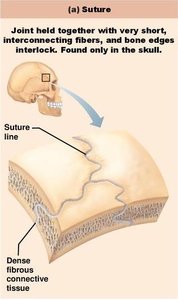
Sutures: Rigid, interlocking joints found only in the skull. Allow for growth during youth and ossify in adulthood.
Syndesmoses: Bones connected by ligaments; movement varies with fiber length (e.g., distal tibiofibular joint).
Gomphoses: Peg-in-socket joints (e.g., teeth in alveolar sockets).
Cartilaginous Joints
Types and Characteristics
Cartilaginous joints unite bones with cartilage and are not highly movable.
Synchondroses: Bar or plate of hyaline cartilage unites bones (e.g., epiphyseal plate, first rib with manubrium).
Symphyses: Bones united by fibrocartilage; strong, flexible amphiarthroses (e.g., pubic symphysis, intervertebral discs).
Synovial Joints
Structure and Features
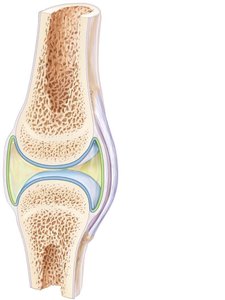
Synovial joints are characterized by a fluid-filled joint cavity and are all diarthrotic. They are the most common type in the limbs.
Articular cartilage: Absorbs compression.
Joint cavity: Contains synovial fluid.
Articular capsule: Two layers—fibrous layer and synovial membrane.
Synovial fluid: Lubricates and nourishes cartilage.
Reinforcing ligaments: Capsular, extracapsular, and intracapsular.
Nerves and blood vessels: Monitor joint position and supply nutrients.
Associated Structures
Bursae: Sacs lined with synovial membrane that reduce friction.
Tendon sheaths: Elongated bursae wrapped around tendons.
Summary Table: Structural and Functional Characteristics of Body Joints
Overview of Major Joints
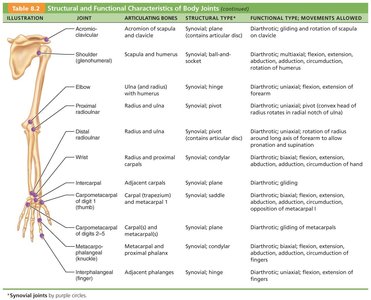
The following tables summarize the structural and functional characteristics of major body joints, including their articulating bones, structural type, functional classification, and movements allowed.
Joint | Articulating Bones | Structural Type | Functional Type | Movements Allowed |
|---|---|---|---|---|
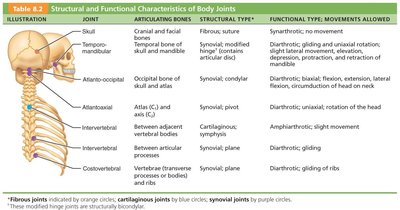
Skull | Cranial and facial bones | Fibrous: suture | Synarthrotic | No movement |
Temporomandibular | Temporal bone & mandible | Synovial: modified hinge | Diarthrotic | Gliding, uniaxial rotation, elevation, depression, protraction, retraction |
Atlanto-occipital | Occipital bone & atlas | Synovial: condyloid | Diarthrotic | Biaxial: flexion, extension, lateral flexion, circumduction, rotation of head |
Atlantoaxial | Atlas & axis | Synovial: pivot | Diarthrotic | Uniaxial: rotation of head |
Intervertebral | Between adjacent vertebral bodies | Cartilaginous: symphysis | Amphiarthrotic | Slight movement |
Intervertebral | Between articular processes | Synovial: plane | Diarthrotic | Gliding |
Costovertebral | Vertebrae & ribs | Synovial: plane | Diarthrotic | Gliding of ribs |
Joint | Articulating Bones | Structural Type | Functional Type | Movements Allowed |
|---|---|---|---|---|
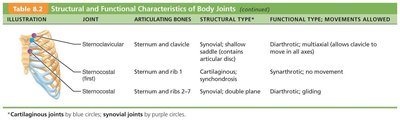
Sternoclavicular | Sternum & clavicle | Synovial: shallow saddle | Diarthrotic | Multiaxial: movement in all axes |
Sternocostal (1st) | Sternum & rib 1 | Cartilaginous: synchondrosis | Synarthrotic | No movement |
Sternocostal (2-7) | Sternum & ribs 2-7 | Synovial: double plane | Diarthrotic | Gliding |
Joint | Articulating Bones | Structural Type | Functional Type | Movements Allowed |
|---|---|---|---|---|
Acromioclavicular | Acromion of scapula & clavicle | Synovial: plane | Diarthrotic | Gliding, rotation of scapula |
Shoulder (glenohumeral) | Scapula & humerus | Synovial: ball-and-socket | Diarthrotic | Multiaxial: flexion, extension, abduction, adduction, rotation |
Elbow | Ulna & humerus | Synovial: hinge | Diarthrotic | Uniaxial: flexion, extension |
Proximal radioulnar | Radius & ulna | Synovial: pivot | Diarthrotic | Uniaxial: rotation of radius |
Distal radioulnar | Radius & ulna | Synovial: pivot | Diarthrotic | Uniaxial: rotation of radius |
Wrist | Radius & carpals | Synovial: condyloid | Diarthrotic | Biaxial: flexion, extension, abduction, adduction, circumduction |
Intercarpal | Carpal bones | Synovial: plane | Diarthrotic | Gliding |
Carpometacarpal (thumb) | Carpal (trapezium) & metacarpal 1 | Synovial: saddle | Diarthrotic | Biaxial: flexion, extension, abduction, adduction, circumduction, opposition |
Carpometacarpal (digits 2-5) | Carpals & metacarpals | Synovial: plane | Diarthrotic | Gliding |
Metacarpophalangeal (knuckle) | Metacarpal & proximal phalanx | Synovial: condyloid | Diarthrotic | Biaxial: flexion, extension, abduction, adduction, circumduction |
Interphalangeal | Adjacent phalanges | Synovial: hinge | Diarthrotic | Uniaxial: flexion, extension |
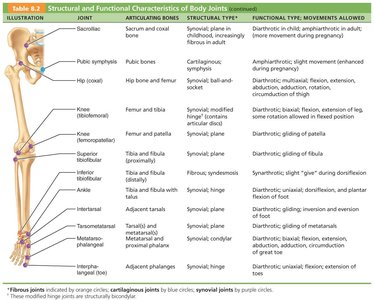
Joint | Articulating Bones | Structural Type | Functional Type | Movements Allowed |
|---|---|---|---|---|
Pubic symphysis | Pubic bones | Cartilaginous: symphysis | Amphiarthrotic | Slight movement |
Hip (coxal) | Hip bone & femur | Synovial: ball-and-socket | Diarthrotic | Multiaxial: flexion, extension, abduction, adduction, rotation |
Knee (tibiofemoral) | Femur & tibia | Synovial: modified hinge | Diarthrotic | Flexion, extension, some rotation |
Patellofemoral | Femur & patella | Synovial: plane | Diarthrotic | Gliding |
Tibiofibular (proximal) | Tibia & fibula | Synovial: plane | Diarthrotic | Gliding |
Tibiofibular (distal) | Tibia & fibula | Fibrous: syndesmosis | Synarthrotic | Slight movement |
Ankle | Tibia & fibula with talus | Synovial: hinge | Diarthrotic | Uniaxial: dorsiflexion, plantar flexion |
Intertarsal | Tarsal bones | Synovial: plane | Diarthrotic | Gliding, inversion, eversion |
Tarsometatarsal | Tarsal & metatarsal bones | Synovial: plane | Diarthrotic | Gliding |
Metatarsophalangeal | Metatarsal & proximal phalanx | Synovial: condyloid | Diarthrotic | Biaxial: flexion, extension, abduction, adduction |
Interphalangeal | Adjacent phalanges | Synovial: hinge | Diarthrotic | Uniaxial: flexion, extension |
Movements Allowed by Synovial Joints
Types of Movements
Synovial joints allow a variety of movements, classified as follows:
Gliding: One flat bone surface glides over another (e.g., intercarpal joints).
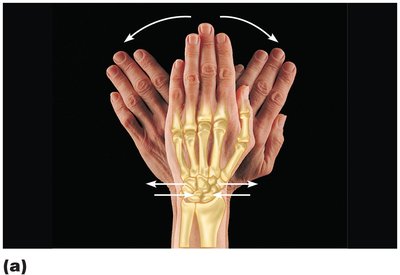
Angular Movements: Increase or decrease the angle between bones. Includes flexion, extension, hyperextension, abduction, adduction, and circumduction.
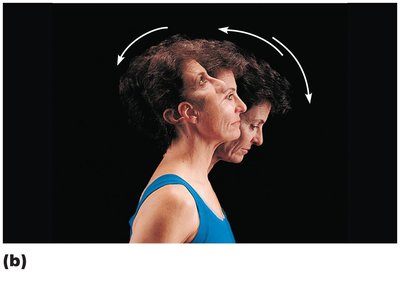
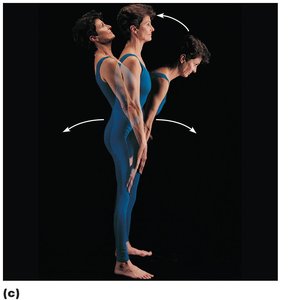
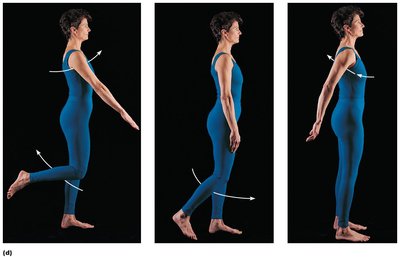
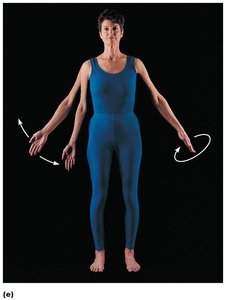
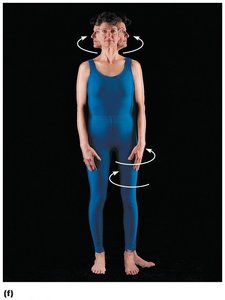
Rotation: Turning of a bone around its own long axis (e.g., neck rotation, shoulder rotation).
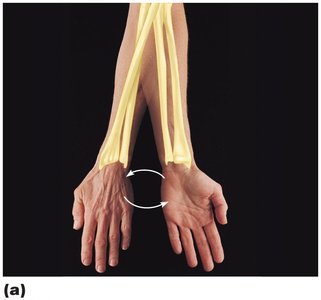
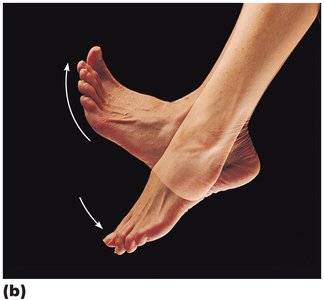
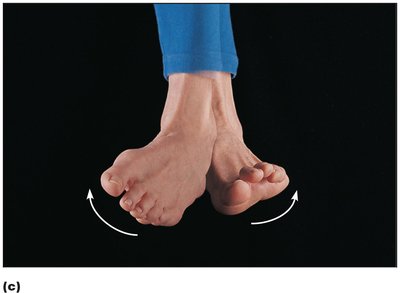
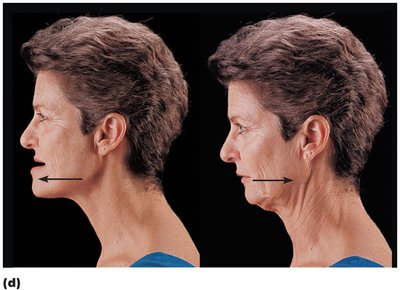
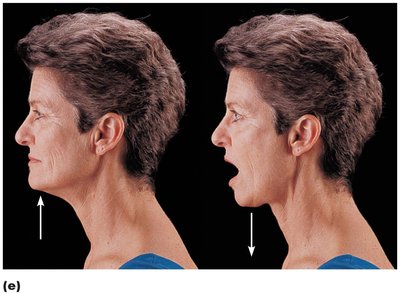
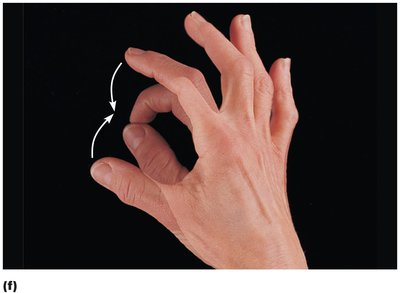
Special Movements: Include supination/pronation, dorsiflexion/plantar flexion, inversion/eversion, protraction/retraction, elevation/depression, and opposition.
Types of Synovial Joints
Classification by Shape and Movement
Synovial joints are classified into six types based on the shape of their articular surfaces and the movements they allow:
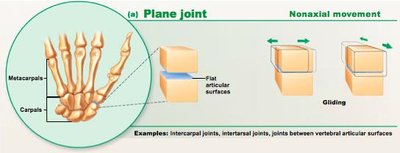
Plane Joint: Flat articular surfaces; nonaxial gliding movements.
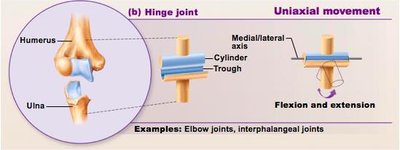
Hinge Joint: Cylinder and trough; uniaxial movement (flexion and extension).
Pivot Joint: Rounded bone fits into a sleeve; uniaxial rotation.
Condylar Joint: Oval articular surfaces; biaxial movement (flexion/extension, abduction/adduction).
Saddle Joint: Each articular surface has both concave and convex areas; biaxial movement.
Ball-and-Socket Joint: Spherical head fits into a cup; multiaxial movement (shoulder and hip joints).
Common Joint Injuries and Disorders
Types of Injuries
Cartilage (meniscal) tears: Caused by compression and shear stress; poor healing due to avascularity.
Sprains: Ligaments stretched or torn; slow healing.
Dislocations (luxations): Bones forced out of alignment; require reduction.
Subluxation: Partial dislocation of a joint.
Inflammatory and Degenerative Conditions
Bursitis: Inflammation of a bursa, usually from friction or trauma.
Tendonitis: Inflammation of tendon sheaths, often from overuse.
Arthritis: Over 100 types; most common are osteoarthritis (OA), rheumatoid arthritis (RA), and gouty arthritis.
Osteoarthritis: Degenerative, irreversible, "wear-and-tear" arthritis.
Rheumatoid Arthritis: Autoimmune, chronic inflammatory disorder.
Developmental Aspects of Joints
Embryonic and Aging Changes
By embryonic week 8, synovial joints resemble adult joints.
Joint size, shape, and flexibility are modified by use.
With aging, ligaments and tendons shorten and weaken; intervertebral discs are more likely to herniate; most elderly individuals have some degree of osteoarthritis.
Full-range-of-motion exercise is key to postponing joint problems.
Summary and Study Recommendations
Review Chapter 8 for detailed information on joints.
Practice identifying joint types, movements, and injuries.
Understand the structural and functional classifications for exam preparation.
