 Indietro
Language of Anatomy & Organ Systems: Study Guide
Guida di studio - Note intelligenti
 Appunti personalizzati basati sui tuoi materiali, ampliati con definizioni chiave, esempi e contesto.
Language of Anatomy & Organ Systems
Anatomical Position and Its Importance
The anatomical position is a standardized posture used as a reference in anatomical descriptions. The individual stands upright, feet together, face forward, arms at the sides, and palms facing forward. This position ensures consistency in anatomical terminology and prevents confusion when describing locations and relationships of body parts.
Supine: Lying down, face up.
Prone: Lying down, face down.
Importance: Prevents crossing of long bones and provides a universal reference for anatomical descriptions.
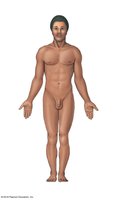
Superficial Anatomy (Surface Anatomical Landmarks)
Surface anatomical landmarks are external features that help identify underlying structures and regions. These landmarks are essential for clinical assessment and communication among healthcare professionals.
Examples: Sternum, clavicle, umbilicus, iliac crest.
Application: Used to locate organs, describe pain, and guide medical procedures.
Directional Terms
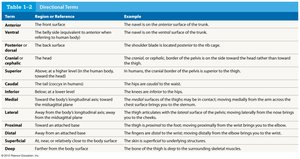
Directional terms are used to describe the locations of structures relative to other structures or locations in the body. These terms are fundamental for precise communication in anatomy.
Anterior (ventral): Toward the front surface.
Posterior (dorsal): Toward the back surface.
Superior (cranial): Toward the head.
Inferior (caudal): Toward the feet.
Medial: Toward the midline.
Lateral: Away from the midline.
Proximal: Closer to the point of attachment.
Distal: Farther from the point of attachment.
Superficial: Nearer to the body surface.
Deep: Farther from the body surface.
Term | Region or Reference | Example |
|---|---|---|
Anterior | The front surface | The navel is on the anterior surface of the trunk. |
Posterior | The back surface | The shoulder blade is located posterior to the rib cage. |
Superior | Above or higher | The cranial, or cephalic, border of the pelvis is on the side toward the head. |
Inferior | Below or lower | The knees are inferior to the waist. |
Medial | Toward the midline | The nose is medial to the cheeks. |
Lateral | Away from the midline | The ears are lateral to the nose. |
Proximal | Closer to the point of attachment | The shoulder is proximal to the wrist. |
Distal | Farther from the point of attachment | The fingers are distal to the wrist. |
Superficial | Nearer to the body surface | The skin is superficial to the underlying muscles. |
Deep | Farther from the body surface | The bone of the thigh is deep to the surrounding skeletal muscles. |
Sectional Planes
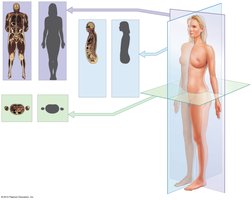
Sectional planes are imaginary lines used to divide the body into regions for anatomical study. The three primary planes are:
Frontal (coronal) plane: Divides the body into anterior and posterior sections.
Transverse (horizontal) plane: Divides the body into superior and inferior sections.
Sagittal plane: Divides the body into left and right sections. The midsagittal plane divides the body exactly at the midline.
Body Cavities
Body cavities are internal spaces that house organs and provide protection, as well as allow for changes in organ size and shape. The two main cavities are:
Dorsal body cavity: Includes the cranial cavity (brain) and spinal cavity (spinal cord).
Ventral body cavity (coelom): Divided by the diaphragm into the thoracic cavity and abdominopelvic cavity.
Essential Functions:
Protect organs from accidental shocks
Permit changes in size and shape of internal organs
Serous Membranes: Line body cavities and cover organs. Consist of two layers:
Parietal layer: Lines the cavity
Visceral layer: Covers the organ
Examples: Pleura (lungs), pericardium (heart), peritoneum (abdominal organs)
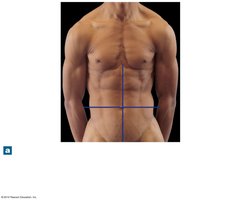
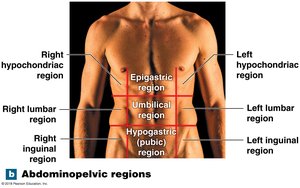
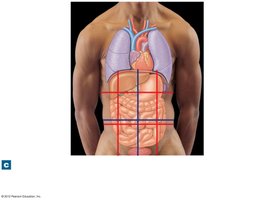
Abdominopelvic Quadrants and Regions
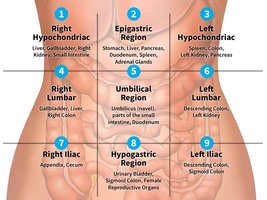
The abdominopelvic cavity is divided into quadrants and regions to facilitate clinical assessment and localization of organs.
Four Quadrants: Right Upper Quadrant (RUQ), Right Lower Quadrant (RLQ), Left Upper Quadrant (LUQ), Left Lower Quadrant (LLQ)
Nine Regions: Right hypochondriac, epigastric, left hypochondriac, right lumbar, umbilical, left lumbar, right iliac, hypogastric, left iliac
Organ Systems Overview
The human body consists of multiple organ systems, each with specific functions and major organs. Understanding these systems is fundamental to anatomy and physiology.
Examples of Organ Systems:
Digestive system: Stomach, intestines, liver, pancreas
Respiratory system: Lungs, trachea
Cardiovascular system: Heart, blood vessels
Lymphatic system: Spleen, lymph nodes
Urinary system: Kidneys, bladder
Reproductive system: Ovaries, testes
Major Functions: Each system has unique roles, such as nutrient absorption, gas exchange, waste elimination, and defense against pathogens.
Clinical Application: Interpretation of Medical Terminology
Medical terminology uses anatomical language to describe symptoms, pain, and injuries. Translating these terms into common language is essential for patient communication.
Example: "Sharp inferior posterior cephalic pain extending into the cervical region and bilaterally into the brachial regions" means "Sharp pain in the lower part of the back of the head that extends down the neck and into both upper arms."
Practice: Translate anatomical descriptions into everyday language for clarity.
Sample Questions for Review
Which body regions have been labeled (called anatomical landmarks)?
Is the region in G distal or proximal to H?
The sternum is ___________ to the heart.
Which organs are cut through by a dotted line above the diaphragm?
Which four abdominopelvic regions are found within the LUQ?
Name an organ only found in the LUQ and its organ system.
One function of the lymphatic organ system?
What organ is found within the umbilical region?
Which abdominal region contains the spleen?
Additional info:
Sectional planes are used in medical imaging (e.g., MRI, CT scans) to view internal structures.
Serous membranes reduce friction between organs and body walls.
Abdominopelvic regions are used to localize pain and pathology in clinical practice.
