 Indietro
Unit 4: Ch 18 Mechanics of Breathing: Structure and Function of the Respiratory System
Guida di studio - Note intelligenti
 Appunti personalizzati basati sui tuoi materiali, ampliati con definizioni chiave, esempi e contesto.
Respiratory System Overview
Functions of the Respiratory System
The respiratory system is essential for gas exchange, regulation of blood pH, protection from pathogens, detection of odors, and vocalization. It works in concert with the cardiovascular, musculoskeletal, and immune systems to maintain homeostasis.
External gas exchange: Oxygen (O2) and carbon dioxide (CO2) are exchanged between air and blood.
Regulation of blood pH: By controlling CO2 excretion, the respiratory system influences acid-base balance.
Protection: Mechanical barriers and immune responses defend against pathogens.
Detection of odors: Olfactory receptors in the nasal cavity sense airborne chemicals.
Vocalization: Air movement across vocal cords enables speech.
External Respiration: Steps and Components
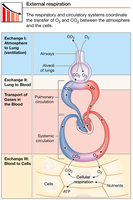
External respiration involves the coordinated transfer of O2 and CO2 between the atmosphere, blood, and cells. It includes pulmonary ventilation, alveolar gas exchange, gas transport, and systemic gas exchange.
Pulmonary ventilation: Movement of air into and out of the lungs.
Alveolar gas exchange: Exchange of gases between air in alveoli and blood in pulmonary capillaries.
Gas transport: Movement of gases in the blood to tissues.
Systemic gas exchange: Exchange of gases between blood and tissues.
Cellular respiration: Cells use O2 for aerobic metabolism, producing CO2.
Structural Divisions of the Respiratory System
Upper vs. Lower Respiratory System
The respiratory system is divided into upper and lower regions, each with distinct anatomical features and functions.
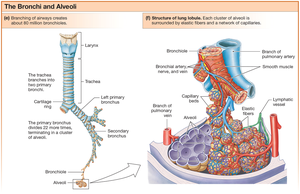
Upper respiratory system: Includes the oral and nasal cavities, pharynx, and larynx. It conducts both food and air.
Lower respiratory system: Comprises the trachea, bronchi, bronchioles, and alveoli. It conducts air only and is the site of gas exchange.
Functional Divisions: Conducting and Respiratory Zones
Conducting Zone
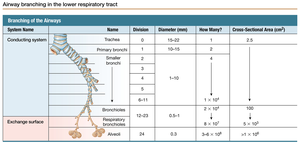
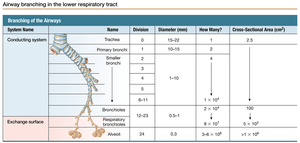
The conducting zone transports and conditions air before it reaches the gas exchange surfaces. It includes the trachea, bronchi, and bronchioles, which are lined with mucosa, submucosa, muscularis, and cartilage.
Transport: Moves air to and from the lungs.
Conditioning: Warms, moistens, and filters air.
Respiratory Zone
The respiratory zone is where gas exchange occurs. It includes respiratory bronchioles, alveolar ducts, and alveoli, which are lined with simple cuboidal or squamous epithelium.
Respiratory bronchioles: Simple cuboidal epithelium, little smooth muscle.
Alveolar ducts and alveoli: Simple squamous epithelium, optimal for gas diffusion.
Conditioning of Air in the Conducting Zone
Warming and Moistening Air
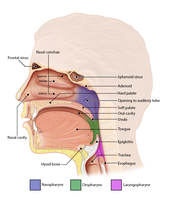
Air is warmed and humidified as it passes through the nasal and oral pathways. The nasal cavity is more effective at conditioning air due to its structure and mucosal lining.
Warming: External air temperature is adjusted to body temperature (37°C).
Moistening: Atmospheric humidity is increased to 100% body humidity.
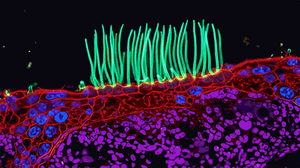
Filtering Air: Mucociliary Escalator
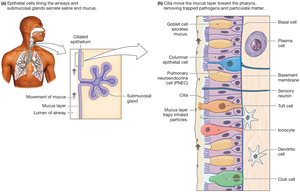
The mucociliary escalator is a defense mechanism that removes pathogens and irritants from the airways. Ciliated epithelial cells and goblet cells produce mucus and move it toward the pharynx.
Ciliated epithelium: Moves mucus and trapped particles upward.
Goblet cells: Secrete sticky mucus containing immunoglobulins.
Basal cells: Serve as progenitor cells for epithelial regeneration.
Saline Secretion and Ion Transport
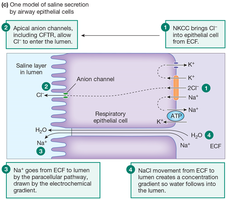
Saline secretion over cilia is regulated by ion channels and transporters, including the CFTR channel. Proper function is essential for effective mucociliary clearance.
Na+/K+ ATPase pump: Maintains ion gradients.
NKCC symporter: Transports Na+, K+, and 2 Cl- into epithelial cells.
CFTR channel: Allows Cl- to enter the lumen, facilitating saline secretion.
Paracellular movement: Na+ and water move by electrochemical and osmotic gradients.
Cystic Fibrosis and Mucociliary Dysfunction
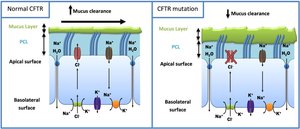
Cystic fibrosis is caused by mutations in the CFTR channel, leading to reduced saline secretion, thick mucus build-up, increased airway resistance, and frequent bacterial infections.
CFTR mutation: Impairs Cl- transport and mucociliary clearance.
Clinical consequences: Thick mucus restricts airflow and increases infection risk.
Primary Ciliary Dyskinesia
Primary ciliary dyskinesia is a rare genetic disorder affecting the structure and function of cilia, resulting in abnormal mucus clearance and respiratory dysfunction.
Abnormal ciliary movement: Impairs mucociliary escalator.
Clinical impact: Chronic respiratory infections and reduced airway clearance.
Respiratory Zone Functions
Alveolar Cells and Functions
Alveoli are the primary site of gas exchange and contain specialized cells for this purpose.
Type I cells: Facilitate alveolar gas exchange.
Type II cells: Produce surfactant to reduce surface tension.
Alveolar macrophages (Type III): Provide immune defense.
Alveoli and Cardiovascular Relationship
The respiratory membrane consists of Type I alveolar cells, fused basement membrane, and capillary endothelium. Most alveoli are covered by capillaries, and connective tissue provides structural support.
Respiratory membrane: Thin barrier for efficient gas exchange.
Connective tissue: Contains elastin and collagen for elasticity.
Pulmonary Circulation
Pulmonary circulation is characterized by low pressure and high compliance, facilitating efficient gas exchange.
Volume: ≈ 0.5 L
Pulmonary flow: ≈ 5 L/min (equal to systemic flow)
Pulmonary arterial pressure: ≈ 25/8 mm Hg
Low resistance: Due to short vessel length, high compliance, and large diameter arterioles.
Gas Laws Relevant to Pulmonary Physiology
Ideal Gas Law
The ideal gas law describes the relationship between pressure, volume, temperature, and the number of gas molecules.
Equation:
Boyle’s Law: (Pressure and volume are inversely related in a closed system)
Dalton’s Law
Dalton’s law states that the total pressure of a gas mixture is the sum of the partial pressures of individual gases.
Partial pressure: Pressure contributed by each gas in a mixture.
Calculation:
Example: (dry air at 25°C)
Application of Gas Laws
Volume and pressure: Increasing volume decreases pressure, and vice versa.
Partial pressures: Drive movement of gases during ventilation and gas exchange.
Ventilation and Pulmonary Volumes
Ventilation Terms
Ventilation refers to the process of breathing, including inspiration (inhalation) and expiration (exhalation). Quiet breathing involves active inspiration and passive expiration.
Respiratory cycle: Begins with inhalation.
Lung Volumes and Capacities
Lung volumes and capacities are important for assessing respiratory function. There are four primary lung volumes and four capacities.
Tidal volume (TV): Volume of air moved in a single breath.
Inspiratory reserve volume (IRV): Additional air inhaled after a normal inspiration.
Expiratory reserve volume (ERV): Additional air exhaled after a normal expiration.
Residual volume (RV): Air remaining in lungs after maximal exhalation.
Lung capacities:
Functional residual capacity (FRC):
Inspiratory capacity (IC):
Vital capacity (VC):
Total lung capacity (TLC):
Pulmonary Function and Gas Exchange Summary
Understanding the mechanics of breathing, airway structure, and gas laws is fundamental for analyzing pulmonary function and gas exchange. The respiratory system's efficiency depends on proper airway conditioning, mucociliary clearance, and the integrity of alveolar and vascular structures.
