 Indietro
Membrane Potentials and Action Potentials: Fundamentals of the Nervous System
Guida di studio - Note intelligenti
 Appunti personalizzati basati sui tuoi materiali, ampliati con definizioni chiave, esempi e contesto.
Membrane Potentials and Basic Principles of Electricity
Resting Membrane Potential
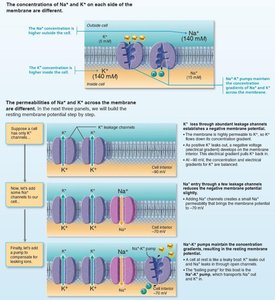
The resting membrane potential is a fundamental property of neurons, allowing them to respond rapidly to stimuli. It is the voltage difference across the plasma membrane when the cell is at rest, typically around -70 mV. The cytoplasmic side of the membrane is negatively charged relative to the outside, and the membrane is said to be polarized.
Key Point: The resting membrane potential is generated by differences in ionic composition and plasma membrane permeability.
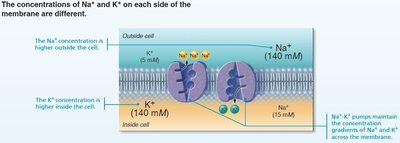
Key Point: The extracellular fluid (ECF) has a higher concentration of Na+ than the intracellular fluid (ICF), while the ICF has a higher concentration of K+.
Key Point: The sodium-potassium pump (Na+/K+ ATPase) maintains these concentration gradients by pumping three Na+ out and two K+ in.
Key Point: The membrane is much more permeable to K+ than Na+, leading to a net negative charge inside the cell.
Role of Membrane Ion Channels
Membrane ion channels are large proteins that allow selective passage of ions. There are two main types:
Leakage (nongated) channels: Always open, allowing ions to move down their concentration gradients.
Gated channels: Open or close in response to specific stimuli. Three main types are:
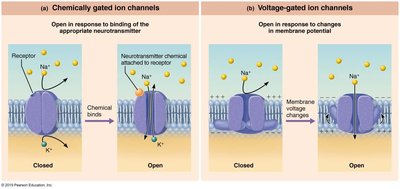
Chemically gated (ligand-gated) channels: Open in response to binding of a specific chemical, such as a neurotransmitter.
Voltage-gated channels: Open and close in response to changes in membrane potential.
Mechanically gated channels: Open and close in response to physical deformation, such as touch.
Changes in Membrane Potential
Depolarization and Hyperpolarization
Changes in membrane potential are essential for neuronal signaling. These changes occur when ion concentrations or membrane permeability are altered.
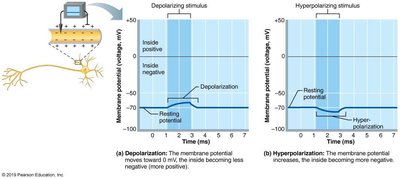
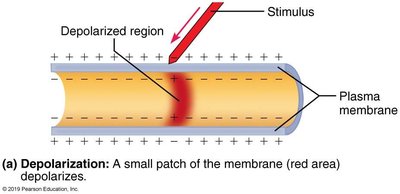
Depolarization: The membrane potential becomes less negative (moves toward zero), increasing the probability of generating an action potential.
Hyperpolarization: The membrane potential becomes more negative (moves away from zero), decreasing the probability of generating an action potential.
Graded Potentials
Characteristics and Spread
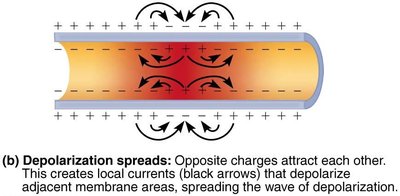
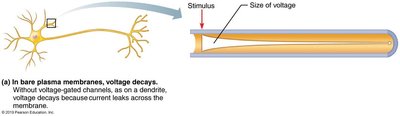
Graded potentials are short-lived, localized changes in membrane potential. They are triggered by stimuli that open gated ion channels and can result in depolarization or hyperpolarization.
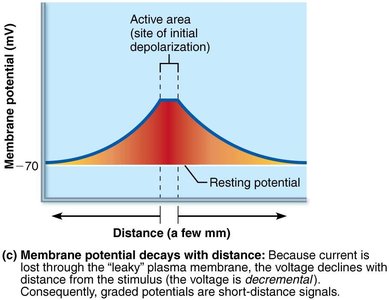
Key Point: The strength of the stimulus determines the magnitude and distance the current flows.
Key Point: Graded potentials decay quickly and are only effective over short distances.
Key Point: Types include receptor potentials (in sensory neurons) and postsynaptic potentials (in neurons).
Action Potentials
Definition and Steps
Action potentials (APs) are the principal means of long-distance communication in neurons. They are brief, rapid reversals of membrane potential that do not decay over distance.
Key Point: APs occur only in axons and muscle cells.
Key Point: APs are generated by the opening of specific voltage-gated channels.
Key Point: The process involves four main steps:
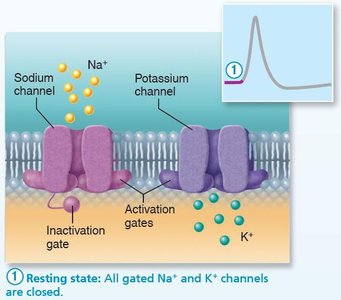
Resting State: All gated Na+ and K+ channels are closed. Only leakage channels are open, maintaining the resting membrane potential.
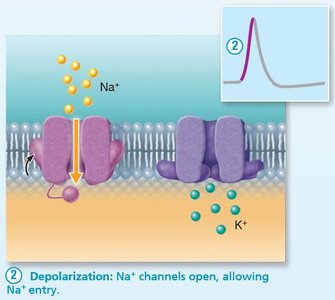
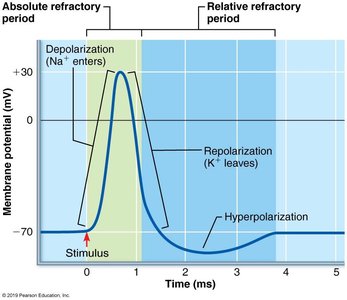
Depolarization: Voltage-gated Na+ channels open, allowing Na+ to enter the cell. At threshold (~-55 mV), all Na+ channels open, causing a spike in membrane potential to +30 mV.
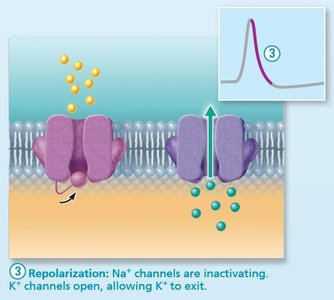
Repolarization: Na+ channels inactivate, and K+ channels open, allowing K+ to exit the cell. The membrane returns to its resting potential.
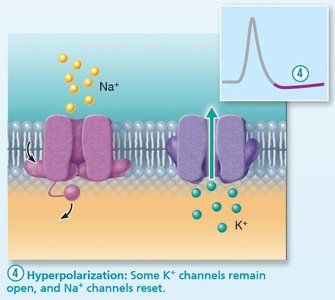
Hyperpolarization: Some K+ channels remain open, causing the membrane potential to dip below the resting level. Na+ channels reset.
Threshold and All-or-None Phenomenon
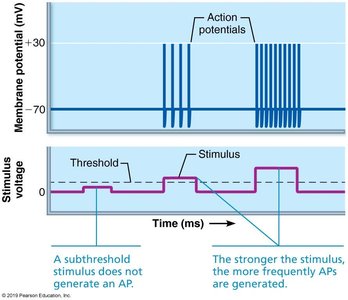
For an action potential to occur, the membrane must reach a threshold voltage. If threshold is reached, the AP is generated; if not, no AP occurs. This is known as the all-or-none phenomenon.
Propagation of Action Potentials
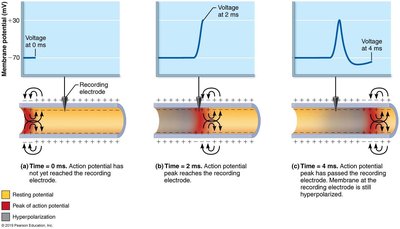
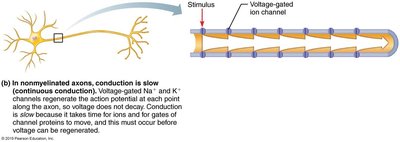
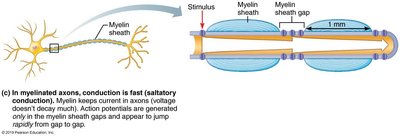
Once initiated, an AP propagates along the axon, allowing the signal to travel from the origin to the terminals. In nonmyelinated axons, each segment depolarizes and repolarizes in sequence. In myelinated axons, APs jump from gap to gap (nodes of Ranvier), a process called saltatory conduction.
Coding for Stimulus Intensity
Frequency of Action Potentials
All action potentials are identical in size and duration. The central nervous system distinguishes between weak and strong stimuli by the frequency of APs generated.
Key Point: Higher frequencies indicate stronger stimuli.
Refractory Periods
Absolute and Relative Refractory Periods
The refractory period is the time during which a neuron cannot generate another action potential. It ensures one-way transmission and prevents overlap of APs.
Absolute refractory period: From opening of Na+ channels until they reset. No new AP can be generated.
Relative refractory period: Follows the absolute period. Most Na+ channels have reset, but some K+ channels remain open. A stronger stimulus is required to generate an AP.
Conduction Velocity
Factors Affecting Velocity
Action potential conduction velocity varies depending on axon diameter and degree of myelination.
Axon diameter: Larger diameter fibers conduct impulses faster due to less resistance.
Degree of myelination: Myelinated axons conduct impulses much faster via saltatory conduction.
Continuous conduction: Occurs in nonmyelinated axons and is slower.
Saltatory conduction: Occurs in myelinated axons and is about 30 times faster.
Classification of Nerve Fibers
Nerve fibers are classified based on diameter, myelination, and conduction speed:
Group | Diameter | Myelination | Speed | Function |
|---|---|---|---|---|
Group A | Largest | Myelinated | 150 m/s (~300 mph) | Somatic sensory and motor fibers |
Group B | Intermediate | Lightly myelinated | 15 m/s (~30 mph) | Visceral motor and sensory fibers |
Group C | Smallest | Unmyelinated | 1 m/s (~2 mph) | Visceral motor and sensory fibers |
Summary Table: Steps of Action Potential Generation
Step | Channel Activity | Membrane Potential Change |
|---|---|---|
Resting State | All gated Na+ and K+ channels closed | -70 mV |
Depolarization | Na+ channels open | Rises to +30 mV |
Repolarization | Na+ channels inactivate, K+ channels open | Returns toward -70 mV |
Hyperpolarization | Some K+ channels remain open, Na+ channels reset | Dips below -70 mV |
Key Equations
Nernst Equation: Used to calculate the equilibrium potential for a particular ion.
Goldman-Hodgkin-Katz Equation: Used to calculate the resting membrane potential considering multiple ions.
Example: The sodium-potassium pump is essential for maintaining the resting membrane potential and restoring ionic conditions after an action potential.
Additional info: The notes above expand on the original content with academic context, definitions, and relevant equations to ensure completeness and clarity for exam preparation.
