 Indietro
Membrane Potentials and Action Potentials in Neurons: Fundamentals of the Nervous System
Guida di studio - Note intelligenti
 Appunti personalizzati basati sui tuoi materiali, ampliati con definizioni chiave, esempi e contesto.
Fundamentals of the Nervous System and Nervous Tissue
Membrane Potentials
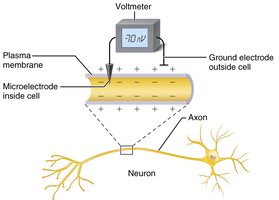
The membrane potential is a fundamental property of neurons, allowing them to transmit electrical signals. Neurons are highly excitable cells that can rapidly change their resting membrane potential, which is essential for communication within the nervous system.
Resting Membrane Potential: The voltage difference across the plasma membrane of a resting neuron, typically around -70 mV. The inside of the cell is negatively charged relative to the outside.
Polarization: The membrane is said to be polarized when there is a difference in charge across it.
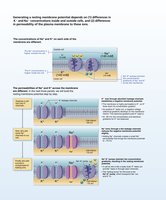
Generation: Resting membrane potential is generated by differences in ionic composition (mainly Na+ and K+) and plasma membrane permeability.
Basic Principles of Electricity
Electrical properties of neurons are governed by the movement of ions across the plasma membrane. The following terms are essential:
Voltage: Potential energy generated by separated charge. Greater charge difference = higher voltage.
Current: Flow of electrical charge (ions) between two points. Used to do work in the cell.
Resistance: Hindrance to charge flow. Insulators have high resistance; conductors have low resistance.
Plasma Membrane Ion Channels
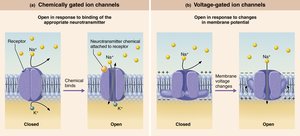
Leakage Channels: Always open, allowing ions to move passively.
Gated Channels: Open and close in response to specific stimuli. Types include:
Chemically gated (ligand-gated): Open with binding of a specific chemical, such as a neurotransmitter.
Voltage-gated: Open and close in response to changes in membrane potential.
Mechanically gated: Open in response to physical deformation, as in sensory receptors.
Ion Movement and Membrane Potential
When gated channels are open, ions diffuse quickly across the membrane. The direction of movement is determined by:
Concentration Gradient: Ions move from areas of higher to lower concentration.
Electrical Gradient: Ions move toward areas of opposite electrical charge.
Net Flow: The strongest gradient drives the net flow of ions, creating electrical currents and voltage changes across the membrane.
Resting Membrane Potential: Ionic Composition and Permeability
Differences in Ionic Composition:
Cell cytosol has lower Na+ concentration than extracellular fluid (ECF), balanced by Cl-.
Cell cytosol has higher K+ concentration than ECF, balanced by negatively charged proteins.
K+ plays the most important role in membrane potential.
Differences in Plasma Membrane Permeability:
Membrane is slightly permeable to Na+ (diffuses in), but 25x more permeable to K+ (diffuses out).
Sodium-Potassium Pump (Na/K ATPase): Stabilizes the resting membrane potential by pumping 3 Na+ out for every 2 K+ in.
Changing the Resting Membrane Potential
Membrane potential changes when ion concentrations or membrane permeability change. These changes produce two types of signals:
Graded Potentials: Incoming signals operating over short distances.
Action Potentials: Long-distance signals of axons.
Terms Describing Membrane Potential Changes
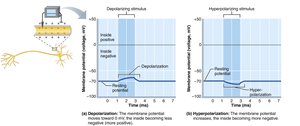
Depolarization: Decrease in membrane potential (moves toward zero and above); inside becomes less negative.
Hyperpolarization: Increase in membrane potential (moves away from zero); inside becomes more negative.
Graded Potentials
Characteristics and Types
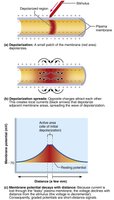
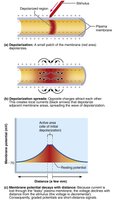
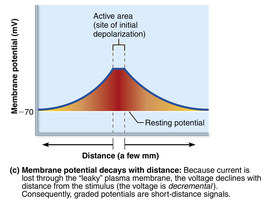
Graded potentials are short-lived, localized changes in membrane potential. The stronger the stimulus, the greater the voltage change and the farther the current flows. They are triggered by stimuli that open gated ion channels and result in either depolarization or hyperpolarization.
Types:
Receptor potential: Occurs in sensory neuron receptors.
Postsynaptic potential: Occurs in neurons.
End-plate potential: Occurs in skeletal muscle cells.
Spread and Decay: Graded potentials act as signals only over short distances, such as dendrites and cell body. Current dissipates quickly and decays.
Initiation of Action Potentials: Graded potentials are essential in initiating action potentials.
Action Potentials
Definition and Properties
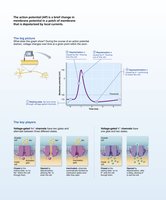
An action potential (AP) is a brief reversal of membrane potential due to the movement of ions (primarily Na+) across the membrane. APs occur only in excitable cells (neurons and muscles) and are referred to as nerve impulses in neurons. They are generated and propagated along the axon and do not decay over long distances.
Phases of Action Potential
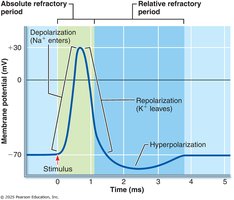
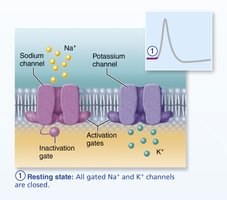
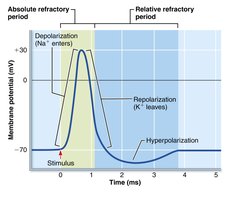
Resting State: All voltage-gated channels are closed; only leakage channels are open, maintaining the resting membrane potential.
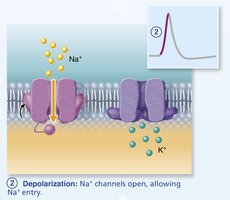
Depolarization: Voltage-gated Na+ channels open, Na+ rushes into the cell, causing the inside to become less negative. At threshold, all Na+ channels open, resulting in a spike to +30 mV.
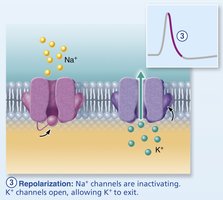
Repolarization: Na+ channels inactivate, K+ channels open, and K+ exits the cell, returning the membrane to resting potential.
Hyperpolarization: Some K+ channels remain open, causing the membrane potential to dip below resting voltage before returning to baseline.
Threshold and All-or-None Phenomenon
Threshold: The minimum depolarization required to trigger an action potential, typically a 15–20 mV change.
All-or-None: An action potential either occurs completely or not at all.
Propagation of Action Potential
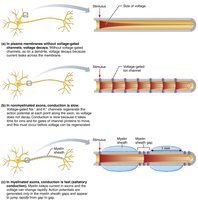
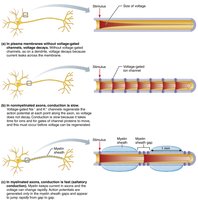
Propagation: AP is transmitted along the length of the axon toward axon terminals. In nonmyelinated axons, each segment depolarizes and repolarizes in sequence. In myelinated axons, AP jumps from gap to gap (nodes of Ranvier).
Directionality: AP occurs only in a forward direction due to inactivation of channels behind the AP.
Refractory Periods
Absolute Refractory Period: Time during which a neuron cannot trigger another AP; ensures one-way transmission.
Relative Refractory Period: Follows absolute period; only exceptionally strong stimulus can trigger an AP.
Conduction Velocity
Factors Affecting Velocity:
Axon Diameter: Larger diameter = faster conduction.
Degree of Myelination: Myelinated axons conduct faster (saltatory conduction) than nonmyelinated (continuous conduction).
Saltatory Conduction: AP jumps from node to node in myelinated axons, increasing speed.
Clinical—Homeostatic Imbalance: Multiple Sclerosis (MS)
Multiple sclerosis is an autoimmune disease where myelin sheaths in the CNS are destroyed, leading to impaired impulse conduction. Symptoms include visual disturbances, weakness, loss of muscular control, speech disturbances, and incontinence. Treatment involves drugs that modify immune system activity; maintaining high vitamin D levels may reduce risk.
Classification of Axons (Nerve Fibers)
Fiber Type | Diameter | Myelination | Speed of Conduction | Function |
|---|---|---|---|---|
A fibers | Largest | Heavily myelinated | ~150 m/s | Somatic motor and most somatic sensory neurons |
B fibers | Intermediate | Lightly myelinated | Slower than A fibers | Autonomic (visceral) sensory and motor neurons |
C fibers | Smallest | Nonmyelinated | ~1 m/s or less | Autonomic (visceral) sensory and motor neurons |
Key Equations
Ohm's Law: Relationship between voltage, current, and resistance: Where I is current, V is voltage, and R is resistance.
Summary
Membrane potentials and action potentials are central to neuronal function. Understanding the ionic basis, channel operation, and propagation mechanisms is essential for grasping how the nervous system communicates and responds to stimuli.
