 Indietro
Ch.11 Part 2
Guida di studio - Note intelligenti
 Appunti personalizzati basati sui tuoi materiali, ampliati con definizioni chiave, esempi e contesto.
Membrane Potentials and Neuronal Excitability
Resting Membrane Potential
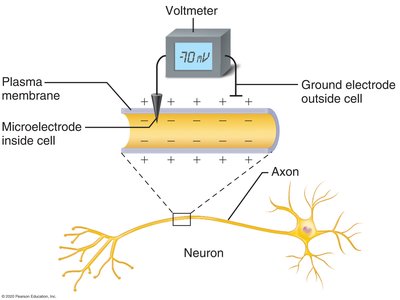
The resting membrane potential is a fundamental property of all cells, but is especially important in neurons, which are highly excitable and capable of rapid changes in membrane potential. The resting membrane potential of a neuron is typically around −70 mV, with the inside of the cell being more negative relative to the outside. This voltage difference is measured using a voltmeter and is due to differences in ionic composition and membrane permeability.
Polarization: The membrane is said to be polarized when there is a voltage difference across it.
Typical range: −40 mV to −90 mV, depending on cell type.
Key ions: Sodium (Na+), Potassium (K+), Chloride (Cl−), and negatively charged proteins.
Basic Principles of Electricity in Biological Systems
Electrical properties in neurons are governed by the movement of ions across the plasma membrane. The following terms are essential:
Voltage (V): Potential energy generated by separated charge, measured in volts (V) or millivolts (mV).
Current (I): Flow of electrical charge (ions) between two points.
Resistance (R): Hindrance to charge flow; insulators have high resistance, conductors have low resistance.
Ohm’s Law: (Current is directly proportional to voltage and inversely proportional to resistance.)
Ion Channels and Membrane Permeability
Membrane ion channels are large proteins that allow selective passage of ions. There are two main types:
Leakage (nongated) channels: Always open, allow passive movement of ions.
Gated channels: Open or close in response to specific stimuli.
Three main types of gated channels:
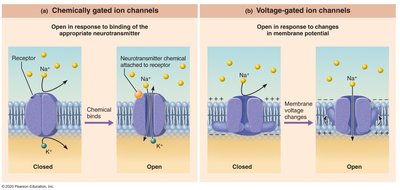
Chemically gated (ligand-gated): Open in response to binding of a specific chemical, such as a neurotransmitter.
Voltage-gated: Open in response to changes in membrane potential.
Mechanically gated: Open in response to physical deformation of the receptor.
Electrochemical Gradients
Ions move across membranes according to their electrochemical gradient, which combines both electrical and chemical gradients. Ion flow creates electrical currents and changes membrane voltage, described by the rearranged Ohm’s law:
Generating the Resting Membrane Potential
The resting membrane potential is established by:
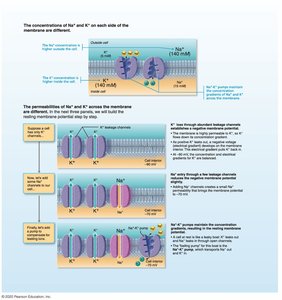
Differences in ionic composition: Extracellular fluid (ECF) has higher Na+, intracellular fluid (ICF) has higher K+. K+ plays the most important role.
Differences in membrane permeability: Membrane is more permeable to K+ than Na+, and impermeable to large anionic proteins.
Sodium-potassium pump (Na+/K+ ATPase): Maintains concentration gradients by pumping 3 Na+ out and 2 K+ in.
Changes in Membrane Potential
Types of Changes
Membrane potential changes occur when ion concentrations or membrane permeability change. These changes produce two types of signals:
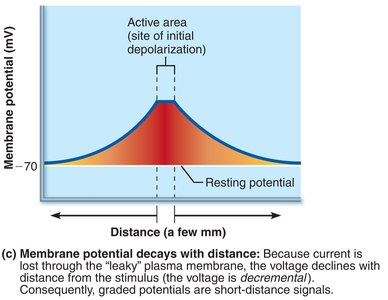
Graded potentials: Short-distance, localized changes in membrane potential.
Action potentials: Long-distance signals, especially in axons.
Key terms:
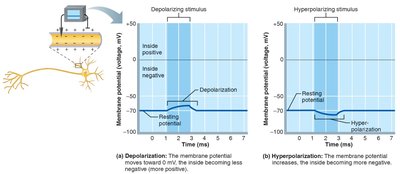
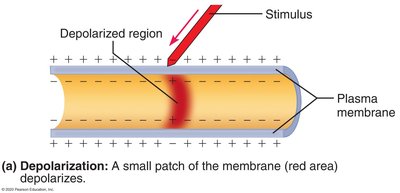
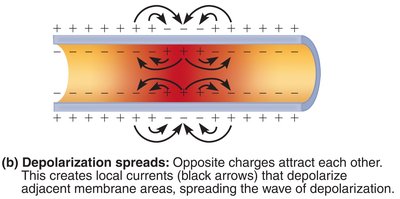
Depolarization: Membrane potential decreases (moves toward zero), inside becomes less negative. Increases probability of producing an impulse.
Hyperpolarization: Membrane potential increases (moves away from zero), inside becomes more negative. Decreases probability of producing an impulse.
Graded Potentials
Characteristics and Spread
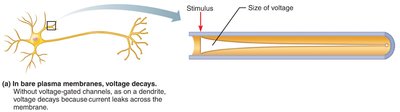
Graded potentials are triggered by stimuli that open gated ion channels, resulting in depolarization or hyperpolarization. The stronger the stimulus, the greater the voltage change and the farther the current flows. Graded potentials decay quickly and are only effective over short distances.
Receptor potential: Graded potential in sensory neuron receptors.
Postsynaptic potential: Graded potential in neurons.
Action Potentials
Overview and Steps
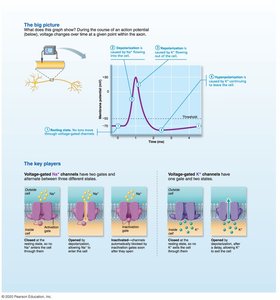
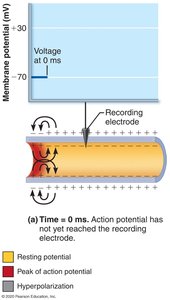
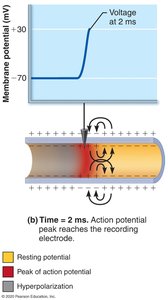
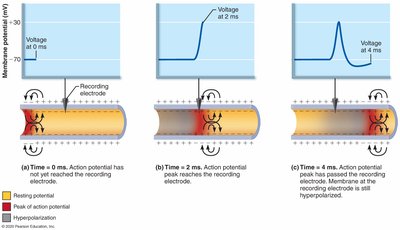
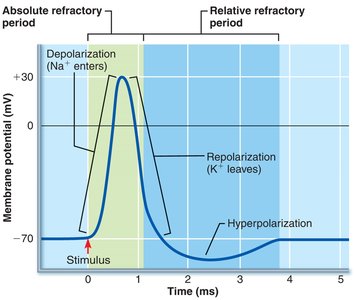
Action potentials (APs) are the principal means of long-distance communication in neurons. They involve a brief reversal of membrane potential (~100 mV) and do not decay over distance. APs are generated by the opening of specific voltage-gated channels and are also referred to as nerve impulses.
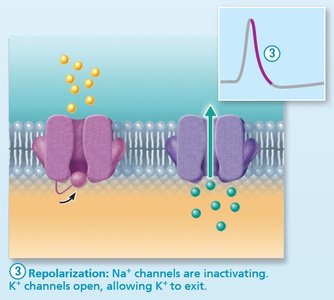
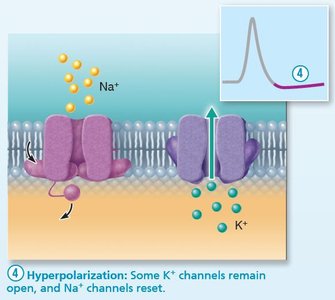
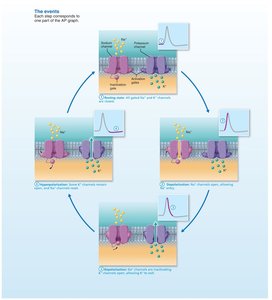
Four main steps:
Resting state: All gated Na+ and K+ channels are closed; only leakage channels are open.
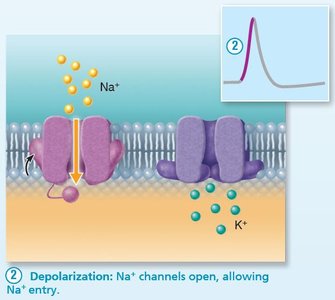
Depolarization: Voltage-gated Na+ channels open, Na+ rushes in, membrane potential rises to +30 mV.
Repolarization: Na+ channels inactivate, K+ channels open, K+ exits, membrane returns to resting potential.
Hyperpolarization: Some K+ channels remain open, inside becomes more negative than resting state, Na+ channels reset.
Threshold and All-Or-None Phenomenon
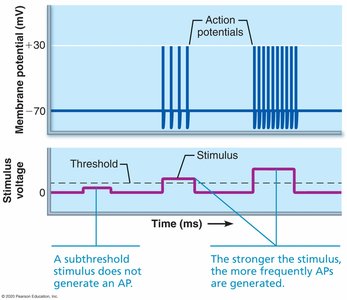
For an action potential to occur, depolarization must reach a threshold voltage. If threshold is reached, the AP is generated; if not, it does not occur. This is known as the all-or-none phenomenon.
Threshold: Membrane depolarized by 15–20 mV.
Na+ permeability increases, Na+ influx exceeds K+ efflux.
Positive feedback cycle begins.
Propagation of Action Potentials
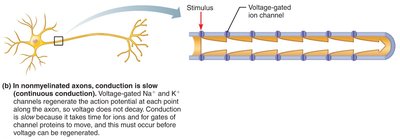
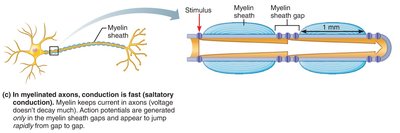
APs are propagated along the axon by local currents that open voltage-gated Na+ channels in adjacent areas. In nonmyelinated axons, each segment depolarizes and repolarizes in sequence. In myelinated axons, propagation is faster and occurs only at myelin sheath gaps.
Coding for Stimulus Intensity
All action potentials are alike, regardless of stimulus intensity. The central nervous system distinguishes between weak and strong stimuli by the frequency of impulses. Higher frequencies indicate stronger stimuli.
Refractory Periods
The refractory period is the time during which a neuron cannot trigger another action potential. There are two types:
Absolute refractory period: From opening of Na+ channels until they reset; ensures all-or-none event and one-way transmission.
Relative refractory period: Follows absolute period; most Na+ channels have reset, some K+ channels still open, threshold elevated. Only strong stimuli can trigger AP.
Conduction Velocity
Factors Affecting Velocity
Action potential conduction velocity varies based on axon diameter and degree of myelination:
Larger diameter: Less resistance, faster conduction.
Myelination: Myelin sheaths insulate axons, enabling faster conduction.
Continuous conduction: Slow, occurs in nonmyelinated axons.
Saltatory conduction: Fast, occurs in myelinated axons; APs jump from gap to gap.
Nerve Fiber Classification
Group | Diameter | Myelination | Speed | Function |
|---|---|---|---|---|
A | Largest | Myelinated | ~150 m/s | Somatic sensory & motor fibers |
B | Intermediate | Lightly myelinated | ~15 m/s | ANS visceral motor & sensory fibers |
C | Smallest | Unmyelinated | ~1 m/s | ANS visceral motor & sensory fibers |
Clinical Relevance: Multiple Sclerosis and Impulse Propagation
Multiple Sclerosis (MS)
MS is an autoimmune disease where myelin sheaths in the CNS are destroyed, leading to impaired impulse conduction. Symptoms include visual disturbances, weakness, loss of muscular control, speech disturbances, and incontinence. Treatment involves drugs that modify immune system activity; high vitamin D levels may reduce risk.
Factors Impairing AP Propagation
Local anesthetics: Block voltage-gated Na+ channels.
Cold or pressure: Interrupt blood circulation and oxygen delivery, causing numbness.
Additional info: These notes expand on the original slides by providing definitions, context, and examples for each key concept, ensuring a comprehensive and self-contained study guide for exam preparation.
