 Indietro
Metabolism and Nutrition: An Overview for Anatomy & Physiology Students
Guida di studio - Note intelligenti
 Appunti personalizzati basati sui tuoi materiali, ampliati con definizioni chiave, esempi e contesto.
Metabolism and Nutrition
Overview of Metabolism and Nutrition
Metabolism encompasses all chemical reactions in the body, divided into catabolic (breaking down) and anabolic (building up) processes. Nutrition provides the energy and building blocks for these reactions, measured in Calories (kilocalories).
Calorie: The amount of heat needed to raise 1 kg of water by 1°C; used to quantify food energy.
Metabolism: The sum of all chemical reactions in the body, including energy extraction, synthesis, and breakdown of macromolecules.
Catabolism: Breakdown of molecules to release energy (e.g., glucose, fatty acids, amino acids).
Anabolism: Synthesis of complex molecules from simpler ones, requiring energy.
Energy Requirements of Metabolic Reactions
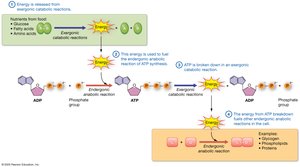
Metabolic reactions are governed by the law of conservation of energy and are classified as exergonic (energy-releasing) or endergonic (energy-consuming). These reactions are coupled in cells to efficiently manage energy flow.
Exergonic reactions: Release energy (e.g., catabolic reactions).
Endergonic reactions: Require energy input (e.g., anabolic reactions).
Cells use energy from exergonic reactions to drive endergonic processes, often via ATP.
Adenosine Triphosphate (ATP) and Phosphorylation
ATP is the primary energy currency of the cell. Its high-energy phosphate bonds are unstable and release energy upon hydrolysis, which is used for cellular work and phosphorylation of other molecules.
ATP hydrolysis: Releases energy and forms ADP and inorganic phosphate.
Phosphorylation: Transfer of a phosphate group from ATP to another molecule, making it more reactive.
About 40% of ATP hydrolysis energy is harnessed for work; the rest is lost as heat.
Glucose Catabolism and ATP Synthesis
Overview of Glucose Catabolism
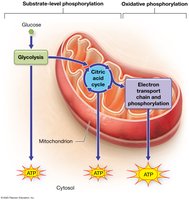
Glucose catabolism involves breaking down glucose to produce ATP through glycolysis, the citric acid cycle, and oxidative phosphorylation.
Glycolysis: Occurs in the cytosol; splits glucose into two pyruvate molecules.
Citric Acid Cycle: Occurs in the mitochondrial matrix; further oxidizes pyruvate derivatives.
Oxidative Phosphorylation: Occurs in the inner mitochondrial membrane; uses electron transport chain (ETC) to generate most ATP.
Glycolysis
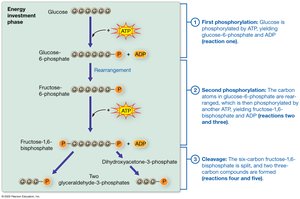
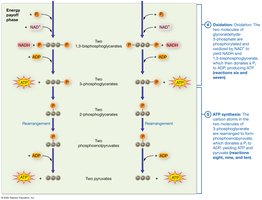
Glycolysis is a ten-step process in the cytosol, divided into energy investment and energy payoff phases.
Energy Investment Phase: Uses 2 ATP to phosphorylate glucose and rearrange it for cleavage.
Energy Payoff Phase: Produces 4 ATP (net gain 2 ATP), 2 NADH, and 2 pyruvate molecules.
Fate of Pyruvate
Pyruvate's fate depends on oxygen availability:
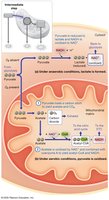
Anaerobic conditions: Pyruvate is reduced to lactate, regenerating NAD+ for glycolysis.
Aerobic conditions: Pyruvate enters mitochondria, is converted to acetyl-CoA, and enters the citric acid cycle.
Citric Acid Cycle (Krebs Cycle)
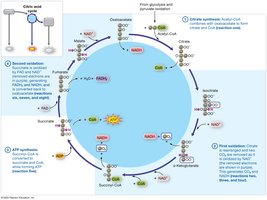
The citric acid cycle is a series of eight reactions in the mitochondrial matrix, producing NADH, FADH2, ATP, and CO2.
Acetyl-CoA combines with oxaloacetate to form citrate.
Produces 3 NADH, 1 FADH2, 1 ATP (per cycle), and releases 2 CO2.
Cycle regenerates oxaloacetate to continue the process.
Oxidative Phosphorylation and Electron Transport Chain (ETC)
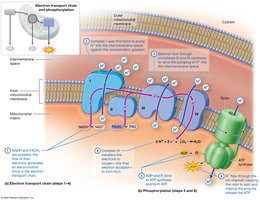
Most ATP is generated via oxidative phosphorylation, which uses the ETC to create a proton gradient that drives ATP synthesis through ATP synthase.
NADH and FADH2 donate electrons to the ETC.
Electron flow powers proton pumps, creating an electrochemical gradient.
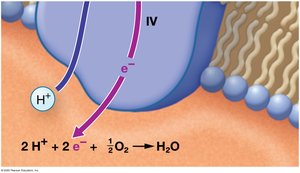
Oxygen is the final electron acceptor, forming water.
ATP synthase uses the proton gradient to synthesize ATP (chemiosmosis).
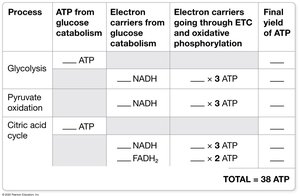
ATP Yield from Glucose Catabolism
The complete oxidation of one glucose molecule yields up to 38 ATP, though actual yield may vary.
Process | ATP from glucose catabolism | Electron carriers from glucose catabolism | Electron carriers going through ETC and oxidative phosphorylation | Final yield of ATP |
|---|---|---|---|---|
Glycolysis | 2 | 2 NADH | 2 × 3 ATP | 8 |
Pyruvate oxidation | 0 | 2 NADH | 2 × 3 ATP | 6 |
Citric acid cycle | 2 | 6 NADH, 2 FADH2 | 6 × 3 ATP, 2 × 2 ATP | 24 |
Total | 38 ATP | |||
Fatty Acid and Amino Acid Catabolism
Fatty Acid Catabolism
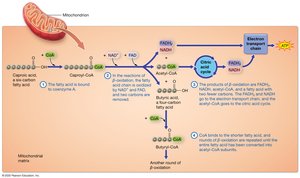
Triglycerides are broken down into glycerol and fatty acids. Fatty acids undergo beta-oxidation to generate acetyl-CoA, NADH, and FADH2, which enter the citric acid cycle and ETC.
Beta-oxidation: Sequential removal of two-carbon units from fatty acids, forming acetyl-CoA.
Energy yield from fatty acids is higher than from glucose.
Amino Acid Catabolism
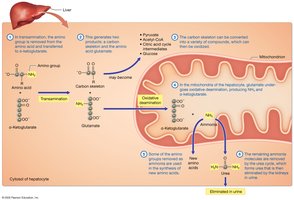
Amino acids are deaminated (removal of amino group) and converted into intermediates for the citric acid cycle or gluconeogenesis. Ammonia produced is converted to urea for excretion.
Transamination: Transfer of amino group to alpha-ketoglutarate, forming glutamate.
Oxidative deamination: Removal of amino group from glutamate, producing ammonia and regenerating alpha-ketoglutarate.
Urea cycle eliminates ammonia as urea in urine.
Anabolic Pathways
Glucose Anabolism
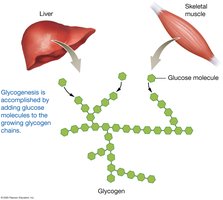
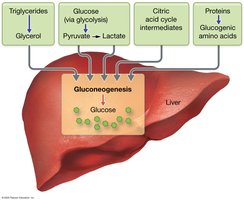
Glucose can be stored as glycogen (glycogenesis) or synthesized from non-carbohydrate sources (gluconeogenesis).
Glycogenesis: Formation of glycogen from glucose, mainly in liver and muscle.
Gluconeogenesis: Synthesis of glucose from pyruvate, lactate, glycerol, and certain amino acids.
Fatty Acid and Amino Acid Anabolism
Fatty acids are synthesized from acetyl-CoA (lipogenesis) and stored as triglycerides. Amino acids are used for protein synthesis or converted to other compounds as needed.
Lipogenesis: Synthesis of fatty acids from acetyl-CoA, stored as triglycerides in adipose tissue.
Protein synthesis: Assembly of amino acids into proteins as directed by DNA.
Metabolic States and Regulation
Absorptive and Postabsorptive States
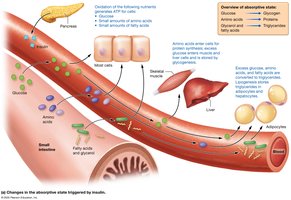
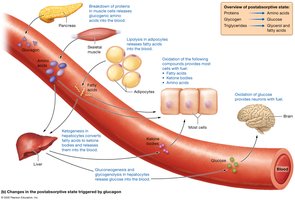
The body alternates between the absorptive state (after eating) and the postabsorptive state (fasting), regulated by hormones such as insulin and glucagon.
Absorptive state: Nutrients are absorbed and stored; insulin promotes glucose uptake and storage.
Postabsorptive state: Stored nutrients are mobilized; glucagon stimulates glycogenolysis and gluconeogenesis.
Regulation of Feeding
Feeding behavior is controlled by hypothalamic centers and hormones such as leptin (satiety), ghrelin (hunger), and insulin.
Satiety center: Inhibits hunger when activated.
Hunger center: Stimulates appetite when activated.
Metabolic Rate and Thermoregulation
Metabolic Rate
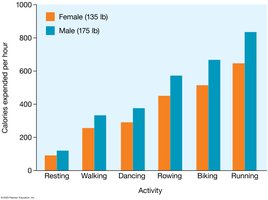
Metabolic rate is the total energy expenditure of the body, measured in kilocalories. Basal metabolic rate (BMR) is the minimum energy required for basic physiological functions at rest.
Thermogenesis: Generation of heat from metabolic processes.
BMR is influenced by hormones, age, sex, muscle mass, and activity.
Heat Exchange and Thermoregulation
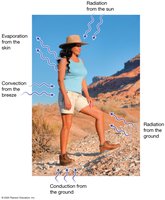
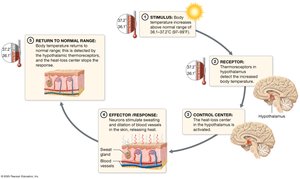
Body temperature is regulated by balancing heat production and loss through radiation, conduction, convection, and evaporation. The hypothalamus acts as the control center for thermoregulation.
Radiation: Transfer of heat via electromagnetic waves.
Conduction: Direct transfer of heat between objects.
Convection: Transfer of heat by movement of air or liquid.
Evaporation: Loss of heat as water vaporizes from body surfaces.
Nutrients: Macronutrients and Micronutrients
Macronutrients
Macronutrients are required in large amounts and include carbohydrates, lipids, and proteins.
Carbohydrates: Main energy source; includes monosaccharides, disaccharides, and polysaccharides.
Lipids: Includes triglycerides, phospholipids, and cholesterol; essential fatty acids must be obtained from the diet.
Proteins: Provide amino acids for synthesis and energy; essential amino acids must be supplied by the diet.
Micronutrients
Micronutrients are required in small amounts and include vitamins and minerals.
Vitamins: Organic compounds, either fat-soluble (A, D, E, K) or water-soluble (B, C).
Minerals: Inorganic elements such as calcium, potassium, iron, and zinc; classified as major minerals or trace elements.
Cholesterol and Body Mass
Cholesterol
Cholesterol is a structural lipid used in membranes and as a precursor for steroid hormones and bile salts. It is transported in the blood by lipoproteins (VLDL, LDL, HDL).
LDL: Delivers cholesterol to tissues; high levels increase cardiovascular risk.
HDL: Removes cholesterol from tissues; high levels are protective.
Body Mass and Energy Balance
Body mass is regulated by the balance between caloric intake and expenditure. Body Mass Index (BMI) is used to assess healthy weight ranges.
Positive energy balance: Intake exceeds expenditure; leads to weight gain.
Negative energy balance: Expenditure exceeds intake; leads to weight loss.
Obesity increases risk for many diseases and is primarily caused by chronic positive energy balance.
