 Indietro
Metabolism and Nutrition: Study Guide for Anatomy & Physiology
Guida di studio - Note intelligenti
 Appunti personalizzati basati sui tuoi materiali, ampliati con definizioni chiave, esempi e contesto.
Metabolism and Nutrition
Overview of Metabolism and Nutrition
Metabolism encompasses all chemical reactions occurring within the body, divided into catabolic (breaking down molecules to release energy) and anabolic (building complex molecules using energy) processes. The energy content in food is measured in calories and kilocalories, with 1 kilocalorie equaling 1000 calories. These reactions are essential for maintaining cellular and organismal function.
Catabolism: Exergonic reactions that break down complex molecules (e.g., glucose, fatty acids, amino acids) to release energy.
Anabolism: Endergonic reactions that synthesize complex molecules, requiring energy input.
Energy Transfer: Energy released from catabolic reactions is used to fuel anabolic reactions, often via ATP.
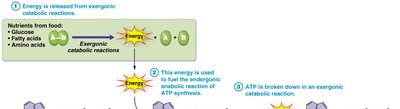
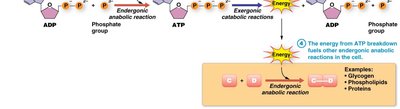
Additional info: The law of conservation of energy states that energy cannot be created or destroyed, only transformed.
Adenosine Triphosphate (ATP) and Phosphorylation
ATP is the primary energy currency of cells. The bond between the second and third phosphate groups is unstable and releases energy when broken by hydrolysis, forming ADP and inorganic phosphate. This energy is used for cellular functions and phosphorylation, where a phosphate group is transferred to another molecule.
ATP Hydrolysis:
Phosphorylation: Enzymatic transfer of phosphate from ATP to another reactant.
Oxidation-Reduction Reactions and Electron Carriers
Metabolic reactions often involve oxidation (loss of electrons) and reduction (gain of electrons). Electron carriers such as NAD+ and FAD facilitate these reactions, shuttling electrons during cellular respiration.
Oxidation: Loss of electrons.
Reduction: Gain of electrons.
Electron Carriers: NAD+ and FAD are reduced to NADH and FADH2 during metabolism.
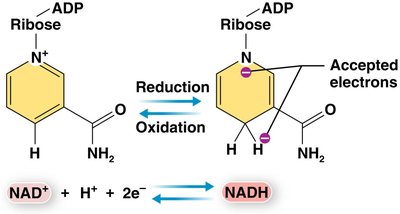
Additional info: These carriers are essential for ATP synthesis in cellular respiration.
Glucose Catabolism and ATP Synthesis
Overview of Aerobic Cellular Respiration
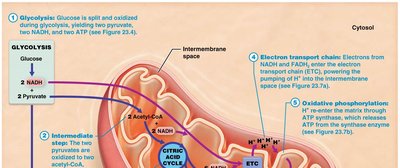
Aerobic cellular respiration consists of four main steps: glycolysis, acetyl formation (transition reaction), citric acid cycle (Krebs cycle), and electron transport chain (ETC). These processes occur in different cellular compartments and collectively produce ATP.
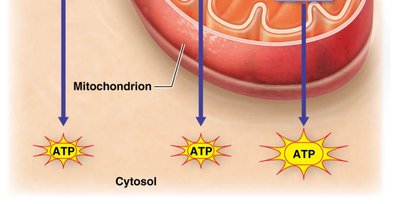
Glycolysis: Occurs in cytosol; produces small amounts of ATP.
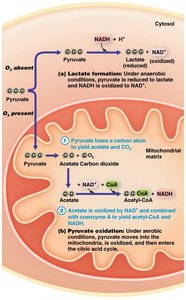
Acetyl Formation: Occurs in mitochondrial matrix; transitions pyruvate to acetyl-CoA.
Citric Acid Cycle: Occurs in mitochondrial matrix; produces ATP, NADH, FADH2, and CO2.
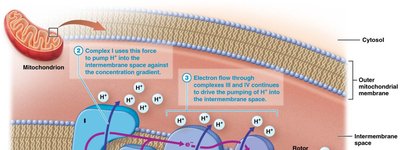
Electron Transport Chain: Occurs in inner mitochondrial membrane; produces most ATP via oxidative phosphorylation.
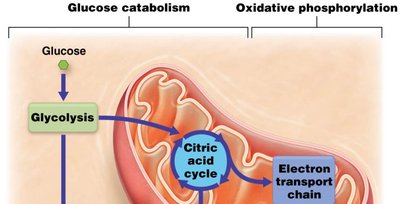
Glycolysis
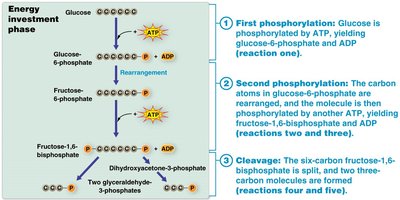
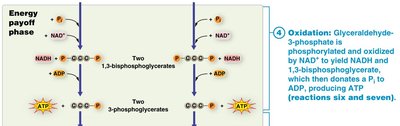
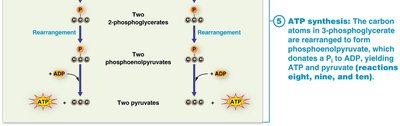
Glycolysis is a ten-step enzymatic process that converts glucose into pyruvate, producing a net gain of 2 ATP and 2 NADH. The process is divided into energy investment and energy payoff phases.
Energy Investment: First five steps use 2 ATP.
Energy Payoff: Last five steps produce 4 ATP.
End Products: 2 pyruvate, 2 ATP (net), 2 NADH.
Fate of Pyruvate
After glycolysis, pyruvate can undergo two different pathways depending on oxygen availability:
Anaerobic (no oxygen): Pyruvate is converted to lactic acid; no further ATP is produced.
Aerobic (oxygen present): Pyruvate is converted to acetyl-CoA, producing NADH and CO2, and enters the citric acid cycle.
Citric Acid Cycle (Krebs Cycle)
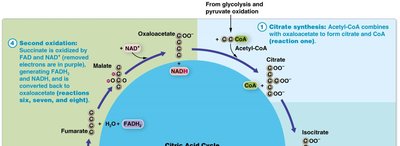
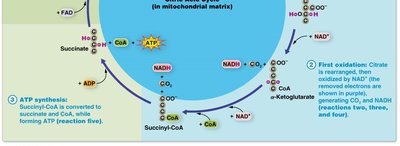
The citric acid cycle is a series of enzymatic reactions in the mitochondrial matrix that uses substrate-level phosphorylation to produce ATP, NADH, FADH2, and CO2. Acetyl-CoA combines with oxaloacetate to form citrate, which is processed through the cycle.
End Products: 2 ATP, 4 CO2, 6 NADH, 2 FADH2 per glucose molecule.
Electron Carriers: NADH and FADH2 carry electrons to the ETC.
Electron Transport Chain and Oxidative Phosphorylation
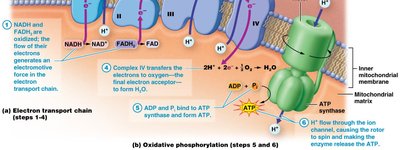
The ETC is located in the inner mitochondrial membrane. NADH and FADH2 deliver electrons, which are passed through protein complexes, pumping H+ into the intermembrane space. The resulting gradient drives ATP synthase, producing 32–34 ATP. Oxygen is the final electron acceptor, forming water.
ATP Yield: Most ATP is produced in this step.
Oxygen: Essential for ETC function; combines with electrons and H+ to form water.
ATP Yield from Glucose Catabolism
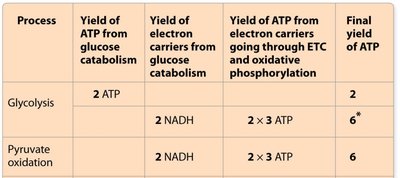
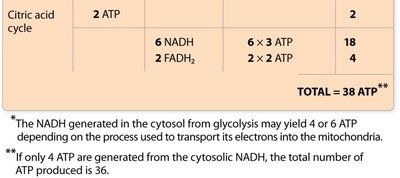
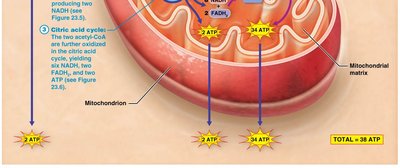
The total ATP yield from one molecule of glucose is approximately 36–38 ATP, depending on the efficiency of electron transport and shuttle mechanisms.
Process | Yield of ATP from glucose catabolism | Yield of electron carriers from glucose catabolism | Yield of ATP from electron carriers going through ETC and oxidative phosphorylation | Final yield of ATP |
|---|---|---|---|---|
Glycolysis | 2 ATP | 2 NADH | 2 x 3 ATP | 2 + 6 = 8 ATP |
Pyruvate oxidation | 0 ATP | 2 NADH | 2 x 3 ATP | 6 ATP |
Citric acid cycle | 2 ATP | 6 NADH, 2 FADH2 | 6 x 3 ATP, 2 x 2 ATP | 2 + 18 + 4 = 24 ATP |
Total | 36–38 ATP | |||
Fatty Acid and Amino Acid Catabolism
Fatty Acid Catabolism
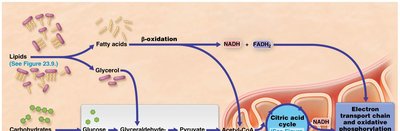
Fatty acids are broken down by lipolysis and beta-oxidation, producing acetyl-CoA, NADH, and FADH2. This process yields more energy than glucose catabolism. Ketogenesis occurs in the liver, producing ketone bodies, which can be used by other tissues for energy.
Lipolysis: Breakdown of triglycerides into fatty acids and glycerol.
Beta-oxidation: Conversion of fatty acids to acetyl-CoA.
Ketogenesis: Formation of ketone bodies; excess leads to ketosis and potentially ketoacidosis.
Amino Acid Catabolism
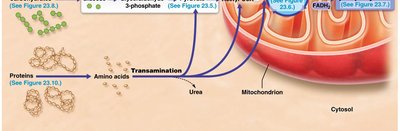
Amino acids are deaminated (removal of amino group) via transamination, producing urea (excreted by kidneys) and carbon skeletons that can be converted to glucose, pyruvate, or acetyl-CoA for energy production.
Transamination: Removal of amino group, forming glutamate and then ammonia.
Urea Cycle: Ammonia is converted to urea for excretion.
Carbon Skeletons: Used for glucose production or energy.
Anabolic Pathways
Glucose Anabolism
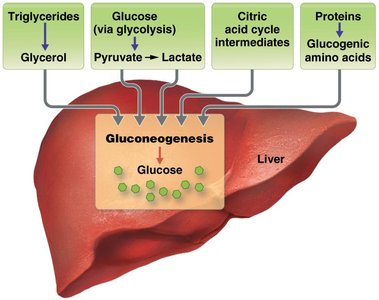
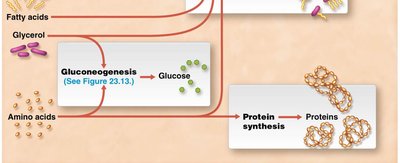
Anabolic pathways are essential for homeostasis, including nutrient storage and synthesis. Glycogenesis (formation of glycogen), glycogenolysis (breakdown of glycogen), and gluconeogenesis (formation of glucose from non-carbohydrates) are key processes.
Glycogenesis: Synthesis of glycogen, stimulated by insulin.
Glycogenolysis: Breakdown of glycogen, stimulated by glucagon.
Gluconeogenesis: Formation of glucose from amino acids, glycerol, or lactate.
Fatty Acid Anabolism
Lipogenesis is the creation of lipids from fatty acids and glycerol, which are stored as triglycerides in adipocytes. Excess glucose and amino acids can be converted to fatty acids.
Lipogenesis: Synthesis of triglycerides from fatty acids and glycerol.
Storage: Triglycerides are stored in adipose tissue.
Amino Acid Anabolism
The body uses amino acids to synthesize proteins. There are 9 essential amino acids (must be obtained from diet) and 11 non-essential amino acids (can be synthesized). Complete proteins contain all essential amino acids.
Protein Synthesis: Amino acids are used to build proteins.
Essential Amino Acids: Must be obtained from dietary sources.
Complete Proteins: Provide all essential amino acids.
Metabolic States and Regulation of Feeding
Absorptive State
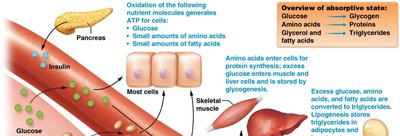
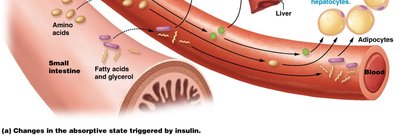
The absorptive state occurs during and immediately after eating, when nutrients are absorbed and used for energy or stored. Insulin is the primary hormone, promoting glucose uptake and storage.
Glucose: Used for ATP production; excess stored as glycogen or fat.
Amino Acids: Used for protein synthesis.
Fatty Acids: Stored as triglycerides.
Postabsorptive State
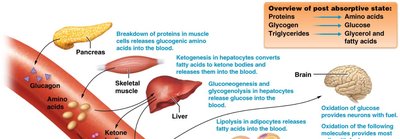
The postabsorptive state occurs when the digestive tract is empty and energy must be derived from stored nutrients. Glucagon is the primary hormone, stimulating glycogenolysis, lipolysis, ketogenesis, and gluconeogenesis.
Glycogenolysis: Breakdown of glycogen to glucose.
Lipolysis: Breakdown of fats to fatty acids.
Ketogenesis: Formation of ketone bodies.
Gluconeogenesis: Production of glucose from non-carbohydrates.
Glucose Sparing: Use of fatty acids for energy, preserving glucose for nervous system.
Regulation of Feeding
The hypothalamus regulates feeding through the satiety and hunger centers. Hormones such as leptin, ghrelin, and insulin modulate these centers, influencing appetite and food intake.
Satiety Center: Promotes fullness.
Hunger Center: Stimulates appetite.
Leptin: Produced by adipocytes; stimulates satiety.
Ghrelin: Produced by stomach; stimulates hunger.
Insulin: Stimulates satiety after feeding.
Metabolic Rate and Thermoregulation
Metabolic Rate
Metabolic rate is the amount of energy expended by cells for all chemical reactions. Basal metabolic rate (BMR) is measured at rest and varies with factors such as hormones, age, gender, muscle mass, and activity.
Thermogenesis: Generation of heat as a byproduct of metabolism.
Calorimetry: Measurement of heat production to determine metabolic rate.
Heat Exchange Between Body and Environment
Heat is exchanged via radiation, conduction, convection, and evaporation. Sweating and insensible heat loss help regulate body temperature.
Radiation: Transfer of heat without contact.
Conduction: Transfer of heat via direct contact.
Convection: Transfer of heat through fluids or gases.
Evaporation: Loss of heat as water changes from liquid to gas.
Thermoregulation
Body temperature is maintained within a narrow range (35.8–38.2°C). Core temperature is measured in deep tissues, while shell temperature varies with the environment. Negative feedback loops regulate temperature homeostasis.
Nutrition and Body Mass
Macronutrients
Macronutrients (carbohydrates, proteins, lipids) are required in large amounts for energy and structural functions. Essential nutrients must be obtained from the diet.
Micronutrients
Micronutrients include vitamins (organic) and minerals (inorganic). Fat-soluble vitamins can be stored, while water-soluble vitamins are excreted if in excess. Minerals are required for various physiological functions, with trace elements needed in small amounts.
Structural Lipid: Cholesterol
The liver synthesizes most cholesterol needed by the body. Cholesterol is packaged into lipoproteins for transport. Chylomicrons absorb dietary fat and transport it to adipose tissue.
Additional info: These notes provide a comprehensive overview of metabolism and nutrition, suitable for exam preparation in Anatomy & Physiology.
