 Indietro
Metabolism and Nutrition: Study Guide for Anatomy & Physiology
Guida di studio - Note intelligenti
 Appunti personalizzati basati sui tuoi materiali, ampliati con definizioni chiave, esempi e contesto.
Metabolism and Nutrition
Overview of Metabolism and Nutrition
Metabolism encompasses all chemical reactions occurring within the body, divided into catabolic (energy-releasing) and anabolic (energy-consuming) processes. Nutrition provides the substrates for these reactions, and energy content in food is measured in kilocalories.
Metabolism: Sum of all chemical reactions in the body.
Catabolism: Breakdown of complex molecules into simpler ones, releasing energy (exergonic).
Anabolism: Synthesis of complex molecules from simpler ones, requiring energy (endergonic).
Energy Measurement: 1 calorie raises 1g water by 1°C; 1 kilocalorie raises 1kg water by 1°C.
Energy Requirements of Metabolic Reactions
The law of conservation of energy states that energy cannot be created or destroyed, only transformed. Metabolic reactions transfer energy between molecules, primarily through ATP.
ATP (Adenosine Triphosphate): The cell's energy currency; energy is released when the bond between the 2nd and 3rd phosphate is broken.
Phosphorylation: Transfer of a phosphate group from ATP to another molecule, often catalyzed by enzymes.
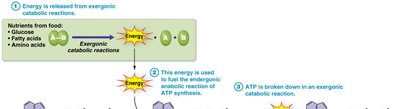
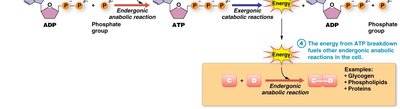
Nutrients and ATP Generation
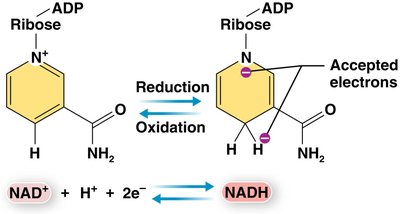
ATP synthesis relies on oxidation-reduction (redox) reactions, which involve electron transfer. Electron carriers such as NAD+ and FAD facilitate these reactions.
Oxidation: Loss of electrons.
Reduction: Gain of electrons.
Electron Carriers: NAD+ and FAD accept electrons during cellular respiration.
Glucose Catabolism and ATP Synthesis
Overview of Aerobic Cellular Respiration
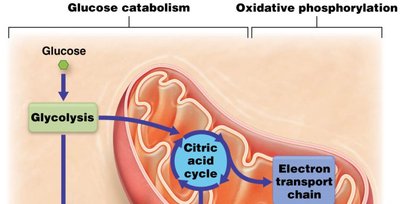
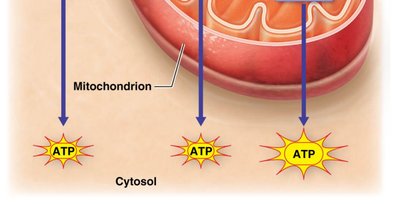
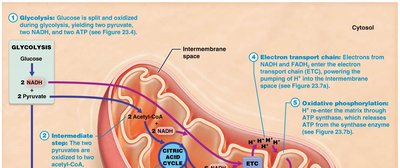
Aerobic cellular respiration consists of four main steps: glycolysis, acetyl formation (transition reaction), citric acid cycle (Krebs cycle), and electron transport chain (ETC). These steps occur in different cellular compartments and produce ATP via substrate-level and oxidative phosphorylation.
Glycolysis: Occurs in cytosol; produces ATP and pyruvate.
Acetyl Formation: Occurs in mitochondrial matrix; converts pyruvate to acetyl-CoA.
Citric Acid Cycle: Occurs in mitochondrial matrix; produces ATP, NADH, FADH2, and CO2.
Electron Transport Chain: Occurs in inner mitochondrial membrane; produces most ATP.
Glycolysis
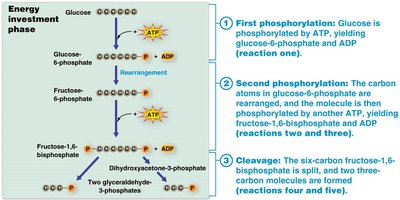
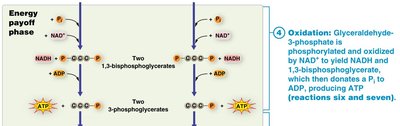
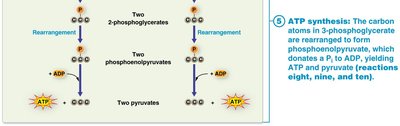
Glycolysis is a 10-step enzymatic process that splits glucose into two pyruvate molecules. It consists of an energy investment phase (uses 2 ATP) and an energy payoff phase (produces 4 ATP and 2 NADH).
Net Gain: 2 ATP, 2 NADH, 2 pyruvate.
Energy Investment: First five steps use ATP.
Energy Payoff: Last five steps generate ATP and NADH.
The Fate of Pyruvate
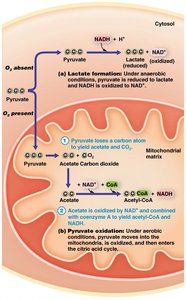
Pyruvate produced in glycolysis can undergo different fates depending on oxygen availability. In anaerobic conditions, it is converted to lactic acid. In aerobic conditions, it is converted to acetyl-CoA for entry into the citric acid cycle.
Anaerobic: Pyruvate → Lactic acid (no further ATP produced).
Aerobic: Pyruvate → Acetyl-CoA (produces NADH and CO2).
Citric Acid Cycle (Krebs Cycle)
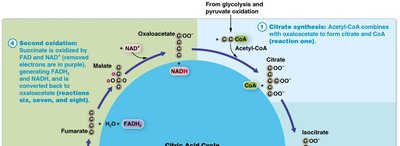
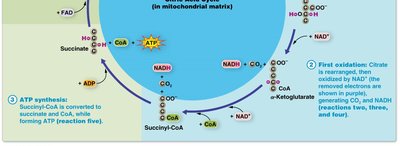
The citric acid cycle is a series of reactions that further oxidize acetyl-CoA, producing ATP, NADH, FADH2, and CO2. Substrate-level phosphorylation generates ATP directly.
End Products: 2 ATP, 4 CO2, 6 NADH, 2 FADH2 per glucose.
Key Steps: Acetyl-CoA combines with oxaloacetate to form citrate; multiple oxidations regenerate oxaloacetate.
Electron Transport Chain and Oxidative Phosphorylation
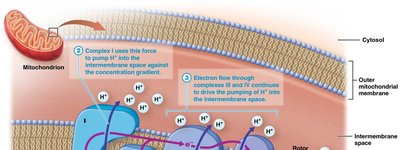
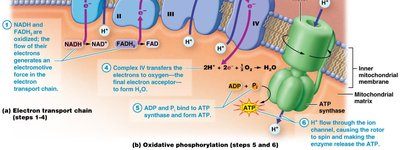
The ETC uses NADH and FADH2 to transfer electrons through a series of carriers in the inner mitochondrial membrane, creating a proton gradient. ATP synthase uses this gradient to produce ATP. Oxygen is the final electron acceptor, forming water.
Location: Inner mitochondrial membrane (cristae).
ATP Yield: 32–34 ATP per glucose.
Oxygen: Essential as the final electron acceptor.
ATP Yield from Glucose Catabolism
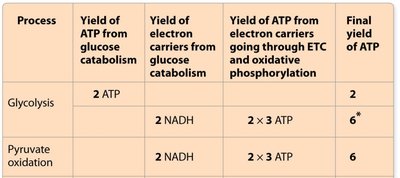
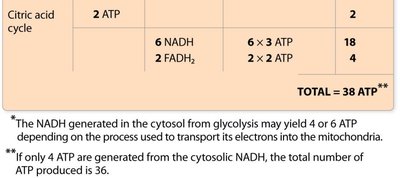
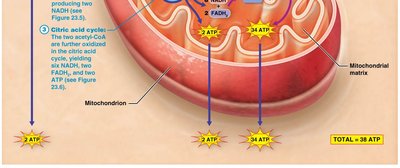
The total ATP yield from one molecule of glucose is typically 36–38 ATP, depending on the efficiency of electron transport and shuttle mechanisms.
Process | Yield of ATP from glucose catabolism | Yield of electron carriers from glucose catabolism | Yield of ATP from electron carriers going through ETC and oxidative phosphorylation | Final yield of ATP |
|---|---|---|---|---|
Glycolysis | 2 ATP | 2 NADH | 2 x 3 ATP | 2 + 6 = 8 ATP |
Pyruvate oxidation | 0 ATP | 2 NADH | 2 x 3 ATP | 6 ATP |
Citric acid cycle | 2 ATP | 6 NADH, 2 FADH2 | 6 x 3 ATP, 2 x 2 ATP | 2 + 18 + 4 = 24 ATP |
Total | 36–38 ATP | |||
Fatty Acid and Amino Acid Catabolism
Fatty Acid Catabolism
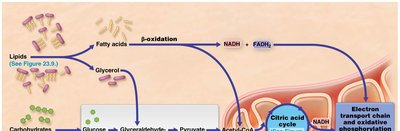
Fatty acids are broken down by beta-oxidation into acetyl-CoA, which enters the citric acid cycle. This process yields more energy than glucose catabolism. Ketogenesis occurs in the liver, producing ketone bodies during prolonged fasting or carbohydrate restriction.
Lipolysis: Breakdown of triglycerides into fatty acids and glycerol.
Beta-oxidation: Conversion of fatty acids to acetyl-CoA.
Ketogenesis: Formation of ketone bodies; excess leads to ketosis and potentially ketoacidosis.
Amino Acid Catabolism
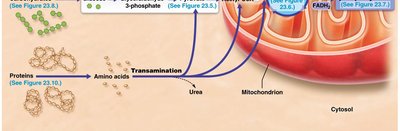
Amino acids are deaminated (removal of amino group) in the liver, producing urea for excretion and carbon skeletons that can be converted to glucose or acetyl-CoA.
Transamination: Transfer of amino group to α-ketoglutarate, forming glutamate.
Urea Cycle: Ammonia is converted to urea for excretion by kidneys.
Carbon Skeletons: Used for gluconeogenesis or energy production.
Anabolic Pathways
Glucose Anabolism
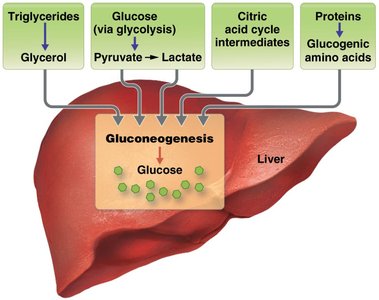
Anabolic pathways synthesize macromolecules and store nutrients. Glycogenesis forms glycogen from glucose, glycogenolysis breaks down glycogen, and gluconeogenesis produces glucose from non-carbohydrate sources.
Glycogenesis: Formation of glycogen, stimulated by insulin.
Glycogenolysis: Breakdown of glycogen, stimulated by glucagon.
Gluconeogenesis: Synthesis of glucose from amino acids, glycerol, or lactate.
Fatty Acid Anabolism
Lipogenesis synthesizes fatty acids and triglycerides for storage in adipocytes. Excess glucose and amino acids can be converted to fatty acids.
Lipogenesis: Creation of lipids using fatty acid synthase.
Triglyceride Formation: Fatty acids combine with glycerol.
Amino Acid Anabolism
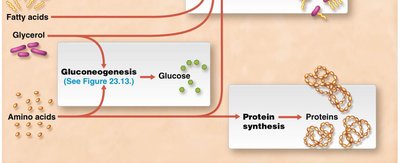
Amino acids are used for protein synthesis. Essential amino acids must be obtained from the diet, while non-essential amino acids can be synthesized by the body.
Protein Synthesis: Assembly of proteins from amino acids.
Essential Amino Acids: Must be consumed in the diet.
Complete Proteins: Provide all essential amino acids.
Metabolic States and Regulation of Feeding
Absorptive State
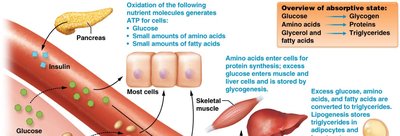
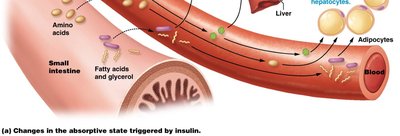
During the absorptive state, nutrients are absorbed and used for energy or stored. Insulin is the primary hormone regulating this state.
Glucose: Used for ATP production; excess stored as glycogen or fat.
Amino Acids: Used for protein synthesis.
Insulin: Promotes nutrient uptake and storage.
Postabsorptive State
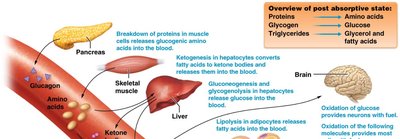
In the postabsorptive state, the body maintains blood glucose levels by mobilizing stored nutrients. Glucagon is the primary hormone regulating this state.
Glycogenolysis: Breakdown of glycogen to glucose.
Lipolysis: Breakdown of fats to fatty acids.
Ketogenesis: Formation of ketone bodies.
Gluconeogenesis: Production of glucose from non-carbohydrates.
Glucose Sparing: Use of fatty acids for energy, reserving glucose for nervous tissue.
Regulation of Feeding
The hypothalamus regulates feeding through satiety and hunger centers. Hormones such as leptin, ghrelin, and insulin modulate these centers.
Satiety Center: Promotes fullness.
Hunger Center: Promotes hunger.
Leptin: Produced by adipocytes; stimulates satiety.
Ghrelin: Produced by stomach; stimulates hunger.
Insulin: Stimulates satiety after feeding.
Metabolic Rate and Thermoregulation
Metabolic Rate
Metabolic rate is the energy expenditure of the body, measured in calories. Basal metabolic rate (BMR) is the rate at rest. Factors affecting metabolic rate include hormones, activity, age, and muscle mass.
Thermogenesis: Generation of heat during metabolism.
Calorimetry: Measurement of heat production.
BMR: Basal metabolic rate; varies by individual.
Heat Exchange Between Body and Environment
Heat is exchanged by radiation, conduction, convection, and evaporation. Sweating and insensible heat loss help regulate body temperature.
Radiation: Transfer of heat without contact.
Conduction: Transfer of heat by direct contact.
Convection: Transfer of heat through fluids or gases.
Evaporation: Loss of heat as water changes to vapor.
Thermoregulation
Body temperature is maintained within a narrow range by negative feedback mechanisms. Core temperature is measured internally, while shell temperature varies with the environment.
Core Temperature: Deep body structures; measured rectally.
Shell Temperature: Superficial structures; varies with environment.
Nutrition and Body Mass
Macronutrients
Macronutrients are required in large amounts and include carbohydrates, proteins, and lipids. They provide energy and structural components for the body.
Carbohydrates: Main energy source.
Proteins: Structural and functional molecules.
Lipids: Energy storage and membrane structure.
Micronutrients
Micronutrients include vitamins and minerals, required in smaller amounts. Vitamins are organic, while minerals are inorganic. Both are essential for physiological functions.
Fat-soluble Vitamins: Stored in the body; excess can disrupt homeostasis.
Water-soluble Vitamins: Not stored; excess excreted in urine.
Minerals: Elements required for various functions; trace elements needed in small amounts.
Structural Lipid: Cholesterol
Cholesterol is synthesized by the liver and packaged into lipoproteins for transport. Chylomicrons absorb dietary fat and transport it to adipose tissue.
Liver: Synthesizes most cholesterol.
Lipoproteins: Transport cholesterol and other lipids.
Chylomicrons: Transport dietary fat to adipose tissue.
Key Equations
ATP Hydrolysis:
Oxidation-Reduction:
Glucose Catabolism:
