 Indietro
Metabolism & Thermoregulation Study Guide – Step-by-Step Guidance
Guida di studio - Note intelligenti
 Appunti personalizzati basati sui tuoi materiali, ampliati con definizioni chiave, esempi e contesto.
Q3. Explain the difference between substrate-level phosphorylation and oxidative phosphorylation.
Background
Topic: Cellular Respiration & ATP Synthesis
This question tests your understanding of the two main mechanisms by which cells generate ATP during metabolism: substrate-level phosphorylation and oxidative phosphorylation.
Key Terms and Formulas:
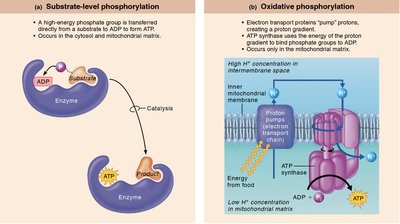
Substrate-level phosphorylation: Direct transfer of a phosphate group from a substrate to ADP, forming ATP.
Oxidative phosphorylation: ATP formation driven by the transfer of electrons through the electron transport chain, creating a proton gradient used by ATP synthase.
ATP: Adenosine triphosphate, the cell's energy currency.
ADP: Adenosine diphosphate, precursor to ATP.
Electron Transport Chain (ETC): Series of protein complexes in the inner mitochondrial membrane.
Key formula for oxidative phosphorylation:
Step-by-Step Guidance
Identify where each process occurs: substrate-level phosphorylation happens in the cytosol (during glycolysis) and mitochondrial matrix (during citric acid cycle), while oxidative phosphorylation occurs only in the inner mitochondrial membrane.
Describe substrate-level phosphorylation: a high-energy phosphate group is transferred directly from a substrate molecule to ADP by an enzyme, forming ATP.
Describe oxidative phosphorylation: electrons from NADH and FADH2 are passed through the electron transport chain, creating a proton gradient across the inner mitochondrial membrane.
Explain how the proton gradient powers ATP synthase: protons flow back into the mitochondrial matrix through ATP synthase, which catalyzes the formation of ATP from ADP and inorganic phosphate.
Compare the amount of ATP produced by each process and note that oxidative phosphorylation is responsible for the majority of ATP generated during cellular respiration.
Try solving on your own before revealing the answer!
Final Answer:
Substrate-level phosphorylation involves the direct transfer of a phosphate group from a substrate to ADP, forming ATP, and occurs in the cytosol and mitochondrial matrix. Oxidative phosphorylation uses the energy from electrons transferred through the electron transport chain to create a proton gradient, which powers ATP synthase to generate ATP in the inner mitochondrial membrane. Oxidative phosphorylation produces most of the ATP during cellular respiration.
Q5. Summarize the important events and products of glycolysis. (Include in your answer where in the cell glycolysis occurs and be sure to explain why the net gain of ATP is 2 rather than 4.)
Background
Topic: Glycolysis – Cellular Metabolism
This question tests your knowledge of the steps, location, and products of glycolysis, as well as your understanding of ATP yield.
Key Terms and Formulas:
Glycolysis: The metabolic pathway that breaks down glucose into pyruvic acid.
ATP: Energy currency of the cell.
NADH: Electron carrier produced during glycolysis.
Location: Cytosol of the cell.
Key formula:
Step-by-Step Guidance
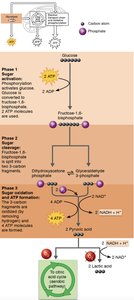
Identify the location: glycolysis occurs in the cytosol of cells.
Phase 1 – Sugar activation: glucose is phosphorylated twice, using two ATP molecules, and converted to fructose-1,6-bisphosphate.
Phase 2 – Sugar cleavage: fructose-1,6-bisphosphate is split into two 3-carbon fragments (glyceraldehyde 3-phosphate and dihydroxyacetone phosphate).
Phase 3 – Sugar oxidation and ATP formation: the two 3-carbon fragments are oxidized, NAD+ is reduced to NADH, and four ATP molecules are produced by substrate-level phosphorylation.
Calculate net ATP gain: although four ATP are produced, two are consumed in phase 1, resulting in a net gain of two ATP per glucose molecule.
Try solving on your own before revealing the answer!
Final Answer:
Glycolysis occurs in the cytosol and consists of three phases: sugar activation (uses 2 ATP), sugar cleavage (splits glucose into two 3-carbon fragments), and sugar oxidation/ATP formation (produces 4 ATP and 2 NADH). The net gain is 2 ATP because 2 ATP are used in the first phase and 4 are produced in the third phase. The products are 2 pyruvic acid, 2 NADH, and 2 ATP.
Q7. The citric acid cycle (also called the TCA cycle or Krebs cycle) begins with a 3-carbon citric acid molecule undergoing a series of redox reactions that removes H atoms and transfers them to the coenzymes NAD+ and FAD. Where does the TCA cycle occur? What are the products of each turn of the TCA cycle? How many times does the cycle “turn” per glucose molecule?
Background
Topic: Citric Acid Cycle (Krebs Cycle) – Cellular Respiration
This question tests your understanding of the location, products, and frequency of the citric acid cycle in glucose metabolism.
Key Terms and Formulas:
Citric Acid Cycle (Krebs Cycle): Series of reactions in the mitochondrial matrix that oxidize acetyl-CoA.
NADH and FADH2: Electron carriers produced during the cycle.
ATP: Produced by substrate-level phosphorylation.
CO2: Waste product released during decarboxylation steps.
Key formula:
Step-by-Step Guidance
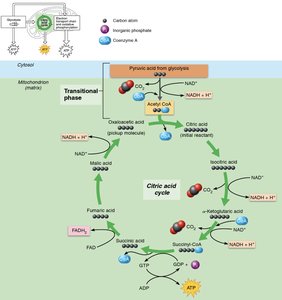
Identify the location: the citric acid cycle occurs in the mitochondrial matrix.
For each turn of the cycle, acetyl-CoA enters and undergoes a series of redox reactions, resulting in the removal of hydrogen atoms and transfer to NAD+ and FAD.
Each turn produces two CO2 molecules, three NADH, one FADH2, and one ATP (via substrate-level phosphorylation).
Since one glucose molecule yields two acetyl-CoA molecules, the cycle turns twice per glucose.
Summarize the total products per glucose by multiplying the products of one turn by two.
Try solving on your own before revealing the answer!
Final Answer:
The citric acid cycle occurs in the mitochondrial matrix. Each turn produces 2 CO2, 3 NADH, 1 FADH2, and 1 ATP. The cycle turns twice per glucose molecule, so the total products per glucose are 4 CO2, 6 NADH, 2 FADH2, and 2 ATP.
Q8. Summarize the important events and products of the electron transport chain (ETC). Where are the respiratory complexes of the ETC located? What is the energy source for the proton pumps of the ETC? What is the final electron acceptor for the ETC?
Background
Topic: Electron Transport Chain (ETC) – Cellular Respiration
This question tests your understanding of the ETC's function, location, energy source, and final electron acceptor.
Key Terms and Formulas:
Electron Transport Chain (ETC): Series of protein complexes in the inner mitochondrial membrane.
Proton Gradient: Created by pumping H+ ions across the membrane.
ATP Synthase: Enzyme that uses the proton gradient to synthesize ATP.
Final Electron Acceptor: Oxygen (O2).
Key formula:
Step-by-Step Guidance
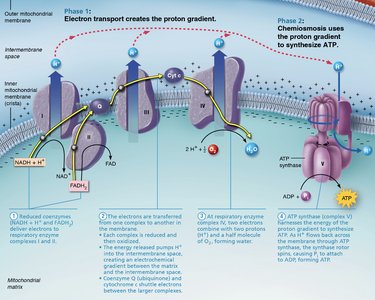
Identify the location: the ETC is located in the inner mitochondrial membrane.
Describe the process: NADH and FADH2 deliver electrons to the ETC, which are passed through a series of complexes.
As electrons move through the complexes, energy is released and used to pump protons (H+) into the intermembrane space, creating an electrochemical gradient.
ATP synthase harnesses the energy of the proton gradient to synthesize ATP as protons flow back into the matrix.
At the end of the chain, electrons combine with oxygen and protons to form water, making oxygen the final electron acceptor.
Try solving on your own before revealing the answer!
Final Answer:
The ETC is located in the inner mitochondrial membrane. NADH and FADH2 deliver electrons, which are passed through complexes, creating a proton gradient. ATP synthase uses this gradient to produce ATP. Oxygen is the final electron acceptor, forming water. The main products are water and about 28 ATP per glucose.
