 Indietro
Microbiology Foundations: Classification, Shapes, and Evolution
Guida di studio - Note intelligenti
 Appunti personalizzati basati sui tuoi materiali, ampliati con definizioni chiave, esempi e contesto.
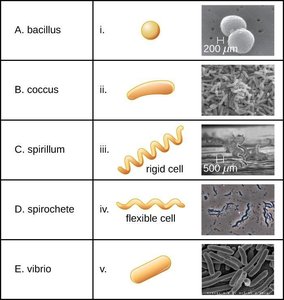
Q45. Match the bacterial shape with the illustration.
Background
Topic: Bacterial Morphology
This question tests your understanding of the different shapes of bacteria and your ability to identify them based on visual representations and descriptions.
Key Terms:
Bacillus: Rod-shaped bacterium
Coccus: Spherical bacterium
Spirillum: Rigid, spiral-shaped bacterium
Spirochete: Flexible, spiral-shaped bacterium
Vibrio: Comma-shaped bacterium
Step-by-Step Guidance
Review the descriptions and illustrations for each bacterial shape. Pay attention to the cell's rigidity, flexibility, and overall form.
Match the name of each shape (bacillus, coccus, spirillum, spirochete, vibrio) to the corresponding visual and description (i.–v.).
For example, identify which image shows a spherical cell (coccus) and which shows a rod-shaped cell (bacillus).
Look for spiral shapes and distinguish between rigid (spirillum) and flexible (spirochete) spirals.
Use the visual clues and the provided micrographs to help confirm your matches.
Try solving on your own before revealing the answer!
Final Answer:
A. bacillus = v. B. coccus = i. C. spirillum = iii. D. spirochete = iv. E. vibrio = ii.
Each bacterial shape is matched to its correct illustration and micrograph based on cell morphology.
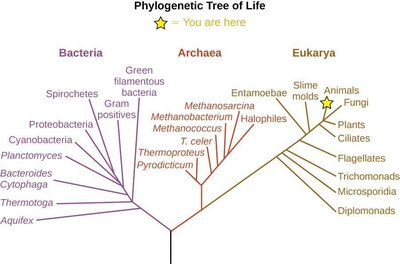
Q77. Consider the phylogenetic tree below. Explain how it shows the relationships between Bacteria, Archaea, and Eukarya, and their common ancestor. Of these three groups, which two are more closely related and how can you tell from the figure?
Background
Topic: Phylogenetic Relationships
This question tests your ability to interpret a phylogenetic tree and understand evolutionary relationships among the three domains of life: Bacteria, Archaea, and Eukarya.
Key Terms:
Phylogenetic tree: A diagram showing evolutionary relationships among organisms.
Common ancestor: The root of the tree from which all domains diverge.
Branching: Indicates evolutionary divergence.
Step-by-Step Guidance
Examine the root of the phylogenetic tree to identify the common ancestor shared by Bacteria, Archaea, and Eukarya.
Observe how the branches split from the root, noting which domains branch off together and which diverge separately.
Compare the proximity of the branches for Archaea and Eukarya versus Bacteria to determine which groups are more closely related.
Look for visual cues such as the length and direction of the branches to infer evolutionary relationships.
Try solving on your own before revealing the answer!
Final Answer:
The tree shows that Bacteria, Archaea, and Eukarya all branch from a single root, indicating a common ancestor. Archaea and Eukarya branch more closely together, suggesting they are more closely related to each other than either is to Bacteria. This is evident from the tree structure, where Archaea and Eukarya share a more recent common branch.
