 Indietro
Midterm Study Guide: Endocrine, Blood, Lymphatic, and Cardiovascular Systems
Guida di studio - Note intelligenti
 Appunti personalizzati basati sui tuoi materiali, ampliati con definizioni chiave, esempi e contesto.
Endocrine System
Major Organs and Hormones
The endocrine system is composed of glands that secrete hormones directly into the bloodstream to regulate body functions. Each gland produces specific hormones with distinct physiological effects.
Hypothalamus: Controls the pituitary and pineal glands; produces antidiuretic hormone (ADH) and oxytocin (OXT).
Posterior Pituitary: Releases ADH and OXT.
Pineal Gland: Secretes melatonin, which regulates circadian rhythms.
Anterior Pituitary: Produces ACTH (adrenocorticotropic hormone), TSH (thyroid-stimulating hormone), GH (growth hormone), PRL (prolactin), FSH (follicle-stimulating hormone), LH (luteinizing hormone), and MSH (melanocyte-stimulating hormone).
Thyroid: Produces T3 (triiodothyronine), T4 (thyroxine), and calcitonin (CT).
Parathyroid: Secretes parathyroid hormone (PTH).
Adrenal Glands: Medulla releases epinephrine (E) and norepinephrine (NE); Cortex produces cortisol, aldosterone, and androgens.
Pancreas: Secretes insulin and glucagon to regulate blood glucose.
Kidneys: Produce calcitriol, erythropoietin (EPO), and renin.
Thymus: Secretes thymosin, important for T-cell development.
Feedback Loops
Hormone secretion is regulated by feedback mechanisms:
Negative Feedback: The most common mechanism; a change in a physiological variable triggers a response that counteracts the initial change, maintaining homeostasis. Example: Increased blood glucose stimulates insulin release, which lowers glucose levels, reducing insulin secretion.
Positive Feedback: The response amplifies the original stimulus. Example: Oxytocin release during childbirth intensifies uterine contractions.
Blood
Major Components and Functions
Blood is a connective tissue with two main components:
Plasma (~55%): Contains water, proteins (albumin, globulins, fibrinogen), and solutes (electrolytes, nutrients, waste).
Formed Elements (~45%): Includes red blood cells (RBCs), white blood cells (WBCs), and platelets.
Five Functions of Blood:
Transport of gases, nutrients, hormones, and waste
Regulation of pH and ion composition
Restriction of fluid loss (hemostasis)
Defense against toxins and pathogens
Stabilization of body temperature
White Blood Cells (WBCs)
WBCs are classified by the presence or absence of granules:
Granulocytes:
Neutrophils: Phagocytize bacteria
Eosinophils: Target parasites and modulate allergic responses
Basophils: Release histamine in inflammatory reactions
Agranulocytes:
Lymphocytes: Mediate adaptive immunity (B and T cells)
Monocytes: Differentiate into macrophages for phagocytosis
Blood Cell Breakdown
Liver: Metabolizes hemoglobin breakdown products (bilirubin)
Spleen: Removes old RBCs and recycles iron
Kidneys: Excrete waste from hemoglobin metabolism
Hemostasis
Hemostasis is the process of stopping blood loss and involves four phases:
Vascular Spasm: Vasoconstriction reduces blood flow
Platelet Plug Formation: Platelets adhere to exposed collagen
Coagulation: Fibrin forms a stable clot
Clot Retraction and Repair: Tissue is repaired and clot dissolves
This is a positive feedback loop because each step amplifies the next until bleeding stops.
Lymphatic System
Major Parts and Roles
The lymphatic system returns interstitial fluid to the bloodstream and provides immune defense.
Lymph Vessels: Transport lymph fluid
Lymph Nodes: Filter lymph and house immune cells
Spleen: Filters blood, recycles RBCs, and stores WBCs
Thymus: Site of T-cell maturation
Tonsils: Protect against inhaled/ingested pathogens
Innate vs. Adaptive Immunity
Innate Immunity: Non-specific, immediate response; includes barriers (skin), phagocytes, NK cells, and inflammation. Characteristics: Rapid, no memory, general defense.
Adaptive Immunity: Specific, slower to develop, long-lasting. Characteristics: Specificity, memory, systemic response. Involves B and T lymphocytes.
Cellular and Humoral Immunity
Cellular Immunity: T cells recognize and destroy infected cells. Helper T cells enhance B cell response (humoral immunity).
Humoral Immunity: B cells produce antibodies that neutralize pathogens.
Long-term Immunity: Memory cells are produced for faster future responses.
Immune Cells and Molecules
T cells: Cell-mediated immunity
B cells: Antibody production
NK cells: Destroy abnormal cells
Interferons: Antiviral proteins
Perforins: Proteins that lyse target cells
APC cells: Present antigens to T cells
Interleukins: Cytokines that regulate immune responses
Cardiovascular/Circulatory System
Cardiac vs. Skeletal Muscle
Cardiac muscle is striated like skeletal muscle but has unique features:
Structure: Cardiac muscle cells are branched, interconnected by intercalated discs, and have a single nucleus. Skeletal muscle fibers are long, cylindrical, and multinucleated.
Function: Cardiac muscle contracts involuntarily and rhythmically; skeletal muscle contracts voluntarily.
Key Terms and Definitions
Stroke Volume (SV): Volume of blood pumped per beat
Cardiac Output (CO): Volume of blood pumped per minute
Preload: Degree of stretch of heart muscle before contraction
Afterload: Resistance the heart must overcome to eject blood
Systolic: Pressure during ventricular contraction
Diastolic: Pressure during ventricular relaxation
Angiogenesis: Formation of new blood vessels
End-Diastolic Volume (EDV): Volume of blood in ventricle at end of filling
Vasoconstriction: Narrowing of blood vessels
Vasodilation: Widening of blood vessels
Syncope: Temporary loss of consciousness (fainting)
Endocarditis: Inflammation of the heart's inner lining
Myocarditis: Inflammation of the heart muscle
Fibrillation: Rapid, irregular heart contractions
Cardiac Action Potential
The cardiac action potential is essential for coordinated heart contraction. It consists of several phases:
Phase 0 (Depolarization): Rapid Na+ influx
Phase 1 (Initial Repolarization): Na+ channels close, K+ efflux
Phase 2 (Plateau): Ca2+ influx balances K+ efflux
Phase 3 (Repolarization): Ca2+ channels close, K+ efflux continues
Phase 4 (Resting Potential): Leaky K+ channels maintain resting state
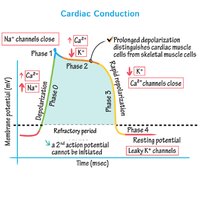
Refractory Period: A second action potential cannot be initiated, ensuring proper heart rhythm.
Heart Anatomy and Blood Flow
The heart is a four-chambered organ that pumps blood through two circuits: pulmonary (to the lungs) and systemic (to the body).
Right Atrium: Receives deoxygenated blood from the body
Right Ventricle: Pumps blood to the lungs
Left Atrium: Receives oxygenated blood from the lungs
Left Ventricle: Pumps blood to the body
Valves: Ensure one-way flow (tricuspid, pulmonary, mitral, aortic)
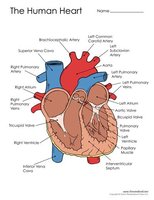
Blood Flow Pathway: Body → Right Atrium → Right Ventricle → Lungs → Left Atrium → Left Ventricle → Body
Chamber | Receives Blood From | Pumps Blood To |
|---|---|---|
Right Atrium | Body (via vena cavae) | Right Ventricle |
Right Ventricle | Right Atrium | Lungs (via pulmonary artery) |
Left Atrium | Lungs (via pulmonary veins) | Left Ventricle |
Left Ventricle | Left Atrium | Body (via aorta) |
