 Indietro
Muscle Contraction and Energy in Human Anatomy & Physiology
Guida di studio - Note intelligenti
 Appunti personalizzati basati sui tuoi materiali, ampliati con definizioni chiave, esempi e contesto.
Muscles and Muscle Tissue
Whole Muscle Contraction
Muscle contraction is a fundamental process in the human body, enabling movement and force generation. The principles governing contraction apply to both individual muscle fibers and entire muscles.
Muscle tension: The force exerted by a muscle on a load or object.
Isometric contraction: Muscle tension increases but does not exceed the load; muscle does not shorten.
Isotonic contraction: Muscle shortens because muscle tension exceeds the load.
Motor Units
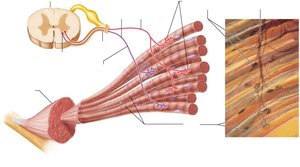
A motor unit is the basic functional unit of muscle contraction, consisting of a motor neuron and all the muscle fibers it innervates. The number of fibers per motor unit determines the precision of control.
Smaller motor units allow for finer control.
Muscle fibers from a motor unit are distributed throughout the muscle, so stimulation causes weak contraction of the whole muscle.
The Muscle Twitch
A muscle twitch is the simplest contraction, resulting from a single action potential. It consists of three phases:
Latent period: Excitation-contraction coupling; no tension.
Period of contraction: Cross bridge formation; tension increases.
Period of relaxation: Ca2+ reentry into the sarcoplasmic reticulum; tension declines.
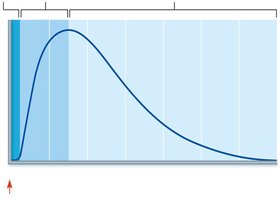
Differences in twitch strength and duration are due to metabolic properties and enzyme variations between muscles.
Graded Muscle Responses
Normal muscle contraction is smooth and varies in strength according to demand. Graded responses are achieved by changing the frequency and strength of stimulation.
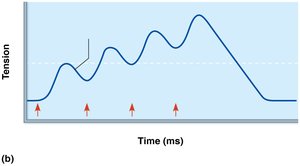
Frequency: Increasing stimulus frequency leads to temporal (wave) summation.
Strength: Recruitment of more motor units increases contraction strength.
Temporal Summation
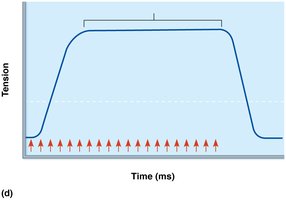
When stimuli are delivered rapidly, muscle fibers do not fully relax, resulting in increased force. This can progress to:
Unfused (incomplete) tetanus: Sustained, quivering contraction.
Fused (complete) tetanus: Smooth, sustained contraction plateau; no relaxation between stimuli.
Recruitment (Multiple Motor Unit Summation)
Recruitment involves activating more motor units to increase contraction strength. It follows the size principle:
Smallest motor units are recruited first.
Larger motor units are recruited as stimulus intensity increases.
Motor units contract asynchronously to prevent fatigue.
Muscle Tone
Muscle tone is the constant, slightly contracted state of all muscles, maintained by spinal reflexes. It keeps muscles firm, healthy, and ready to respond.
Isotonic and Isometric Contractions
Muscle contractions can be classified as isotonic or isometric:
Isotonic contractions: Muscle changes length and moves a load. Includes concentric (muscle shortens) and eccentric (muscle lengthens) contractions.
Isometric contractions: Muscle tension increases but the muscle does not change length.
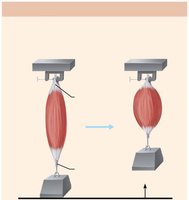
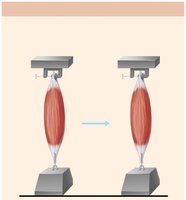
Electrochemical and mechanical events are similar in both types, but only isotonic contractions result in movement.
Energy for Contraction and ATP
ATP in Muscle Contraction
ATP is essential for muscle contraction, powering cross bridge movement, calcium pumping, and restoring ion gradients. Muscle stores of ATP are depleted quickly and must be regenerated.
Mechanisms of ATP Regeneration
Direct phosphorylation: Creatine phosphate (CP) donates a phosphate to ADP, forming ATP. Duration: ~15 seconds.
Anaerobic pathway: Glycolysis breaks down glucose to pyruvic acid, generating 2 ATP per glucose. In low oxygen, pyruvic acid is converted to lactic acid. Duration: 30–40 seconds.
Aerobic pathway: Occurs in mitochondria, requires oxygen, and produces up to 32 ATP per glucose. Fuels include glucose, fatty acids, and amino acids. Duration: Hours.
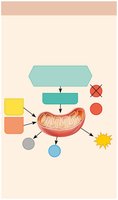
Energy Systems During Exercise
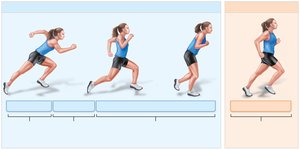
Different energy systems are used depending on exercise duration and intensity:
Short-duration, high-intensity exercise: Relies on stored ATP, creatine phosphate, and anaerobic glycolysis.
Prolonged-duration exercise: Relies on aerobic respiration.
Muscle Fatigue
Muscle fatigue is the inability to contract despite continued stimulation. Causes include:
Ionic imbalances (K+, Na+, Ca2+).
Increased inorganic phosphate (Pi).
Decreased ATP and increased magnesium.
Decreased glycogen.
Excess Postexercise Oxygen Consumption (EPOC)
After exercise, muscles require extra oxygen to replenish reserves, convert lactic acid, restore glycogen, and resynthesize ATP and creatine phosphate. This is known as EPOC, formerly called "oxygen debt."
Summary Table: Pathways for ATP Regeneration
Pathway | Oxygen Use | Products | ATP Yield | Duration |
|---|---|---|---|---|
Direct Phosphorylation | None | ATP, Creatine | 1 ATP per CP | ~15 seconds |
Anaerobic Glycolysis | None | ATP, Lactic Acid | 2 ATP per glucose | 30–40 seconds |
Aerobic Respiration | Required | ATP, CO2, H2O | 32 ATP per glucose | Hours |
Summary Table: Types of Muscle Contraction
Type | Muscle Length | Movement | Example |
|---|---|---|---|
Isotonic (Concentric) | Shortens | Yes | Biceps lifting a book |
Isotonic (Eccentric) | Lengthens | Yes | Biceps lowering a book |
Isometric | No change | No | Holding a weight steady |
