 Indietro
Muscle Contraction and Energy in Skeletal Muscle Chapter 9B
Guida di studio - Note intelligenti
 Appunti personalizzati basati sui tuoi materiali, ampliati con definizioni chiave, esempi e contesto.
Muscle Contraction: Principles and Types
Whole Muscle Contraction
Muscle contraction is governed by the same principles whether it occurs in a single muscle fiber or an entire muscle. The process produces muscle tension, which is the force exerted on a load or object to be moved. Contraction may or may not result in muscle shortening, depending on the type of contraction.
Isometric contraction: Muscle tension increases but does not exceed the load, so the muscle does not shorten.
Isotonic contraction: Muscle tension exceeds the load, resulting in muscle shortening.
Motor Units
A motor unit consists of a motor neuron and all the muscle fibers it innervates. The number of fibers per motor unit varies, affecting the degree of fine control. Muscle fibers from a motor unit are distributed throughout the muscle, so stimulation of a single motor unit causes only a weak contraction of the entire muscle.
Smaller motor units allow for greater fine control.
Motor units contract asynchronously to prevent fatigue.
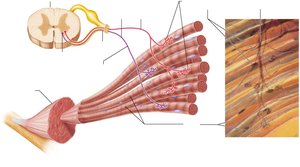
Muscle Twitch and Graded Responses
Muscle Twitch
A muscle twitch is the simplest contraction, resulting from a muscle fiber’s response to a single action potential. It consists of three phases:
Latent period: Excitation-contraction coupling occurs; no tension is seen.
Period of contraction: Cross bridge formation; tension increases.
Period of relaxation: Ca2+ reentry into the sarcoplasmic reticulum; tension declines to zero.
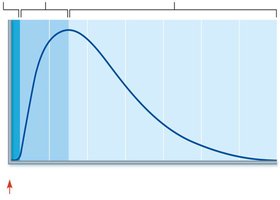
Differences in twitch strength and duration are due to variations in metabolic properties and enzymes between muscles.
Graded Muscle Responses
Normal muscle contraction is smooth and strength varies with needs. Graded responses are required for proper control of skeletal movement and are achieved by changing the frequency and strength of stimulation.
Frequency: Increasing stimulus frequency leads to wave (temporal) summation, unfused tetanus, and fused tetanus.
Strength: Recruitment of additional motor units increases contraction strength.
Temporal Summation
When two stimuli are received in rapid succession, muscle fibers do not fully relax, resulting in increased force. Higher frequencies lead to unfused (incomplete) tetanus, and at even higher frequencies, fused (complete) tetanus occurs.
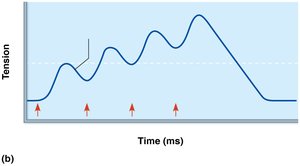
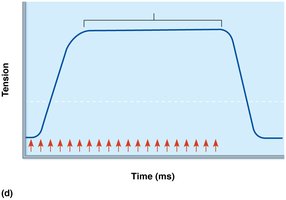
Recruitment and Size Principle
Recruitment involves activating more motor units to increase contraction strength. Motor units with smaller fibers are recruited first, followed by larger units as stimulus intensity increases.
Muscle Tone and Types of Contraction
Muscle Tone
Muscle tone is a constant, slightly contracted state of all muscles, maintained by spinal reflexes. It keeps muscles firm, healthy, and ready to respond.
Isotonic and Isometric Contractions
Isotonic contractions involve muscle length changes and movement of a load. They can be:
Concentric: Muscle shortens and does work (e.g., lifting a book).
Eccentric: Muscle lengthens while generating force (e.g., lowering a book).
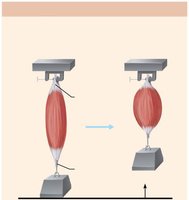
Isometric contractions occur when the load is greater than the maximum tension the muscle can generate, so the muscle neither shortens nor lengthens.
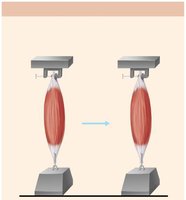
Electrochemical and mechanical events are the same in both types, but in isotonic contractions, actin filaments shorten and cause movement, while in isometric contractions, cross bridges generate force without shortening actin filaments.
Energy for Muscle Contraction
ATP and Its Regeneration
ATP is the only source of energy for contractile activities and must be regenerated quickly. Muscle fibers have limited ATP stores, which are depleted in 4–6 seconds. ATP is regenerated by three mechanisms:
Direct phosphorylation: Creatine phosphate (CP) donates a phosphate to ADP to form ATP. This process is catalyzed by creatine kinase and lasts about 15 seconds.
Anaerobic pathway: Glycolysis breaks down glucose into pyruvic acid, generating 2 ATP per glucose. In low oxygen, pyruvic acid is converted to lactic acid.
Aerobic pathway: Occurs in mitochondria, requires oxygen, and produces up to 32 ATP per glucose. Fuels include glucose, fatty acids, and amino acids.
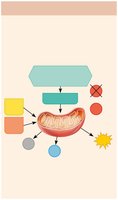
Energy Systems During Exercise
During short-duration, high-intensity exercise, ATP is supplied first by stored ATP, then by creatine phosphate, and finally by anaerobic glycolysis. For prolonged-duration exercise, aerobic pathways predominate.
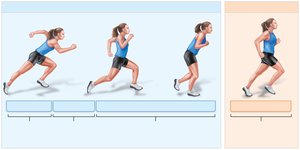
Muscle Fatigue and Recovery
Muscle Fatigue
Muscle fatigue is the physiological inability to contract despite continued stimulation. Causes include ionic imbalances, increased inorganic phosphate, decreased ATP, increased magnesium, and decreased glycogen. Lack of ATP is rarely the cause except in severely stressed muscles.
Excess Postexercise Oxygen Consumption (EPOC)
After exercise, muscles require extra oxygen to replenish reserves, reconvert lactic acid to pyruvic acid, replace glycogen stores, and resynthesize ATP and creatine phosphate. This process is known as excess postexercise oxygen consumption (EPOC), formerly called "oxygen debt."
