 Indietro
Muscle Contraction and Energy Metabolism: Study Notes for Anatomy & Physiology
Guida di studio - Note intelligenti
 Appunti personalizzati basati sui tuoi materiali, ampliati con definizioni chiave, esempi e contesto.
Muscles and Muscle Tissue
Whole Muscle Contraction
Muscle contraction is governed by the same principles in both single muscle fibers and whole muscles. The process produces muscle tension, which is the force exerted on a load or object to be moved. Muscle contraction may or may not result in muscle shortening, depending on the type of contraction:
Isometric contraction: Muscle tension increases but does not exceed the load, so the muscle does not shorten.
Isotonic contraction: Muscle tension exceeds the load, causing the muscle to shorten.
Motor Units and Muscle Control
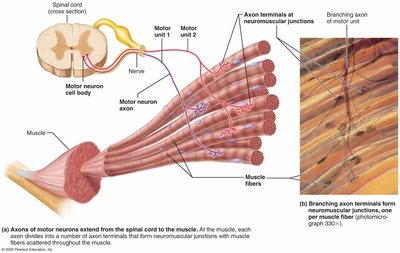
Each muscle is innervated by at least one motor nerve, which contains axons of multiple motor neurons. These axons branch into terminals that form neuromuscular junctions (NMJs) with individual muscle fibers. The motor unit is the functional unit consisting of a motor neuron and all the muscle fibers it supplies. Motor units allow for fine control of muscle contraction, especially when the number of fibers per unit is small.
Muscle fibers from a motor unit are distributed throughout the muscle, so stimulation of a single motor unit causes only a weak contraction of the entire muscle.
The Muscle Twitch
A muscle twitch is the simplest contraction, resulting from a muscle fiber's response to a single action potential from a motor neuron. It can be observed and recorded as a myogram, which traces contraction activity. The muscle twitch consists of three phases:
Latent period: Events of excitation-contraction coupling occur; no muscle tension is seen.
Period of contraction: Cross bridge formation occurs; tension increases.
Period of relaxation: Ca2+ reentry into the sarcoplasmic reticulum (SR); tension declines to zero.
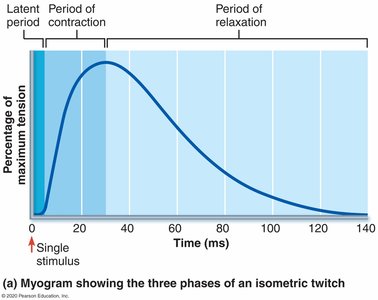
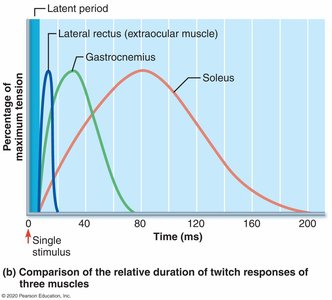
Muscle contracts faster than it relaxes. Differences in strength and duration of twitches are due to variations in metabolic properties and enzymes between muscles. For example, eye muscles contract rapidly and briefly, while larger muscles like the calf contract more slowly and sustain contraction longer.
Graded Muscle Responses
Muscle Response to Stimulus Frequency
Normal muscle contraction is smooth, and strength varies with needs. Graded muscle responses are required for proper control of skeletal movement and are achieved by changing the frequency and strength of stimulation.
Single stimulus: Results in a single contractile response (muscle twitch).
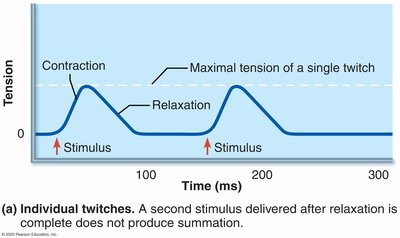
Wave (temporal) summation: Occurs when two stimuli are received in rapid succession. Muscle fibers do not fully relax between stimuli, so twitches increase in force. Additional Ca2+ released with the second stimulus stimulates more shortening.
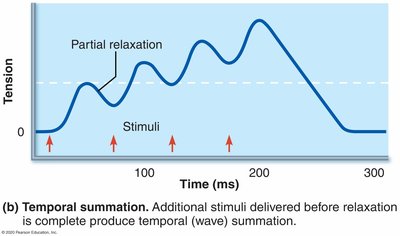
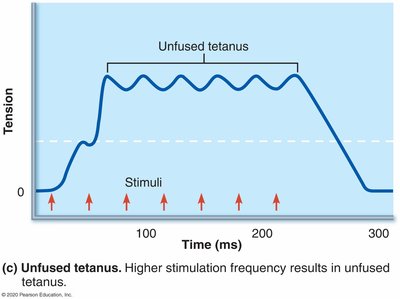
Unfused (incomplete) tetanus: As stimulus frequency increases, muscle tension reaches near maximum, producing smooth, continuous contractions. Further increase leads to sustained, quivering contraction.
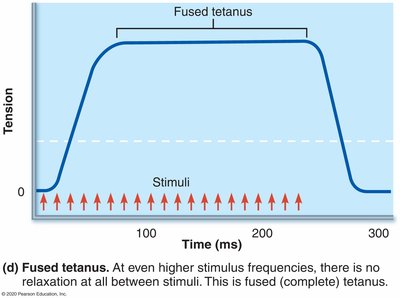
Fused (complete) tetanus: At even higher stimulus frequencies, there is no relaxation between stimuli, resulting in a smooth, sustained contraction plateau. Prolonged contractions can lead to muscle fatigue.
Muscle Response to Stimulus Strength
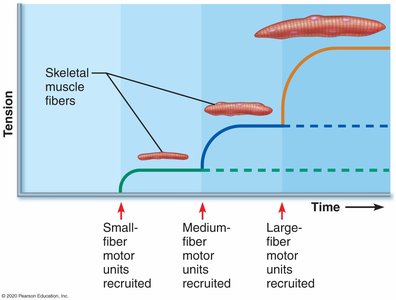
Recruitment, or multiple motor unit summation, involves sending stimuli to more muscle fibers for more precise control. Types of stimulus involved:
Subthreshold stimulus: Not strong enough to cause contraction.
Threshold stimulus: Strong enough to cause the first observable contraction.
Maximal stimulus: Strongest stimulus that increases maximum contractile force; all motor units have been recruited.
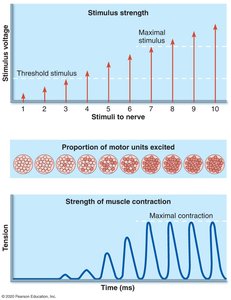
Recruitment works on the size principle: motor units with the smallest muscle fibers are recruited first, followed by larger fibers as stimulus intensity increases. Largest motor units are activated only for the most powerful contractions. Motor units contract asynchronously to help prevent fatigue.
Muscle Tone
Muscle tone is the constant, slightly contracted state of all muscles, maintained by spinal reflexes. Groups of motor units are alternately activated in response to input from stretch receptors in muscles. Muscle tone keeps muscles firm, healthy, and ready to respond.
Isotonic and Isometric Contractions
Types of Contractions
Isotonic contractions: Muscle changes length and moves a load. Can be concentric (muscle shortens and does work, e.g., biceps contract to pick up a book) or eccentric (muscle lengthens while generating force, e.g., laying a book down causes biceps to lengthen).
Isometric contractions: Load is greater than the maximum tension muscle can generate, so muscle neither shortens nor lengthens.
Electrochemical and mechanical events are the same in both types, but results differ. In isotonic contractions, actin filaments shorten and cause movement. In isometric contractions, cross bridges generate force, but actin filaments do not shorten; myosin heads "spin their wheels" on the same actin-binding site.
Energy for Contraction and ATP
ATP and Muscle Contraction
ATP supplies the energy needed for muscle fibers to:
Move and detach cross bridges
Pump calcium back into the SR
Pump Na+ out and K+ back into the cell after excitation-contraction coupling
Available stores of ATP are depleted in 4–6 seconds, so ATP must be regenerated quickly. ATP is the only source of energy for contractile activities.
Mechanisms of ATP Regeneration
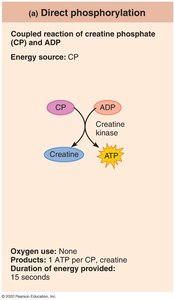
Direct phosphorylation of ADP by creatine phosphate (CP): Creatine phosphate donates a phosphate to ADP to instantly form ATP. Creatine kinase is the enzyme responsible. Muscle fibers have enough ATP and CP reserves to power contraction for about 15 seconds. Equation:
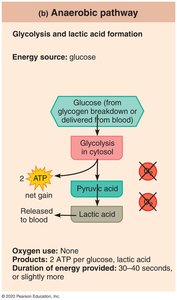
Anaerobic pathway (glycolysis and lactic acid formation): ATP is generated by breaking down glucose. Glycolysis does not require oxygen and produces 2 ATP per glucose. At high intensity, low oxygen prevents pyruvic acid from entering aerobic respiration, so it is converted to lactic acid. Lactic acid diffuses into the bloodstream and is used as fuel or converted back to pyruvic acid or glucose by the liver. Anaerobic respiration yields only 5% as much ATP as aerobic respiration but produces ATP 2.5 times faster. Equation:
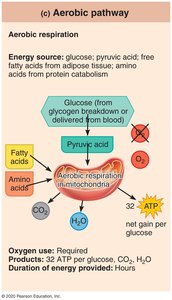
Aerobic pathway: Produces 95% of ATP during rest and light-to-moderate exercise. Slower than anaerobic pathway. Occurs in mitochondria and requires oxygen. Breaks glucose into CO2, H2O, and produces a large amount of ATP (up to 32 per glucose). Fuels include glucose from glycogen, bloodborne glucose, and free fatty acids. Fatty acids become the main fuel after 30 minutes of exercise. Equation:
Energy Systems During Exercise
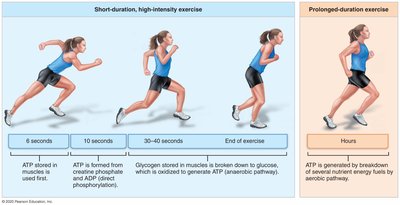
During short-duration, high-intensity exercise, ATP stored in muscles is used first, followed by ATP formed from creatine phosphate and ADP, and then ATP generated from glycolysis. For prolonged-duration exercise, ATP is generated by breakdown of several nutrient energy fuels by the aerobic pathway.
Muscle Fatigue
Causes of Muscle Fatigue
Muscle fatigue is the physiological inability to contract despite continued stimulation. Possible causes include:
Ionic imbalances (K+, Na+, Ca2+) disrupting membrane potential
Increased inorganic phosphate (Pi) from CP and ATP breakdown interfering with calcium release or power generation
Decreased ATP and increased magnesium, which can interfere with voltage-sensitive T tubule proteins
Decreased glycogen
Lack of ATP is rarely a reason for fatigue, except in severely stressed muscles.
Excess Postexercise Oxygen Consumption (EPOC)
After exercise, muscles must return to their pre-exercise state. This involves replenishing oxygen reserves, reconverting lactic acid to pyruvic acid, replacing glycogen stores, and resynthesizing ATP and creatine phosphate reserves. All these steps require extra oxygen, referred to as excess postexercise oxygen consumption (EPOC), formerly known as "oxygen debt."
