Indietro
Muscle Contraction and Physiology: Study Notes for Anatomy & Physiology
Guida di studio - Note intelligenti
 Appunti personalizzati basati sui tuoi materiali, ampliati con definizioni chiave, esempi e contesto.
Muscle Contraction and Physiology
Neuromuscular Junction
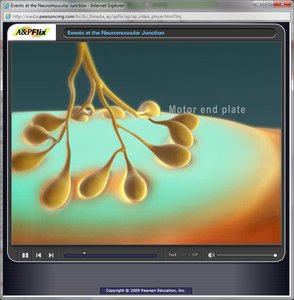
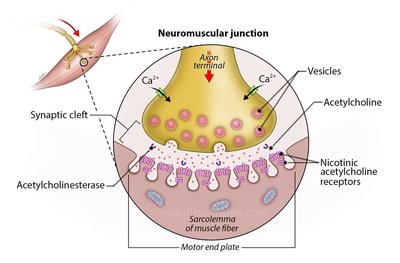
The neuromuscular junction is the site where a motor neuron communicates with a skeletal muscle fiber, enabling muscle contraction. This specialized synapse involves the release of neurotransmitters and the activation of muscle cell receptors.
Motor Neurons: Skeletal muscles are stimulated by motor neurons of the somatic nervous system.
Acetylcholine (ACh): The neurotransmitter released at the neuromuscular junction, which binds to receptors on the sarcolemma (muscle cell membrane).
Synaptic Cleft: The gap between the axon terminal and the muscle fiber where ACh is released.
Acetylcholinesterase: An enzyme in the synaptic cleft that breaks down ACh, terminating the signal.
End Plate Potential: Local depolarization at the motor end plate leads to action potentials (APs) in both directions along the sarcolemma.
Depolarization and Repolarization: Sodium (Na+) influx causes depolarization, followed by potassium (K+) efflux for repolarization.
Na+/K+ Pump: Always working to restore correct ion distributions.
All-or-None Response: Once initiated, the AP triggers Ca2+ release from the sarcoplasmic reticulum, leading to contraction.
Motor Units and Graded Muscle Responses
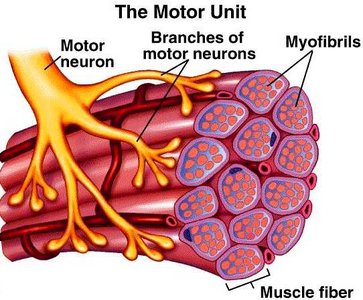
A motor unit consists of a motor neuron and all the muscle fibers it innervates. Muscle responses can be graded to produce smooth, sustained contractions of varying strengths.
Motor Unit: One motor neuron and all the muscle fibers it supplies.
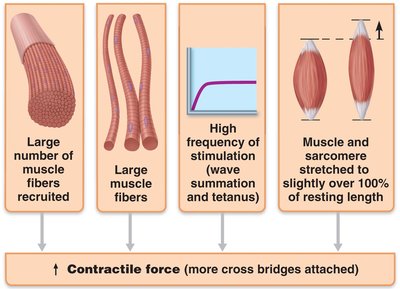
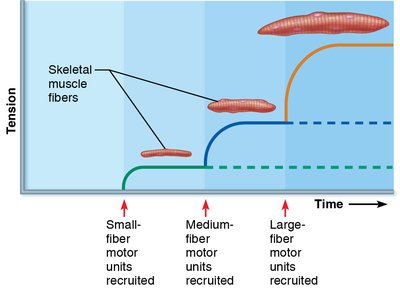
Recruitment: Increasing the number of active motor units increases contraction strength.
Graded Responses: Achieved by changing the frequency of stimulation and the number of motor units activated.
Small Motor Units: Control fine movements; large motor units are for powerful contractions.
Muscle Tone and Summation
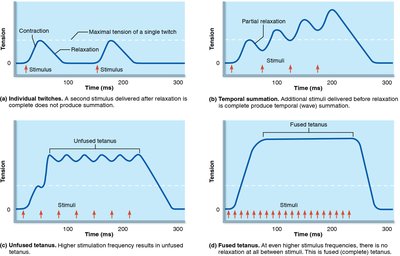
Muscle tone is the constant, slightly contracted state of all muscles, maintained by spinal reflexes. Summation refers to the additive effect of multiple stimuli.
Muscle Tone: Even relaxed muscle is slightly contracted due to spinal reflexes.
Wave Summation: Rapid stimulation increases contraction strength.
Tetanus: Fused tetanus occurs when stimuli are so frequent that relaxation does not occur between contractions.
Types of Muscle Contractions
Muscle contractions are classified as isotonic or isometric, depending on whether the muscle changes length or not.
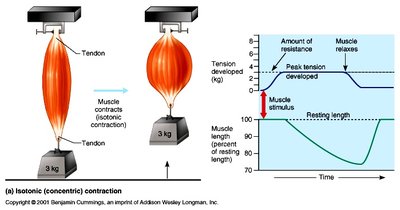
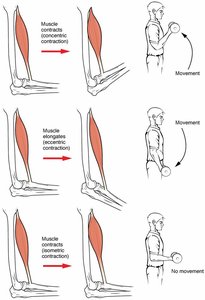
Isotonic Contraction: Muscle changes length and moves a load. Includes concentric (muscle shortens) and eccentric (muscle lengthens) contractions.
Eccentric Contraction: More forceful, uses less ATP, but more prone to delayed-onset soreness.
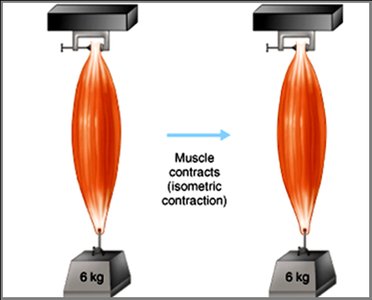
Isometric Contraction: Tension increases, but muscle length remains the same.
Most Movements: Are a mix of isotonic and isometric contractions.

Length-Tension Relationship
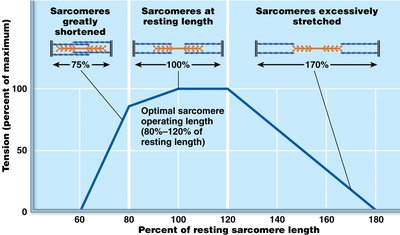
The force a muscle can generate depends on its length at the time of stimulation. Optimal tension occurs when the muscle is slightly stretched.
Optimal Length: Sarcomeres at 80–120% of resting length produce maximal tension.
Too Short/Too Stretched: Reduces the number of cross-bridges and decreases force.