Indietro
Muscle Contraction: The Cross-Bridge Cycle
Guida di studio - Note intelligenti
 Appunti personalizzati basati sui tuoi materiali, ampliati con definizioni chiave, esempi e contesto.
Muscle Contraction: The Cross-Bridge Cycle
Overview of the Cross-Bridge Cycle
The cross-bridge cycle is a fundamental process in muscle contraction, involving the interaction between actin and myosin filaments within muscle fibers. This cycle is powered by ATP and is essential for the sliding filament mechanism that enables muscles to contract and generate force.
Actin: A thin filament protein that forms the backbone of the muscle fiber.
Myosin: A thick filament protein with heads that bind to actin and pull it during contraction.
ATP: Adenosine triphosphate, the energy molecule required for muscle contraction.
Steps of the Cross-Bridge Cycle
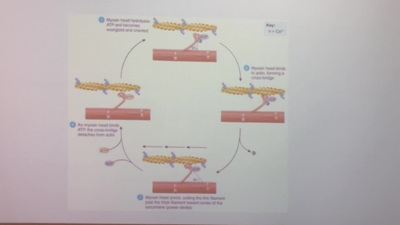
Cross-Bridge Formation: Myosin head binds to actin, forming a cross-bridge.
Power Stroke: Myosin head pivots, pulling the actin filament toward the center of the sarcomere. This movement is known as the power stroke.
Cross-Bridge Detachment: ATP binds to the myosin head, causing it to detach from actin.
Reactivation of Myosin Head: ATP is hydrolyzed to ADP and inorganic phosphate (Pi), re-energizing and reorienting the myosin head for another cycle.
Example: During skeletal muscle contraction, repeated cycles of cross-bridge formation and detachment result in the shortening of muscle fibers, producing movement.
Key Points
The cross-bridge cycle is essential for muscle contraction and movement.
ATP is required both for detachment of the myosin head and for its reactivation.
The process is cyclical and continues as long as calcium ions and ATP are available.