 Indietro
Muscle Physiology: Contraction, Energy, and Mechanics
Guida di studio - Note intelligenti
 Appunti personalizzati basati sui tuoi materiali, ampliati con definizioni chiave, esempi e contesto.
Muscle Contraction: Summation and Tetanus
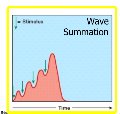
Wave Summation
Wave summation occurs when successive stimuli are delivered to a muscle before it has completely relaxed, resulting in a greater force of contraction. This process is fundamental to understanding how muscles can increase their strength output in response to increased frequency of stimulation.
Definition: The additive effect of multiple muscle twitches due to repeated stimulation.
Mechanism: Each new stimulus arrives before the previous contraction has fully relaxed, causing the contractions to build upon each other.
Example: Rapid tapping of a finger increases the force generated by the muscle.
Incomplete Tetanus
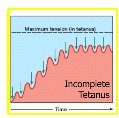
Incomplete tetanus is achieved when the muscle is stimulated at a frequency high enough to produce sustained, but fluctuating, contractions. The muscle does not fully relax between stimuli, resulting in a wavy, sustained contraction.
Definition: A state of partial sustained contraction with some relaxation between stimuli.
Mechanism: Stimuli are frequent, but not so frequent as to eliminate all relaxation.
Example: Shivering muscles during cold exposure.
Complete Tetanus
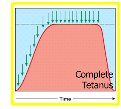
Complete tetanus occurs when the frequency of stimulation is so high that there is no relaxation between stimuli, resulting in a smooth, sustained contraction at maximum tension.
Definition: A state of maximal, continuous muscle contraction with no relaxation.
Mechanism: Rapid, repeated stimuli fuse individual twitches into a single, powerful contraction.
Example: Lifting a heavy object with maximal effort.
Muscle Mechanics: Levers in the Human Body
Types of Levers
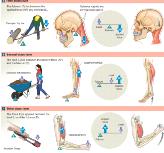
Levers are rigid structures that move around a fixed point called a fulcrum. Muscles, bones, and joints form lever systems in the body, which are classified based on the relative positions of the fulcrum, effort, and load.
First-Class Lever: The fulcrum is between the effort and the load (e.g., neck muscles lifting the head).
Second-Class Lever: The load is between the fulcrum and the effort (e.g., standing on tiptoe).
Third-Class Lever: The effort is between the fulcrum and the load (e.g., biceps flexing the forearm).
Levers in the body allow for a balance between force and speed, depending on their arrangement.
Muscle Energy Metabolism
ATP Production in Muscle Cells
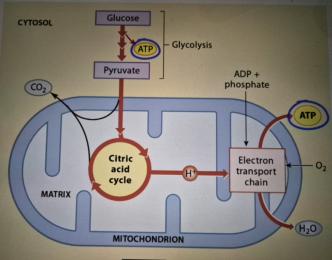
Muscle contraction requires ATP, which is generated through several metabolic pathways. The main sources of ATP in muscle cells are creatine phosphate, glycolysis, and aerobic respiration.
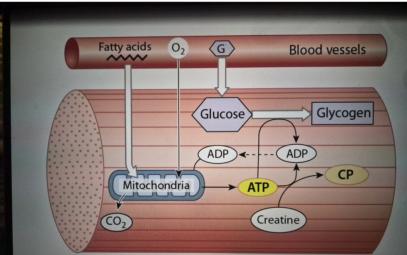
Creatine Phosphate: Provides a rapid, short-term supply of ATP by transferring a phosphate group to ADP.
Glycolysis: Anaerobic breakdown of glucose to produce ATP and pyruvate; occurs in the cytosol.
Aerobic Respiration: Occurs in mitochondria, using oxygen to produce large amounts of ATP from glucose, fatty acids, and other substrates.
Muscle Cell Energy Sources
Muscle cells utilize various substrates for energy, including glucose, glycogen, fatty acids, and creatine phosphate. The choice of substrate depends on the intensity and duration of activity.
Glucose and Glycogen: Used for both anaerobic and aerobic ATP production.
Fatty Acids: Used primarily during prolonged, moderate activity.
Creatine Phosphate: Used for short bursts of intense activity.
Comparison of Muscle Energy Pathways
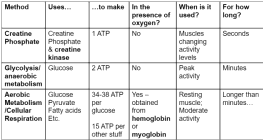
The table below summarizes the main methods of ATP production in muscle cells, their uses, oxygen requirements, and duration of activity supported.
Method | Uses... | ...to make | In the presence of oxygen? | When is it used? | For how long? |
|---|---|---|---|---|---|
Creatine Phosphate | Creatine Phosphate & creatine kinase | 1 ATP | No | Muscles changing activity levels | Seconds |
Glycolysis/anaerobic metabolism | Glucose | 2 ATP | No | Peak activity | Minutes |
Aerobic Metabolism/Cellular Respiration | Glucose, Pyruvate, Fatty acids, etc. | 34-38 ATP per glucose 15 ATP per other stuff | Yes – obtained from hemoglobin or myoglobin | Resting muscle; Moderate activity | Longer than minutes... |
Summary
Muscle physiology encompasses the mechanisms of contraction, the role of levers in movement, and the metabolic pathways that supply energy for muscle activity. Understanding these concepts is essential for comprehending how muscles function during various types of physical activity.
