 Indietro
Muscle Physiology: Motor Units, Contraction, and Metabolism
Guida di studio - Note intelligenti
 Appunti personalizzati basati sui tuoi materiali, ampliati con definizioni chiave, esempi e contesto.
Muscle Physiology
Skeletal Muscle Motor Units
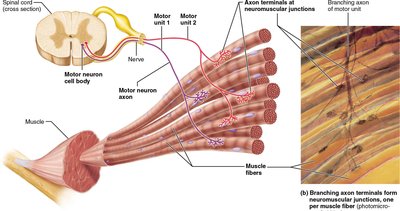
Skeletal muscle fibers are organized into motor units, which are fundamental for muscle contraction and control. A motor unit consists of a motor neuron and all the muscle fibers it innervates.
Motor Unit: The combination of a motor neuron and the muscle fibers it synapses with.
Size Variation: Motor units can be small (few fibers, e.g., larynx, eyes) or large (hundreds to thousands, e.g., biceps, gastrocnemius).
Distribution: Muscle fibers of each unit are spread throughout the muscle for smooth, efficient operation.
Myogram: Recording Muscle Contraction
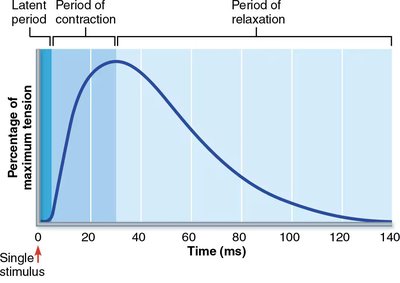
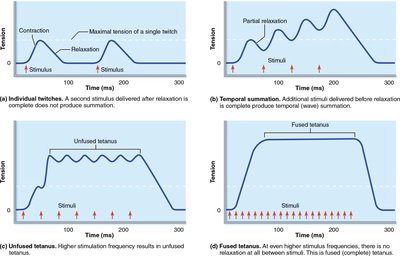
A myogram is a graphical recording of muscle contraction in response to a stimulus. It illustrates the phases of a muscle twitch.
Stimulus: A nerve impulse or electrical charge triggers contraction.
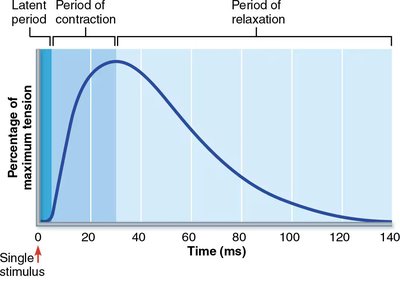
Twitch: The response of a muscle to a single stimulation.
Phases: Latent period (delay), contraction phase (tension/shortening), relaxation phase (lengthening).
Muscle Twitches and the All-or-None Rule
Muscle fibers within a motor unit contract fully when stimulated, following the all-or-none principle.
All-or-None Rule: All fibers in a motor unit contract completely when stimulated.
Graded Muscle Responses
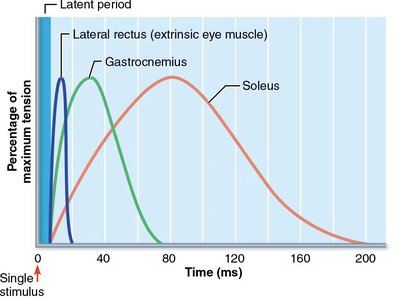
The force of muscle contraction can be varied to meet different functional demands. This is achieved by altering stimulation frequency, stimulus strength, and muscle length.
Temporal Summation: Increasing frequency of stimulation leads to stronger contractions.
Recruitment: Increasing stimulus strength activates more motor units.
Length-Tension Relationship: Changing muscle length affects contraction force.
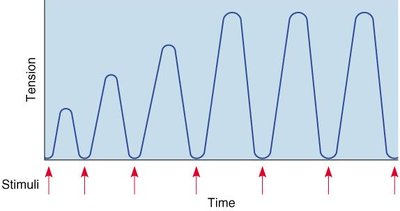
Treppen: The Staircase Effect
Treppen describes the phenomenon where repeated stimulation of a muscle fiber results in progressively stronger contractions, often referred to as the "warming up" effect.
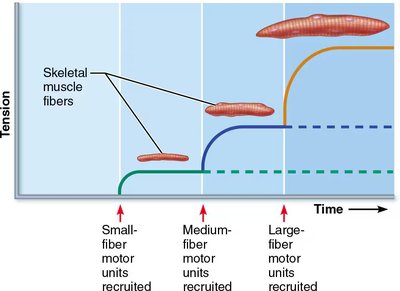
Multiple Motor Unit Summation (Recruitment)
Recruitment is the process of activating additional motor units to increase the force of muscle contraction. The size principle governs the order of recruitment.
Size Principle: Small motor units are recruited first; large units are recruited for powerful contractions.
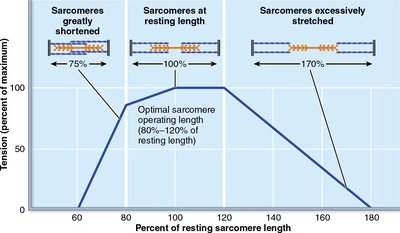
Stretch: Length-Tension Relationship
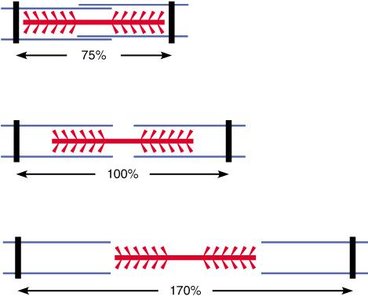
The degree of muscle stretch determines the number of cross bridges formed and thus the tension produced. Optimal sarcomere length allows maximum tension.
Optimal Length (Lo): Maximum cross bridges, no overlap of actin fibers from opposite ends.
Normal Range: 70-130% of Lo.
Types of Muscle Contraction
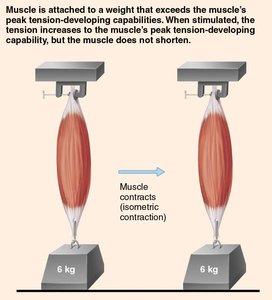
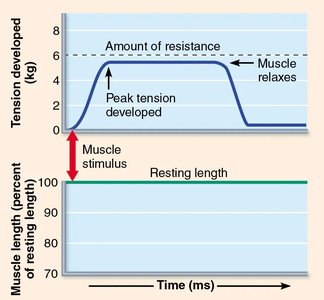
Isometric Contraction
In isometric contraction, muscle tension increases but the muscle does not shorten.
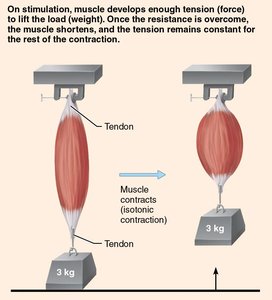
Isotonic Contraction
In isotonic contraction, muscle tension remains constant while the muscle shortens.
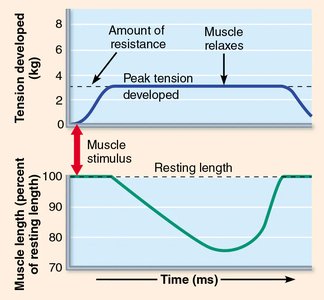
Muscle Tone
Muscle tone is the slight tension exhibited by resting skeletal muscle, established by neural activity. It stabilizes joints and maintains posture.
Alternating Activity: Small groups of motor units are alternately active and inactive.
Function: Keeps muscle firm but immobile.
Muscle Metabolism: Energy Availability
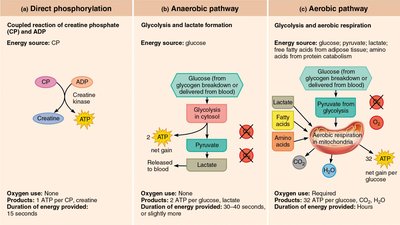
ATP is essential for muscle contraction and is replenished by three main mechanisms:
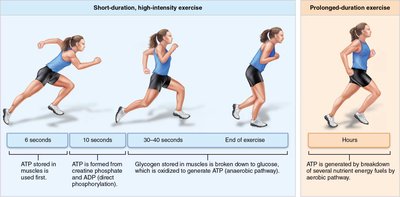
Creatine Phosphate System: Rapid ATP replenishment via direct phosphorylation.
Anaerobic Glycolysis: Produces ATP and lactic acid without oxygen.
Aerobic Respiration: Uses oxygen and multiple substrates for sustained ATP production.
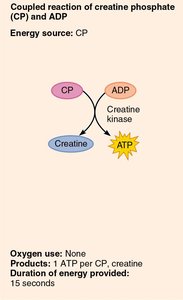
Creatine Phosphate System
Creatine phosphate (CrP) is a high-energy molecule stored in muscles. Creatine kinase transfers a phosphate from CrP to ADP, forming ATP.
Duration: 10-30 seconds.
Equation:
Anaerobic Glycolysis: Lactic Acid System
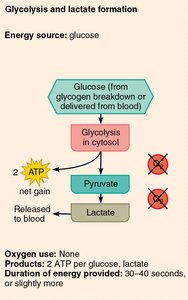
This pathway produces ATP without oxygen, but is inefficient and produces lactic acid as a by-product.
Duration: 30 seconds to 1 minute.
Equation:
Aerobic System
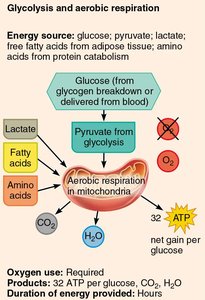
Aerobic respiration uses oxygen and various substrates to produce ATP efficiently for long-term exercise.
Duration: Hours.
Equation:
Muscle Metabolism During Exercise
During exercise, muscles utilize different energy systems depending on the duration and intensity of activity.
Excess Postexercise Oxygen Consumption (EPOC)
EPOC refers to the extra oxygen required after exercise to restore muscle to its pre-exercise state.
Restoration: Oxygen reserves, glycogen stores, ATP and CrP, and conversion of lactic acid to pyruvic acid.
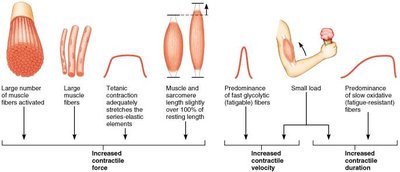
Factors Affecting the Force of Contraction
Several factors influence the force generated by muscle contraction:
Number of muscle fibers contracting (recruitment)
Frequency of stimulation
Degree of muscle stretch
Size of the muscle
Muscle Fiber Types: Speed of Contraction
Muscle fibers are classified based on their contraction speed and resistance to fatigue:
Slow Oxidative Fibers: Contract slowly, fatigue resistant, red color.
Fast Oxidative Fibers: Contract quickly, moderate resistance to fatigue.
Fast Glycolytic Fibers: Contract quickly, easily fatigued, white color.
Force, Velocity, and Duration of Muscle Contraction
The force, velocity, and duration of muscle contraction depend on fiber type, load, and recruitment.
Smooth Muscle Tissue
Structure and Function
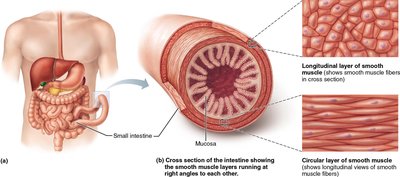
Smooth muscle tissue is found in the walls of hollow organs and is responsible for involuntary movements such as peristalsis and segmentation.
Longitudinal Layer: Contraction shortens the organ.
Circular Layer: Contraction constricts the organ.
Smooth Muscle Contractions
Smooth muscle contractions are coordinated and can be self-excitatory. Peristalsis and segmentation are key processes for moving and mixing substances in hollow organs.
Pacemaker Cells: Set contractile pace for whole sheets of muscle.
Gap Junctions: Allow synchronized contraction.
Sources of Ca2+ and Contraction
Smooth muscle contraction is regulated by calcium ions, which can be sourced from extracellular fluid or internal stores.
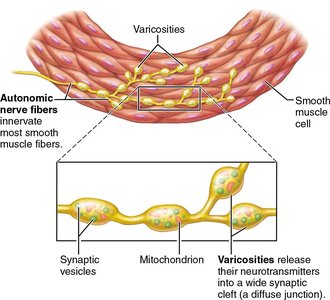
Development and Homeostatic Imbalances
Development of the Muscular System
Muscle tissue develops from embryonic mesoderm called myoblasts. Skeletal muscles form by fusion of myoblasts, while cardiac and smooth muscle myoblasts do not fuse but develop gap junctions.
Neuromuscular Coordination: Development occurs head-to-toe and proximal-to-distal.
Sarcopenia: Age-related loss of muscle mass.
Muscular Dystrophy
Muscular dystrophy is a group of inherited diseases characterized by progressive muscle degeneration and weakness.
Duchenne Muscular Dystrophy: Caused by a defective gene for dystrophin, leading to fragile sarcolemma and muscle fiber damage.
Symptoms: Muscle enlargement due to fat and connective tissue deposits, muscle fiber atrophy.
Summary Table: Muscle Metabolism Pathways
Pathway | Energy Source | Oxygen Use | ATP Yield | Duration |
|---|---|---|---|---|
Direct Phosphorylation | Creatine Phosphate | None | 1 ATP per CP | 15 seconds |
Anaerobic Glycolysis | Glucose | None | 2 ATP per glucose | 30-40 seconds |
Aerobic Respiration | Glucose, fatty acids, amino acids | Required | 32 ATP per glucose | Hours |
