 Indietro
Muscle Systems: Fascicle Arrangement, Levers, Origins & Insertions, and Integration
Guida di studio - Note intelligenti
 Appunti personalizzati basati sui tuoi materiali, ampliati con definizioni chiave, esempi e contesto.
Muscle Systems
Introduction to the Muscular System
The muscular system consists exclusively of skeletal muscles, which are responsible for voluntary movements and posture. The organization of muscles, including their fascicle arrangement, significantly influences the power, range, and speed of movement.
Fascicle Arrangement in Skeletal Muscles
Types of Fascicle Arrangement
Skeletal muscle fibers are grouped into bundles called fascicles. The arrangement of these fascicles determines the muscle's shape and function. Muscles are classified based on their fascicle patterns:
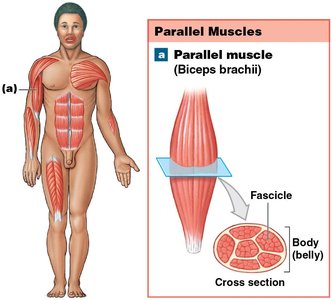
Parallel muscles: Fascicles run parallel to the long axis of the muscle. Most skeletal muscles are of this type, and contraction shortens and fattens the muscle. Example: biceps brachii.
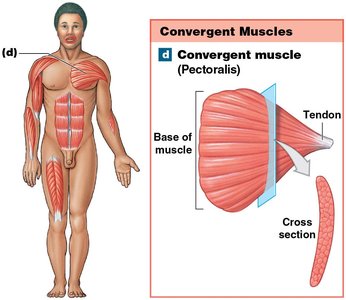
Convergent muscles: Fascicles converge toward a single tendon, with a broad origin and narrow insertion. Example: pectoralis major.
Pennate muscles: Fascicles attach obliquely to a central tendon. These muscles generate more tension but less movement. Subtypes include unipennate, bipennate, and multipennate.
Circular muscles (sphincters): Fascicles are arranged in concentric rings, controlling openings and acting as valves. Example: orbicularis oris.
Parallel Muscles
Fibers are parallel to the muscle's long axis.
Most have tendons at each end.
Contraction shortens and fattens the muscle.
Example: biceps brachii (upper arm).
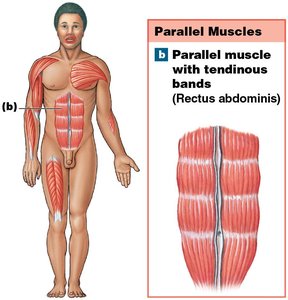
Parallel Muscles with Tendinous Bands
Muscle fibers are parallel, but separated by tendinous bands.
Example: rectus abdominis (abdomen).
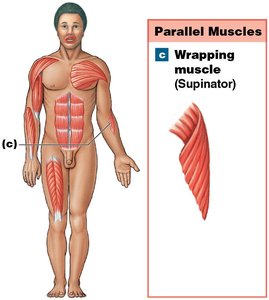
Wrapping Muscles
Muscle fibers wrap around a structure, often stabilizing or rotating it.
Example: supinator (forearm).
Convergent Muscles
Fan-shaped, with a broad origin and narrow insertion.
Allows versatile movement, but less force than parallel muscles.
Example: pectoralis major (chest).
Pennate Muscles
Fibers attach at an angle to the tendon.
Contain more myofibrils, generating greater tension.
Subtypes: Unipennate (fibers on one side), Bipennate (fibers on both sides), Multipennate (tendon branches within muscle).
Unipennate Muscle
All fascicles on the same side of the tendon.
Example: extensor digitorum.
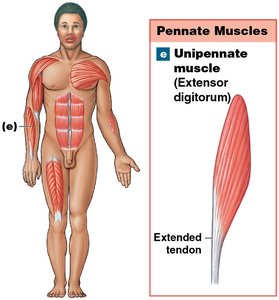
Bipennate Muscle
Fascicles on both sides of a central tendon.
Example: rectus femoris.
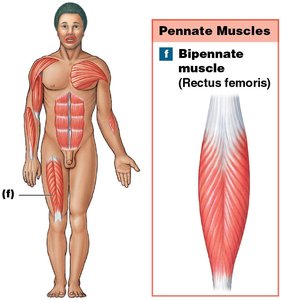
Multipennate Muscle
Tendon branches within the muscle.
Example: deltoid.
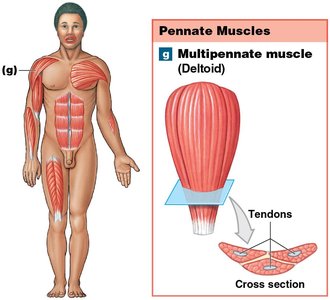
Circular Muscles (Sphincters)
Surround body openings and hollow organs.
Contraction decreases the diameter of the opening.
Example: orbicularis oris (mouth).
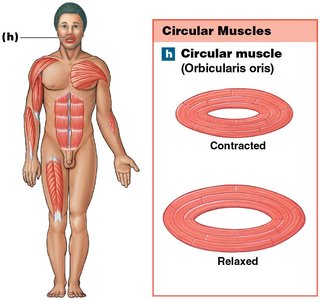
Levers in the Muscular System
Lever Mechanics
Most skeletal muscles attach to bones, forming lever systems. A lever is a rigid structure (bone) that moves around a fixed point (fulcrum, usually a joint) when a force is applied to overcome a load. Levers can alter the direction, speed, distance, and strength of movement.
Classes of Levers
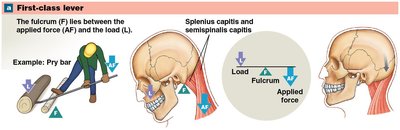
First-class lever: Fulcrum is between the applied force and the load. Example: extension of the neck and lifting the head.
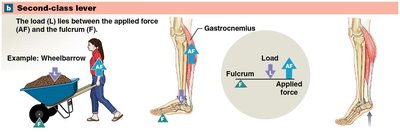
Second-class lever: Load is between the applied force and the fulcrum. Example: ankle extension (plantar flexion) by calf muscles.
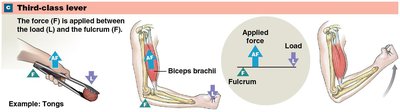
Third-class lever: Applied force is between the load and the fulcrum. Most common in the body; maximizes speed and distance at the expense of force. Example: flexion at the elbow.
First-Class Lever
Fulcrum lies between applied force and load.
Example: extension of the neck.
Second-Class Lever
Load lies between applied force and fulcrum.
Example: plantar flexion at the ankle.
Third-Class Lever
Applied force is between load and fulcrum.
Most common lever type in the body.
Example: flexion at the elbow.
Origins and Insertions
Definitions and Functional Importance
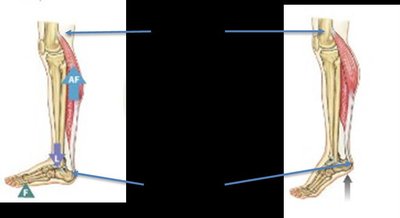
Origin: Fixed point of attachment, usually proximal.
Insertion: Movable point of attachment, usually distal.
Muscle contraction produces movement by pulling the insertion toward the origin.
Muscle Actions
Movements are described by their effect on bones or joints (e.g., flexion, extension, adduction).
Muscles work in groups to maximize efficiency.
Muscle Interactions
Agonist (prime mover): Main muscle responsible for a movement.
Antagonist: Opposes the action of the agonist.
Synergist: Assists the agonist.
Fixator: Stabilizes the origin of the agonist.
Agonists and antagonists work in pairs (e.g., flexors and extensors).
Naming Muscles
Muscle Naming Conventions
Location: abdominus, femoris, brachii, etc.
Origin and insertion: e.g., genioglossus (chin to tongue).
Fascicle organization: rectus (straight), oblique (angled), transverse (horizontal).
Position: externus (external), profundus (deep).
Structural characteristics: trapezius (trapezoid shape), number of heads (biceps = two heads).
Action: flexor, extensor, pronator, abductor, etc.
Effects of Exercise and Integration with Other Systems
Support from Other Body Systems
Cardiovascular system: Delivers oxygen and nutrients, removes carbon dioxide.
Respiratory system: Meets oxygen demand of muscles.
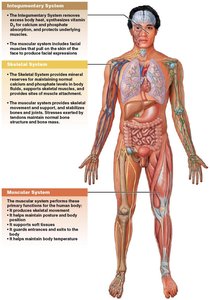
Integumentary system: Disperses heat from muscle activity.
Nervous and endocrine systems: Direct responses and regulate activity.
Age-Related Changes to the Muscular System
Muscle mass and strength decrease with age.
Recovery from injury slows.
Exercise can help maintain muscle function and slow age-related decline.
Summary Table: Fascicle Arrangement Types
Type | Arrangement | Example | Function |
|---|---|---|---|
Parallel | Fibers parallel to long axis | Biceps brachii | Great range of motion |
Convergent | Broad origin, narrow insertion | Pectoralis major | Versatile movement |
Unipennate | Fibers on one side of tendon | Extensor digitorum | High tension |
Bipennate | Fibers on both sides of tendon | Rectus femoris | High tension |
Multipennate | Tendon branches within muscle | Deltoid | Very high tension |
Circular | Concentric rings | Orbicularis oris | Control openings |
Summary Table: Classes of Levers
Class | Arrangement | Example | Function |
|---|---|---|---|
First-class | Fulcrum between force and load | Neck extension | Change direction of force |
Second-class | Load between force and fulcrum | Plantar flexion | Move large load with small force |
Third-class | Force between load and fulcrum | Elbow flexion | Maximize speed and distance |
