 Indietro
Muscle Tissue Practice Questions – Anatomy & Physiology Study Guide
Guida di studio - Note intelligenti
 Appunti personalizzati basati sui tuoi materiali, ampliati con definizioni chiave, esempi e contesto.
Q1. What is the connective tissue sheath surrounding individual muscle fibers?
Background
Topic: Skeletal Muscle Tissue Organization
This question tests your understanding of the layers of connective tissue in skeletal muscle, which protect and organize muscle fibers.
Key Terms:
Muscle fiber: A single muscle cell.
Connective tissue sheaths: Layers that surround muscle components (endomysium, perimysium, epimysium).
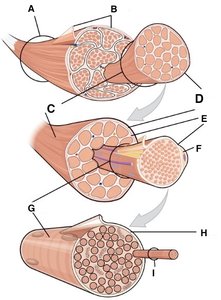
Step-by-Step Guidance
Examine Figure 1 and identify the smallest unit, which is the individual muscle fiber.
Look for the connective tissue layer that directly surrounds each muscle fiber.
Recall the names of the connective tissue layers: endomysium (around fibers), perimysium (around bundles), epimysium (around the whole muscle).
Match the correct term to the structure shown in the diagram.
Try solving on your own before revealing the answer!
Final Answer: Endomysium
The endomysium is the connective tissue sheath that surrounds individual muscle fibers, as shown in Figure 1.
Q2. What is a bundle of muscle cells surrounded by a perimysium?
Background
Topic: Skeletal Muscle Tissue Organization
This question focuses on the structural organization of muscle, specifically the grouping of muscle fibers into fascicles.
Key Terms:
Fascicle: A bundle of muscle fibers.
Perimysium: Connective tissue surrounding each fascicle.
Step-by-Step Guidance
Identify the structure in Figure 1 that consists of a group of muscle fibers.
Find the connective tissue layer that wraps around this group.
Recall the term for a bundle of muscle fibers and the name of its surrounding sheath.
Try solving on your own before revealing the answer!
Final Answer: Fascicle
A fascicle is a bundle of muscle cells surrounded by the perimysium.
Q3. What is the connective tissue covering the exterior of a muscle organ?
Background
Topic: Skeletal Muscle Tissue Organization
This question tests your knowledge of the outermost connective tissue layer that encloses the entire muscle.
Key Terms:
Epimysium: The connective tissue covering the whole muscle.
Step-by-Step Guidance
Look at Figure 1 and identify the layer that wraps around the entire muscle organ.
Recall the three main connective tissue layers and their locations.
Match the term to the structure shown in the diagram.
Try solving on your own before revealing the answer!
Final Answer: Epimysium
The epimysium is the connective tissue covering the exterior of a muscle organ.
Q4. What is the connective tissue surrounding muscle fiber bundles?
Background
Topic: Skeletal Muscle Tissue Organization
This question asks you to identify the connective tissue that surrounds groups of muscle fibers (fascicles).
Key Terms:
Perimysium: Connective tissue surrounding fascicles (bundles of muscle fibers).
Step-by-Step Guidance
Find the bundles of muscle fibers in Figure 1.
Identify the connective tissue layer that wraps around these bundles.
Recall the terminology for the connective tissue layers.
Try solving on your own before revealing the answer!
Final Answer: Perimysium
The perimysium surrounds muscle fiber bundles (fascicles).
Q5. What is an individual muscle fiber?
Background
Topic: Skeletal Muscle Tissue Organization
This question tests your ability to identify the basic contractile cell of skeletal muscle.
Key Terms:
Muscle fiber: A single, elongated muscle cell.
Step-by-Step Guidance
Locate the smallest unit in Figure 1.
Recall the definition of a muscle fiber.
Match the term to the structure shown in the diagram.
Try solving on your own before revealing the answer!
Final Answer: Muscle fiber
An individual muscle fiber is a single muscle cell, as shown in Figure 1.
Q6. What is the I band in a microscopic skeletal muscle fiber?
Background
Topic: Muscle Fiber Microscopic Anatomy
This question tests your knowledge of the sarcomere structure, specifically the regions of the muscle fiber.
Key Terms:
I band: The light band containing only thin (actin) filaments.
Sarcomere: The contractile unit of muscle.
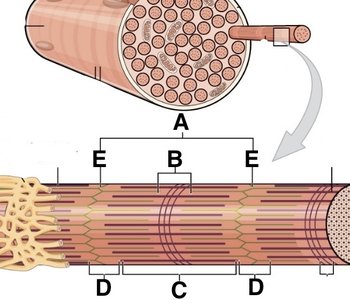
Step-by-Step Guidance
Examine Figure 2 and locate the labeled regions.
Identify the area that appears lighter and is associated with thin filaments.
Recall the definition and location of the I band within the sarcomere.
Try solving on your own before revealing the answer!
Final Answer: I band is the light region containing only thin filaments (actin).
The I band is the area of the sarcomere that contains only actin filaments and appears lighter in Figure 2.
Q7. What is the H zone in a microscopic skeletal muscle fiber?
Background
Topic: Muscle Fiber Microscopic Anatomy
This question focuses on the central region of the A band where only thick filaments are present.
Key Terms:
H zone: The region within the A band that contains only thick (myosin) filaments.
Step-by-Step Guidance
Locate the central area of the A band in Figure 2.
Identify the region that contains only thick filaments.
Recall the definition and location of the H zone.
Try solving on your own before revealing the answer!
Final Answer: H zone is the central region of the A band with only thick filaments.
The H zone is found in the middle of the A band and contains only myosin filaments.
Q8. What is the A band in a microscopic skeletal muscle fiber?
Background
Topic: Muscle Fiber Microscopic Anatomy
This question tests your understanding of the dark band in the sarcomere, which contains both thick and thin filaments.
Key Terms:
A band: The dark band containing both thick (myosin) and thin (actin) filaments.
Step-by-Step Guidance
Identify the dark region in Figure 2.
Recall the composition of the A band (both thick and thin filaments).
Match the term to the structure shown in the diagram.
Try solving on your own before revealing the answer!
Final Answer: A band is the dark region containing both thick and thin filaments.
The A band is the area of the sarcomere that contains both actin and myosin filaments.
Q9. What is the Z disc in a microscopic skeletal muscle fiber?
Background
Topic: Muscle Fiber Microscopic Anatomy
This question tests your knowledge of the boundary structure of the sarcomere.
Key Terms:
Z disc: The structure that defines the boundaries of a sarcomere.
Step-by-Step Guidance
Locate the boundary lines in Figure 2.
Recall the function of the Z disc in anchoring thin filaments and defining sarcomere limits.
Match the term to the structure shown in the diagram.
Try solving on your own before revealing the answer!
Final Answer: Z disc is the boundary of the sarcomere.
The Z disc anchors the thin filaments and marks the ends of each sarcomere.
Q10. What is the sarcomere in a microscopic skeletal muscle fiber?
Background
Topic: Muscle Fiber Microscopic Anatomy
This question tests your understanding of the basic contractile unit of muscle.
Key Terms:
Sarcomere: The segment between two Z discs, the functional unit of muscle contraction.
Step-by-Step Guidance
Identify the region between two Z discs in Figure 2.
Recall the definition and function of the sarcomere.
Match the term to the structure shown in the diagram.
Try solving on your own before revealing the answer!
Final Answer: Sarcomere is the segment between two Z discs.
The sarcomere is the functional contractile unit of muscle, defined as the area between two Z discs.
