 Indietro
Muscles, Movements, and Nerve Supply of the Upper and Lower Limbs
Guida di studio - Note intelligenti
 Appunti personalizzati basati sui tuoi materiali, ampliati con definizioni chiave, esempi e contesto.
Muscles of the Upper and Lower Limbs
Overview
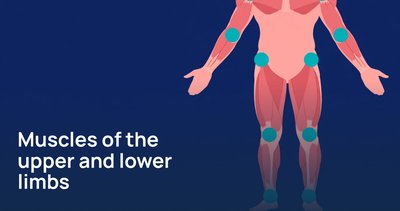
The upper and lower limbs contain numerous muscles responsible for a wide range of movements. Understanding their anatomy, function, and nerve supply is essential for comprehending limb movement and the effects of nerve injuries.
Upper limb muscles include those of the shoulder, arm, forearm, and hand.
Lower limb muscles include those of the hip, thigh, leg, and foot.
Each muscle group is innervated by specific nerves, and injury to these nerves can result in characteristic deficits.
Movements at Major Limb Joints
Elbow Joint: Flexion and Extension
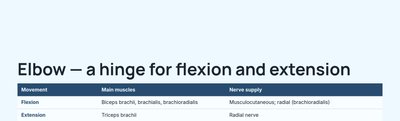
The elbow is a hinge joint that allows flexion and extension. These movements are produced by specific muscles and are controlled by distinct nerves.
Flexion: Bending the elbow to decrease the angle between the forearm and upper arm.
Extension: Straightening the elbow to increase the angle.
Movement | Main Muscles | Nerve Supply |
|---|---|---|
Flexion | Biceps brachii, brachialis, brachioradialis | Musculocutaneous; radial (brachioradialis) |
Extension | Triceps brachii | Radial nerve |
Ankle Joint: Dorsiflexion and Plantarflexion
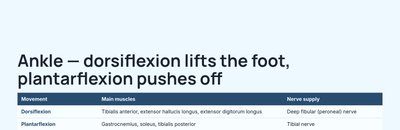
The ankle joint allows two primary movements: dorsiflexion (lifting the foot) and plantarflexion (pushing off with the foot). These actions are performed by different muscle groups and are innervated by specific nerves.
Dorsiflexion: Raising the foot upwards towards the shin.
Plantarflexion: Pointing the foot downwards, as in pushing off during walking.
Movement | Main Muscles | Nerve Supply |
|---|---|---|
Dorsiflexion | Tibialis anterior, extensor hallucis longus, extensor digitorum longus | Deep fibular (peroneal) nerve |
Plantarflexion | Gastrocnemius, soleus, tibialis posterior | Tibial nerve |
Nerve Supply and Effects of Injury
Radial Nerve Injury at the Elbow
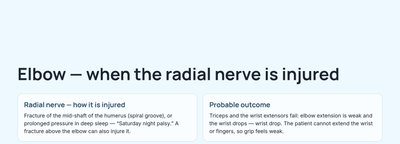
The radial nerve is crucial for extension movements at the elbow and wrist. Injury to this nerve can result in significant functional deficits.
How it is injured: Fracture of the mid-shaft of the humerus (spiral groove), or prolonged pressure in deep sleep ("Saturday night palsy"). A fracture above the elbow can also injure the radial nerve.
Probable outcome: Triceps and wrist extensors fail; elbow extension is weak and the wrist drops. The patient cannot extend the wrist or fingers, so grip feels weak.
Summary Table: Muscles, Movements, and Nerve Supply
This table summarizes the main muscles responsible for movements at the elbow and ankle joints, along with their nerve supply.
Joint | Movement | Main Muscles | Nerve Supply |
|---|---|---|---|
Elbow | Flexion | Biceps brachii, brachialis, brachioradialis | Musculocutaneous; radial (brachioradialis) |
Elbow | Extension | Triceps brachii | Radial nerve |
Ankle | Dorsiflexion | Tibialis anterior, extensor hallucis longus, extensor digitorum longus | Deep fibular (peroneal) nerve |
Ankle | Plantarflexion | Gastrocnemius, soleus, tibialis posterior | Tibial nerve |
Key Terms and Definitions
Flexion: Decreasing the angle between two body parts.
Extension: Increasing the angle between two body parts.
Dorsiflexion: Movement that lifts the foot upwards.
Plantarflexion: Movement that points the foot downwards.
Innervation: The supply of nerves to a muscle or group of muscles.
Clinical Application
Understanding the muscles and their nerve supply is essential for diagnosing and managing limb injuries. For example, radial nerve injury leads to "wrist drop," a classic sign in clinical neurology.
Example: A patient with a humeral fracture may present with inability to extend the wrist and fingers, indicating radial nerve damage.
Additional info:
Other limb movements (shoulder, hip, knee) involve additional muscles and nerves not detailed in these notes.
Muscle actions are often coordinated, and multiple muscles may contribute to a single movement.
