 Indietro
Muscles of the Human Body: Actions, Naming, and Fascicle Arrangements
Guida di studio - Note intelligenti
 Appunti personalizzati basati sui tuoi materiali, ampliati con definizioni chiave, esempi e contesto.
Muscle Actions and Interactions
Functional Groups of Skeletal Muscles
Skeletal muscles are organized into functional groups that coordinate movement by acting on joints. Each muscle can only pull, never push, and the actions of one group are often reversed by another.
Prime mover (agonist): The muscle primarily responsible for a specific movement.
Antagonist: Opposes or reverses the action of the prime mover; located on the opposite side of the joint.
Synergist: Assists the prime mover by adding force or reducing unnecessary movements.
Fixator: A type of synergist that stabilizes the origin of the prime mover.
Example: During elbow flexion, the biceps brachii is the prime mover, the triceps brachii is the antagonist, and the brachialis acts as a synergist.
Muscle Actions Relative to Joint Position
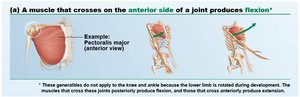
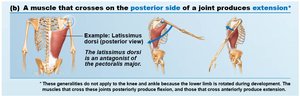
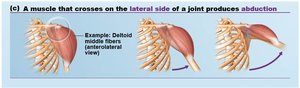
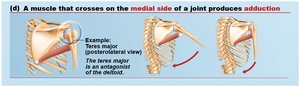
The action of a muscle can be inferred by its position relative to the joint it crosses. This principle is especially useful for understanding movements at the shoulder joint.
Anterior side: Produces flexion
Posterior side: Produces extension
Lateral side: Produces abduction
Medial side: Produces adduction
These generalizations do not apply to the knee and ankle due to developmental rotation of the lower limb.
Naming Skeletal Muscles
Criteria for Naming Muscles
Skeletal muscles are named according to several criteria, often combined for descriptive clarity.
Location: Associated bone or region (e.g., temporalis over temporal bone).
Shape: Distinctive form (e.g., deltoid = triangle).
Size: Relative size (e.g., maximus = largest, minimus = smallest).
Direction of fibers: Orientation (e.g., rectus = straight, transversus = right angles).
Number of origins: (e.g., biceps = two origins, triceps = three origins).
Location of attachments: Origin and insertion points (e.g., sternocleidomastoid).
Action: Movement produced (e.g., flexor, extensor).
Example: Extensor carpi radialis longus—extends the wrist, attached to the radius, and is long.
Fascicle Arrangements in Skeletal Muscles
Patterns of Fascicle Arrangement
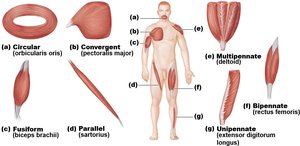
Fascicles are bundles of muscle fibers whose arrangement determines muscle shape and function. The most common patterns are:
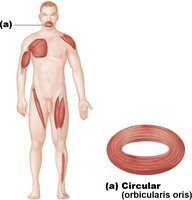
Circular: Fascicles arranged in concentric rings (e.g., orbicularis oris).
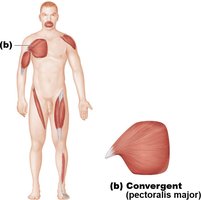
Convergent: Broad origin, fascicles converge to a single tendon (e.g., pectoralis major).
Parallel: Fascicles run parallel to the long axis (e.g., sartorius).
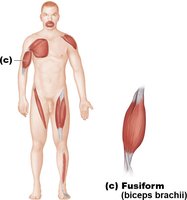
Fusiform: Spindle-shaped with parallel fibers (e.g., biceps brachii).
Pennate: Short fascicles attach obliquely to a central tendon. Types include:
Unipennate: Fascicles attach to one side (e.g., extensor digitorum longus).
Bipennate: Fascicles attach to both sides (e.g., rectus femoris).
Multipennate: Multiple fascicles insert into one tendon (e.g., deltoid).
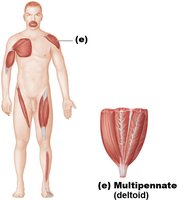
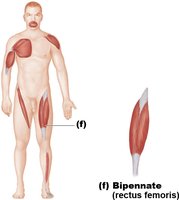
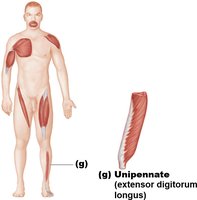
Functional Implications of Fascicle Arrangement
The arrangement of fascicles affects both the range of motion and the power of a muscle:
Range of motion: Muscles with long, parallel fibers shorten more, allowing greater movement.
Power: Muscles with more fibers (e.g., bipennate, multipennate) are stronger but shorten less.
Example: The deltoid (multipennate) is powerful, while the sartorius (parallel) allows greater movement.
Major Skeletal Muscles of the Body
Overview and Learning Tips
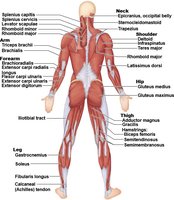
There are over 600 skeletal muscles, grouped by function and location. Muscle tables typically include description, origin and insertion, actions, and innervation.
Use muscle names to infer location and function.
Relate muscle attachments to their actions.
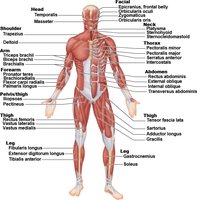
Identify muscles on anatomical figures for spatial understanding.
Practice movements to feel muscle contractions.
Summary Table: Fascicle Arrangements and Examples
Arrangement | Example Muscle | Functional Feature |
|---|---|---|
Circular | Orbicularis oris | Closes openings |
Convergent | Pectoralis major | Versatile movement |
Parallel | Sartorius | Greater range of motion |
Fusiform | Biceps brachii | Spindle-shaped, moderate power |
Unipennate | Extensor digitorum longus | High power, shortens little |
Bipennate | Rectus femoris | High power, shortens little |
Multipennate | Deltoid | Highest power, shortens least |
Key Terms and Definitions
Agonist: Muscle responsible for primary movement.
Antagonist: Muscle that opposes the agonist.
Synergist: Muscle that assists the agonist.
Fixator: Muscle that stabilizes the origin of the agonist.
Fascicle: Bundle of muscle fibers within a skeletal muscle.
Formulas and Equations
Principle of Leverage in Muscle Action
Muscle force and movement are influenced by the lever system at joints:
Mechanical advantage: When the load is closer to the fulcrum than the effort.
Mechanical disadvantage: When the effort is closer to the fulcrum than the load.
Equation:
Muscles with greater mechanical advantage can move heavier loads with less effort.
*Additional info: Academic context was added to clarify muscle actions, naming conventions, fascicle arrangements, and leverage principles, making the notes self-contained and suitable for exam preparation.*
