 Indietro
Muscles of the Shoulder and Upper Limb: Structure, Function, and Anatomy
Guida di studio - Note intelligenti
 Appunti personalizzati basati sui tuoi materiali, ampliati con definizioni chiave, esempi e contesto.
Muscles of the Shoulder and Upper Limb
Overview of Shoulder Muscles
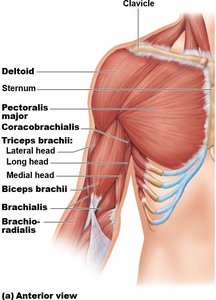
The shoulder and upper limb are moved by a complex group of muscles, many of which cross the shoulder joint and insert on the humerus. These muscles are responsible for a wide range of actions including flexion, extension, adduction, abduction, and rotation of the arm. The prime movers of the shoulder are the pectoralis major, latissimus dorsi, and deltoid muscles.
Pectoralis major: Adducts and medially rotates the arm; flexes the arm at the shoulder.
Deltoid: Responsible for flexion, abduction, and extension of the arm at the shoulder.
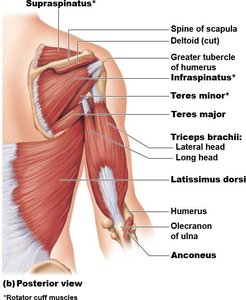
Latissimus dorsi: Extends, adducts, and medially rotates the arm; known as the 'swimmer's muscle'.
Rotator Cuff Muscles and Synergists
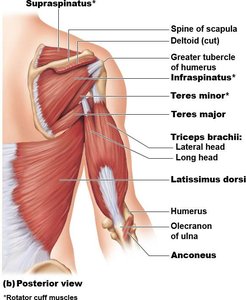
The rotator cuff is a group of four muscles that act as synergists and fixators, stabilizing the shoulder joint and preventing dislocation. These muscles originate on the scapula and reinforce the shoulder capsule. Additional synergists include the coracobrachialis and teres major.
Supraspinatus: Abducts the arm.
Infraspinatus: Rotates the arm laterally.
Teres minor: Rotates the arm laterally.
Subscapularis: Rotates the arm medially.
Teres major: Extends, medially rotates, and adducts the arm.
Coracobrachialis: Flexes and adducts the arm.
Muscles of the Arm: Anterior and Posterior Compartments
The muscles of the arm are divided into anterior and posterior compartments, each with distinct functions. The anterior compartment is primarily responsible for flexion, while the posterior compartment is responsible for extension.
Biceps brachii: Flexes and supinates the forearm; has two heads (short and long).
Brachialis: Deep to biceps brachii; flexes the forearm.
Brachioradialis: Flexes the forearm; located on the lateral forearm.
Triceps brachii: Only muscle of the posterior compartment; extends the forearm; has three heads (long, lateral, medial).
Muscles of the Forearm: Movements of Wrist, Fingers, and Forearm
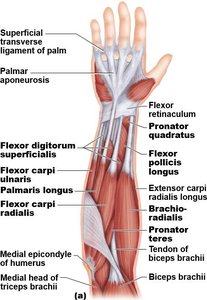
The forearm muscles are responsible for movements of the wrist, fingers, and thumb, as well as pronation and supination of the forearm. These muscles are grouped into flexors (anterior compartment) and extensors (posterior compartment).
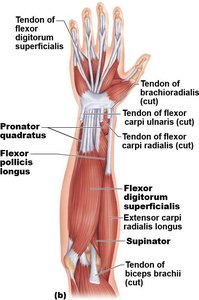
Pronator teres: Pronates the forearm.
Supinator: Supinates the forearm; synergistic with biceps brachii.
Flexor carpi radialis: Flexes and abducts the hand.
Palmaris longus: Tenses skin and fascia of the palm; often absent.
Flexor carpi ulnaris: Flexes and adducts the hand.
Flexor digitorum superficialis: Flexes wrist and middle phalanges of digits II-V.
Extensor Muscles of the Forearm
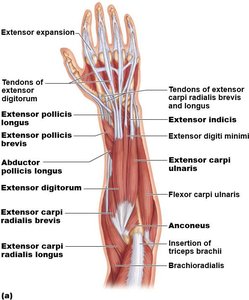
The extensor muscles of the forearm are located in the posterior compartment and are responsible for extension of the wrist and fingers. They also contribute to abduction and adduction of the hand.
Extensor carpi radialis longus: Extends the hand.
Extensor carpi radialis brevis: Extends the hand.
Extensor digitorum: Extends the fingers.
Extensor carpi ulnaris: Extends the hand.
Summary Table: Muscles of the Shoulder and Upper Limb
The following table summarizes the main muscles, their origins, insertions, and actions:
Muscle Name | Origin | Insertion | Action(s) |
|---|---|---|---|
Pectoralis major | Clavicle, sternum | Intertubercular groove of humerus | Adducts, medially rotates, flexes arm |
Deltoid | Acromion, spine of scapula, clavicle | Deltoid tuberosity of humerus | Flexion, abduction, extension of arm |
Latissimus dorsi | Lower thoracic/lumbar vertebrae, iliac crest | Intertubercular groove of humerus | Extension, adduction, medial rotation of arm |
Supraspinatus | Supraspinous fossa | Greater tubercle of humerus | Abduction of arm |
Infraspinatus | Infraspinous fossa | Greater tubercle of humerus | Lateral rotation of arm |
Teres minor | Lateral border of scapula | Greater tubercle of humerus | Lateral rotation of arm |
Subscapularis | Subscapular fossa | Lesser tubercle of humerus | Medial rotation of arm |
Teres major | Posterior surface of scapula | Intertubercular groove of humerus | Extension, medial rotation, adduction of arm |
Coracobrachialis | Coracoid process of scapula | Humerus | Flexion, adduction of arm |
Biceps brachii | Coracoid process, glenoid cavity | Radial tuberosity | Flexion, supination of forearm |
Brachialis | Humerus | Coronoid process of ulna | Flexion of forearm |
Brachioradialis | Humerus | Radius | Flexion of forearm |
Triceps brachii | Glenoid cavity, humerus | Olecranon of ulna | Extension of forearm |
Pronator teres | Humerus, ulna | Radius | Pronation of forearm |
Flexor carpi radialis | Humerus | Third metacarpal | Flexion, abduction of hand |
Palmaris longus | Humerus | Palmar aponeurosis | Tenses palm |
Flexor carpi ulnaris | Humerus | Pisiform, hamate | Flexion, adduction of hand |
Flexor digitorum superficialis | Humerus | Middle phalanges II-V | Flexion of wrist and fingers |
Extensor carpi radialis longus | Humerus | Second metacarpal | Extension of hand |
Extensor carpi radialis brevis | Humerus | Third metacarpal | Extension of hand |
Extensor digitorum | Humerus | Distal phalanges II-V | Extension of fingers |
Extensor carpi ulnaris | Humerus | Fifth metacarpal | Extension of hand |
Key Terms and Concepts
Origin (O): The fixed attachment point of a muscle.
Insertion (I): The movable attachment point of a muscle.
Prime mover: The muscle primarily responsible for a specific movement.
Synergist: A muscle that assists the prime mover.
Fixator: A muscle that stabilizes the origin of the prime mover.
Example: Functional Application
During a swimming stroke, the latissimus dorsi acts as the prime mover for arm extension, while the deltoid and pectoralis major assist in abduction and flexion. The rotator cuff muscles stabilize the shoulder joint, preventing dislocation during vigorous movement.
Additional info:
Muscle actions are often coordinated, with multiple muscles working together to produce smooth and controlled movements. Understanding the origin and insertion of each muscle is essential for predicting its action and clinical relevance, such as in cases of injury or rehabilitation.
