 Indietro
Muscular System Study Guide: Origin, Insertion, Actions, Levers, Fascicle Arrangements, and Naming
Guida di studio - Note intelligenti
 Appunti personalizzati basati sui tuoi materiali, ampliati con definizioni chiave, esempi e contesto.
Q1. Muscles make two parts of the body get ______.
Background
Topic: Muscle Function and Movement
This question is testing your understanding of how muscles create movement by connecting two parts of the body.
Key Terms:
Muscle contraction: The process by which muscles shorten, pulling on bones or other structures.
Origin and insertion: The two attachment points of a muscle, typically on different bones.
Step-by-Step Guidance
Recall that muscles attach to two different points on the skeleton or body structures.
When a muscle contracts, it pulls these two points closer together.
Think about the effect of muscle contraction on the distance between the origin and insertion.
Try solving on your own before revealing the answer!
Final Answer: closer
Muscles make two parts of the body get closer together when they contract, by pulling the insertion toward the origin.
Q2. The insertion moves ______ the origin.
Background
Topic: Muscle Attachment Sites
This question is about the relationship between the origin and insertion during muscle contraction.
Key Terms:
Origin: The fixed or less movable attachment site of a muscle.
Insertion: The movable attachment site of a muscle.
Step-by-Step Guidance
Recall the definitions of origin and insertion.
During contraction, the insertion is pulled toward the origin.
Think about the direction of movement relative to the origin.
Try solving on your own before revealing the answer!
Final Answer: toward
The insertion moves toward the origin during muscle contraction.
Q3. Origin: ______ attachment site. Insertion: ______ attachment site.
Background
Topic: Muscle Anatomy
This question is testing your knowledge of the definitions of origin and insertion.
Key Terms:
Origin: Typically the fixed or less movable attachment.
Insertion: Typically the movable attachment.
Step-by-Step Guidance
Recall which attachment site is usually fixed and which is movable.
Think about how these terms are used in describing muscle actions.
Try solving on your own before revealing the answer!
Final Answer: Origin: fixed; Insertion: movable
The origin is the fixed attachment site, and the insertion is the movable attachment site.
Q4. The origin and insertion determine the ______.
Background
Topic: Muscle Movement
This question is about how the location of origin and insertion affects the type of movement produced by a muscle.
Key Terms:
Origin and insertion: The two points that define the direction and type of movement.
Movement: The action produced by muscle contraction.
Step-by-Step Guidance
Consider how the placement of origin and insertion affects the direction of muscle pull.
Think about what is determined by these two points.
Try solving on your own before revealing the answer!
Final Answer: movement
The origin and insertion determine the movement produced by the muscle.
Q5. EXAMPLE: The origins and insertions of different muscles are given. What type of movement or movements would be created when these muscles contract?
Background
Topic: Muscle Actions Based on Attachments
This question asks you to predict the movement based on the origin and insertion of a muscle.
Key Terms:
Origin: Starting attachment point.
Insertion: Ending attachment point.
Movement: The action produced when the muscle contracts.
Step-by-Step Guidance
Identify the bones or regions where the origin and insertion are located.
Visualize the direction in which the muscle will pull when it contracts.
Consider the joint or body part affected by this contraction.
Think about the type of movement (flexion, extension, rotation, etc.) that would result.
Try solving on your own before revealing the answer!
Final Answer: The movement depends on the specific origin and insertion; for example, a muscle originating at the pubis and inserting at the xiphoid process would flex the trunk.
By analyzing the origin and insertion, you can predict the direction and type of movement produced by muscle contraction.
Q6. PRACTICE: True or False: During a muscle contraction, the origin moves towards the insertion.
Background
Topic: Muscle Contraction Mechanics
This question tests your understanding of which attachment site moves during contraction.
Key Terms:
Origin: Fixed attachment.
Insertion: Movable attachment.
Step-by-Step Guidance
Recall the definitions of origin and insertion.
Think about which site is typically stationary and which moves.
Consider the direction of movement during contraction.
Try solving on your own before revealing the answer!
Final Answer: False, the insertion moves towards the origin during contraction.
The origin is usually fixed, and the insertion moves toward it when the muscle contracts.
Q7. PRACTICE: The flexor carpi ulnaris is a muscle that adducts and flexes the hand at the wrist. The muscle attaches to both the humerus and the base of the 5th metacarpal. Based on the movement that this muscle performs, which attachment is the origin?
Background
Topic: Determining Muscle Origin
This question tests your ability to identify the origin based on the action and attachment sites.
Key Terms:
Origin: The attachment site that is less movable.
Insertion: The attachment site that moves during contraction.
Flexion and adduction: Movements performed by the muscle.
Step-by-Step Guidance
Identify which bone is more stationary during wrist movement.
Recall that the origin is typically on the proximal bone (closer to the trunk).
Consider the direction of movement when the muscle contracts.
Try solving on your own before revealing the answer!
Final Answer: Humerus
The humerus is the origin because it is the less movable attachment site during wrist flexion and adduction.
Q8. PRACTICE: The diagram below shows some of the muscles used for chewing. Using your knowledge of the bones, identify the insertion of the masseter.
Background
Topic: Muscle Attachments in Mastication
This question tests your knowledge of the insertion point of the masseter muscle, which is involved in chewing.
Key Terms:
Masseter: A major muscle of mastication.
Insertion: The movable attachment site.
Step-by-Step Guidance
Recall the function of the masseter muscle (elevates the mandible).
Identify the bone that moves during chewing.
Consider which bone serves as the insertion for the masseter.
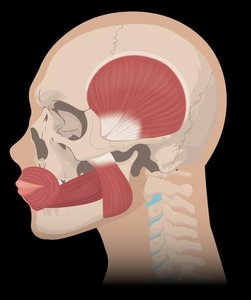
Try solving on your own before revealing the answer!
Final Answer: Mandible
The insertion of the masseter is the mandible, which moves during chewing.
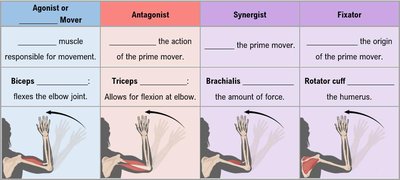
Q9. PRACTICE: True or False: A fixator works to stabilize the insertion of the antagonist.
Background
Topic: Muscle Roles in Movement
This question tests your understanding of the function of a fixator muscle.
Key Terms:
Fixator: A muscle that stabilizes the origin of the agonist.
Agonist and antagonist: Muscles responsible for movement and opposition.
Step-by-Step Guidance
Recall the definition of a fixator muscle.
Think about which attachment site the fixator stabilizes.
Consider whether the fixator acts on the agonist or antagonist.
Try solving on your own before revealing the answer!
Final Answer: False, the fixator stabilizes the origin of the agonist.
The fixator stabilizes the origin of the prime mover (agonist), not the insertion of the antagonist.
Q10. PRACTICE: The genioglossus is the primary muscle involved sticking out your tongue. The styloglossus is responsible for pulling the tongue back in, making it a(n) ______ for sticking out your tongue?
Background
Topic: Muscle Roles (Agonist, Antagonist, Synergist, Fixator)
This question tests your understanding of muscle roles in opposing actions.
Key Terms:
Agonist: Muscle responsible for a specific movement.
Antagonist: Muscle that opposes the action of the agonist.
Step-by-Step Guidance
Identify the action performed by the genioglossus (sticking out the tongue).
Determine the action of the styloglossus (pulling the tongue back in).
Recall which muscle role opposes the action of the agonist.
Try solving on your own before revealing the answer!
Final Answer: Antagonist
The styloglossus is the antagonist for sticking out the tongue, as it performs the opposite action.
Q11. PRACTICE: The soleus, gastrocnemius, and the tibialis anterior are all major muscles of the lower leg. The gastrocnemius and the soleus are both located in the posterior region of the calf, while the tibialis anterior is located in the anterior region of the lower leg. Based only on this information, which statement do you think is most likely true?
Background
Topic: Muscle Location and Function
This question tests your ability to infer muscle relationships based on anatomical location.
Key Terms:
Antagonist: Muscles that oppose each other's actions.
Synergist: Muscles that work together to produce a movement.
Fixator: Muscle that stabilizes a joint.
Step-by-Step Guidance
Identify the location of each muscle (anterior vs. posterior).
Recall that muscles on opposite sides of a joint often act as antagonists.
Consider which muscles are likely to work together or oppose each other based on their location.
Try solving on your own before revealing the answer!
Final Answer: The gastrocnemius and the tibialis anterior are antagonists.
Muscles located on opposite sides of the leg (anterior vs. posterior) typically act as antagonists.
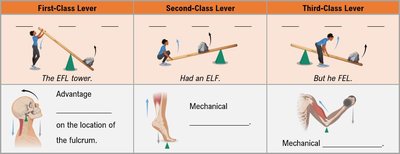
Q12. PRACTICE: In what type of lever is the force applied between the fulcrum and the load?
Background
Topic: Lever Systems in the Body
This question tests your knowledge of the three classes of levers and their arrangement in the body.
Key Terms:
Fulcrum: The pivot point of a lever.
Load: The weight or resistance moved by the lever.
Effort: The force applied to move the load.
Lever classes: First-class, second-class, third-class.
Step-by-Step Guidance
Recall the arrangement of fulcrum, load, and effort in each lever class.
Identify which class has the effort applied between the fulcrum and the load.
Think about common examples in the human body.
Try solving on your own before revealing the answer!
Final Answer: Third-class lever
In a third-class lever, the effort is applied between the fulcrum and the load.
Q13. PRACTICE: Which fascicle arrangement is most well suited to a muscle that needs to generate a lot of force over a small distance?
Background
Topic: Fascicle Arrangements and Muscle Function
This question tests your understanding of how fascicle arrangement affects force and range of movement.
Key Terms:
Fascicle arrangement: The pattern of muscle fibers within a muscle.
Force generation: The ability of a muscle to produce strength.
Range of movement: The distance a muscle can contract.
Step-by-Step Guidance
Recall the different types of fascicle arrangements (unipennate, bipennate, multipennate, fusiform, circular).
Think about which arrangement packs the most fibers into a given area.
Consider which arrangement is best for force generation over a small distance.
Try solving on your own before revealing the answer!
Final Answer: Multipennate
Multipennate fascicle arrangement is best suited for generating a lot of force over a small distance.
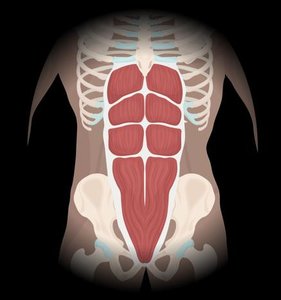
Q14. PRACTICE: Four muscles are shown below. Based on their fascicle arrangement, which muscle doesn’t belong in the group?
Background
Topic: Fascicle Arrangement Identification
This question tests your ability to recognize different fascicle arrangements and identify the outlier.
Key Terms:
Fascicle arrangement: The pattern of muscle fibers within a muscle.
Muscle names: Rectus abdominis, interossei, biceps brachii, sternocleidomastoid.
Step-by-Step Guidance
Recall the typical fascicle arrangement for each muscle listed.
Compare the arrangement of each muscle to the others.
Identify which muscle has a different arrangement from the rest.
Try solving on your own before revealing the answer!
Final Answer: Sternocleidomastoid
The sternocleidomastoid has a different fascicle arrangement compared to the other muscles listed.
Q15. PRACTICE: Based on the name, how does the fibularis brevis compare to the fibularis longus?
Background
Topic: Muscle Naming Conventions
This question tests your understanding of how muscle names reflect their characteristics.
Key Terms:
Brevis: Short.
Longus: Long.
Step-by-Step Guidance
Recall the meaning of "brevis" and "longus" in muscle names.
Compare the expected length of the two muscles.
Think about how the name reflects the muscle's physical characteristics.
Try solving on your own before revealing the answer!
Final Answer: The fibularis brevis muscle is relatively short while the fibularis longus is relatively long.
"Brevis" means short and "longus" means long, so the names indicate their relative lengths.
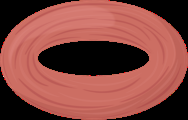
Q16. PRACTICE: Based on the name, how would you expect the orbicularis oris muscle to be shaped?
Background
Topic: Muscle Naming and Shape
This question tests your ability to infer muscle shape from its name.
Key Terms:
Orbicularis: Circular.
Oris: Related to the mouth.
Step-by-Step Guidance
Recall the meaning of "orbicularis" in muscle names.
Think about the typical shape of muscles with this name.
Consider the location and function of the orbicularis oris.
Try solving on your own before revealing the answer!
Final Answer: Circular
The orbicularis oris muscle is shaped in a circular pattern around the mouth.
Q17. PRACTICE: Which of the following muscle names does NOT provide information about the muscle’s actions?
Background
Topic: Muscle Naming and Actions
This question tests your ability to identify which muscle names indicate their actions.
Key Terms:
Muscle action: The movement performed by the muscle.
Muscle naming conventions: Flexor, abductor, extensor, transverse.
Step-by-Step Guidance
Review the meaning of each muscle name listed.
Identify which names describe an action (flexion, abduction, extension).
Determine which name describes a direction or location rather than an action.
Try solving on your own before revealing the answer!
Final Answer: Transverse abdominis
"Transverse abdominis" describes the direction of fibers, not the action performed by the muscle.
