 Indietro
Nervous System: Membrane Potentials, Nerve Signaling, and Synaptic Transmission
Guida di studio - Note intelligenti
 Appunti personalizzati basati sui tuoi materiali, ampliati con definizioni chiave, esempi e contesto.
Nervous System: Electrical Signaling and Synaptic Transmission
Resting Membrane Potential (RMP)
The resting membrane potential (RMP) is the voltage difference across the cell membrane of a neuron when it is not actively transmitting a signal. This potential is essential for the function of excitable cells such as neurons and muscle cells.
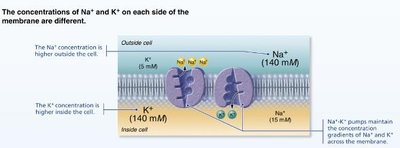
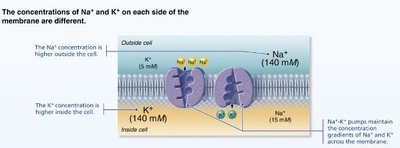
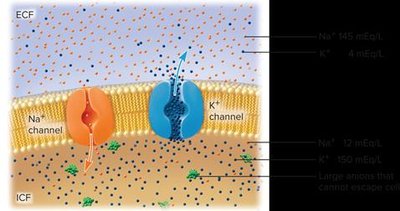
RMP is generated by the unequal distribution of ions (mainly Na+ and K+) across the cell membrane.
Na+ is more concentrated outside the cell, while K+ is more concentrated inside.
Negatively charged anions (phosphates, proteins, nucleic acids) are more abundant inside the cell, making the interior more negative.
The cell membrane is polarized due to this unequal distribution.
Maintaining Resting Membrane Potential
Leakage of Na+ and K+ through their respective channels can disrupt the RMP. The sodium-potassium pump (Na+/K+ ATPase) is crucial for maintaining this potential.
The pump actively transports 3 Na+ ions out of the cell and 2 K+ ions into the cell, using ATP.
This maintains the concentration gradients and the negative charge inside the cell.
Formula for the pump's action:
Nerve Signaling: Ion Channels
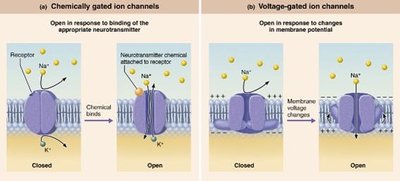
Nerve signaling depends on the opening and closing of ion channels in the plasma membrane. There are two primary types:
Ligand-gated channels: Open in response to binding of a specific chemical (neurotransmitter).
Voltage-gated channels: Open in response to changes in membrane potential.
Action Potential: Generation and Phases
An action potential is a rapid change in membrane potential that propagates along the axon. It consists of four main phases:
Resting State: All voltage-gated Na+ and K+ channels are closed; only leakage channels are open.
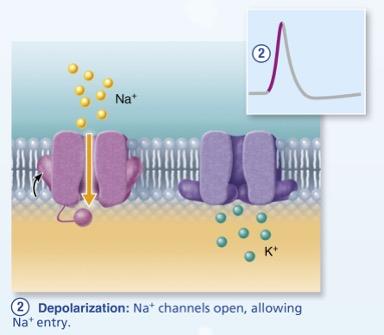
Depolarization: Voltage-gated Na+ channels open, Na+ rushes into the cell, making the inside more positive. Positive feedback causes more Na+ channels to open. Threshold is typically -55 to -50 mV.
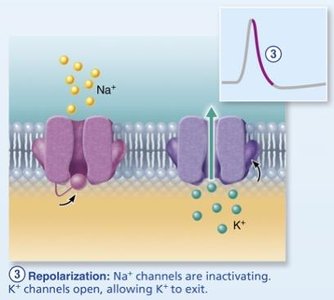
Repolarization: Na+ channels inactivate, voltage-gated K+ channels open, K+ exits the cell, restoring negative membrane potential.
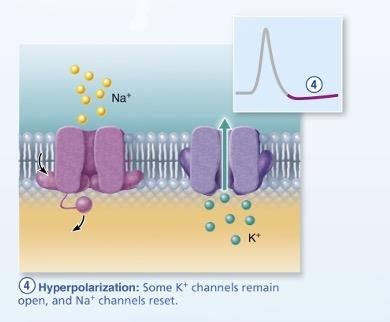
Hyperpolarization: Some K+ channels remain open, causing the membrane potential to become more negative than the resting state. Na+ channels reset.
Conducting a Nerve Signal
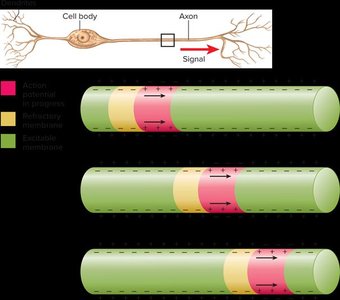
The action potential propagates along the axon in a domino effect, creating a nerve signal. After an action potential, the membrane enters a refractory period during which it cannot be stimulated again.
Continuous conduction: Occurs in unmyelinated axons; action potential is generated at every point along the axon.
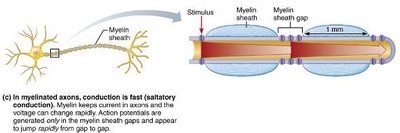
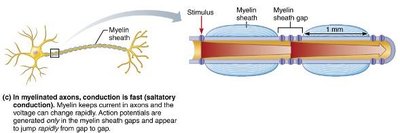
Saltatory conduction: Occurs in myelinated axons; action potential jumps from node to node (Nodes of Ranvier), increasing speed and efficiency.
Clinical Homeostatic Imbalance: Multiple Sclerosis (MS)
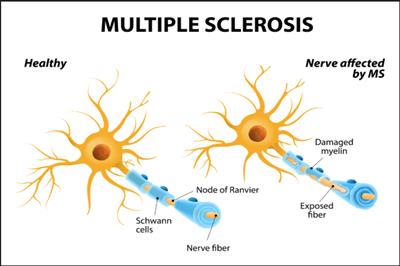
Multiple sclerosis (MS) is an autoimmune disease that destroys myelin sheaths in the CNS, impairing nerve signal conduction.
Symptoms include visual disturbances, weakness, loss of muscular control, speech difficulties, and incontinence.
Treatment involves drugs that modify immune system activity; high vitamin D levels may reduce risk.
Transmitting a Nerve Signal to the Next Cell
Neurons communicate with other cells via synapses. There are two main types:
Electrical synapses: Less common, joined by gap junctions, rapid communication, most abundant in embryonic tissue.
Chemical synapses: Most common, involve neurotransmitter release.
Chemical Synapse Transmission
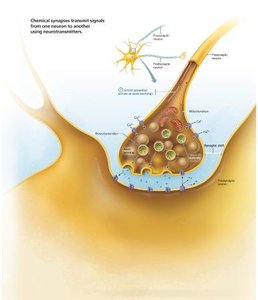
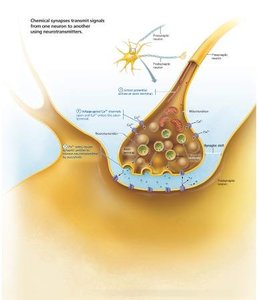
When an action potential reaches the axon terminal, synaptic vesicles release neurotransmitters into the synaptic cleft.
The presynaptic neuron releases neurotransmitters, which bind to receptors on the postsynaptic neuron.
Neurotransmitters are broken down by enzymes or reabsorbed by the presynaptic neuron.
Examples of neurotransmitters: acetylcholine (ACh), norepinephrine, serotonin, dopamine.
Clinical Homeostatic Imbalance: Parkinson's Disease
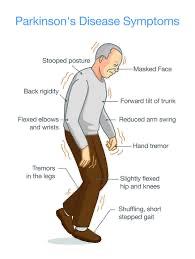
Parkinson's disease is characterized by progressive loss of motor control, typically beginning in a person's 50s or 60s. It is caused by degeneration of dopamine-releasing neurons.
Dopamine acts as an inhibitory neurotransmitter, preventing excessive activity.
Loss of dopamine neurons leads to involuntary muscle contractions and symptoms such as tremors, rigidity, and shuffling gait.
Summary Table: Ion Distribution and Membrane Potential
Ion | Inside Cell | Outside Cell |
|---|---|---|
Na+ | Low | High |
K+ | High | Low |
Negative Anions | High | Low |
Key Formula:
Example: The sodium-potassium pump maintains the RMP by actively transporting ions against their concentration gradients, ensuring the neuron is ready to fire an action potential when stimulated.
Additional info: The refractory period ensures unidirectional propagation of the action potential and prevents overlapping signals.
