 Indietro
Nervous Tissue: Structure, Function, and Cellular Organization
Guida di studio - Note intelligenti
 Appunti personalizzati basati sui tuoi materiali, ampliati con definizioni chiave, esempi e contesto.
Nervous Tissue
Organization of the Nervous System
The nervous system is a complex network responsible for communication and control throughout the body. It is divided both structurally and functionally to facilitate its diverse roles.
Structural Division:
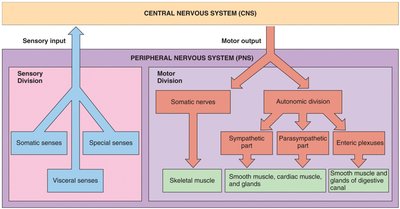
Central Nervous System (CNS): Composed of the brain and spinal cord.
Peripheral Nervous System (PNS): Includes 12 cranial nerves, 31 spinal nerves, and ganglia.
Functional Division:
Sensory Nervous System: Receives information from receptors and transmits it to the CNS.
Motor Nervous System: Sends impulses from the CNS to muscles and glands.
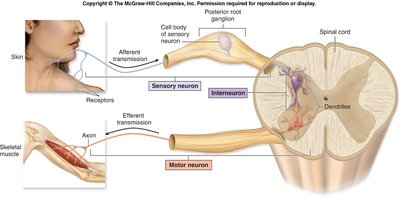
General Functions of the Sensory and Motor Nervous System
The nervous system operates through three main functions:
Sensory Function: Detects stimuli via receptors and transmits information to the CNS.
Integrative Function: Interneurons analyze sensory information, provide perception, and make decisions.
Motor Function: Motor neurons initiate actions in effectors (muscle fibers, glandular cells).
Divisions of the Peripheral Nervous System
The PNS is further divided into somatic, autonomic, and enteric systems, each with distinct roles.
Somatic Nervous System (SNS):
Somatic sensory neurons: Convey information from skin, muscles, joints, and special senses to the CNS.
Somatic motor neurons: Conduct impulses from CNS to skeletal muscles (voluntary control).
Autonomic Nervous System (ANS):
Autonomic sensory neurons: Convey information from visceral organs to the CNS.
Autonomic motor neurons: Regulate smooth muscle, cardiac muscle, and glands (involuntary control).
Sympathetic Division: Supports exercise and emergency actions ("fight-or-flight").
Parasympathetic Division: Maintains resting functions ("rest-and-digest").
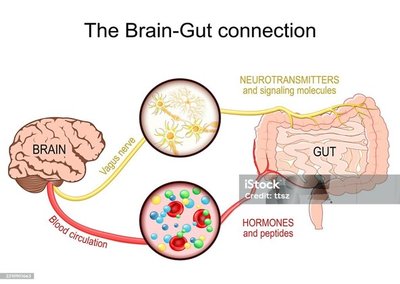
Enteric Nervous System (ENS):
"Brain of the gut" with over 100 million neurons along the GI tract.
Monitors chemical changes and wall stretching; governs muscle contraction and secretions.
Cytology of Nervous Tissue
Types of Cells in Nervous Tissue
Nervous tissue contains two main cell types:
Neurons: Electrically excitable cells that initiate, transmit, and receive nerve impulses.
Glial Cells: Nonexcitable cells that support, protect, and nourish neurons; maintain interstitial fluid.
Neurons: Structure and Function
Neurons are the basic structural units of the nervous system, specialized for communication.
Excitable: Respond to stimuli.
Conductive: Propagate electrical signals.
Secretory: Release neurotransmitters.
Long-lived: Formed during fetal development, functional for life.
Amitotic: Most lose ability to divide after development.
Highly metabolic: Require abundant glucose and oxygen.
Neuron Structure
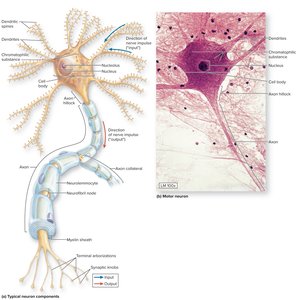
Cell body (soma): Contains nucleus, nucleolus, mitochondria, and chromatophilic substance (ribosomes and rough ER).
Dendrites: Short, branched processes that receive signals and transfer them to the cell body.
Axon: Transmits impulses away from the cell body; may have axon collaterals, terminal arborizations, and synaptic knobs.
Axon hillock: Region where axon connects to cell body.
Neurofilaments: Support cell extensions.
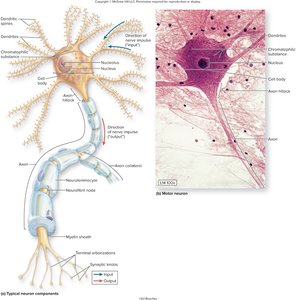
Classification of Neurons
Structural Classification:
Unipolar: Single, short process branches like a T; process is an axon.
Bipolar: Two processes: one dendrite, one axon.
Multipolar: Many dendrites, one axon; most common type.
Functional Classification:
Sensory (afferent) neurons: Transmit impulses from receptors to CNS.
Motor (efferent) neurons: Transmit impulses from CNS to muscles/glands.
Interneurons: Process, store, and communicate information between sensory and motor neurons.
Glial Cells
Glial Cells of the CNS
Glial cells are essential for neuron support and protection. Four types are found in the CNS:
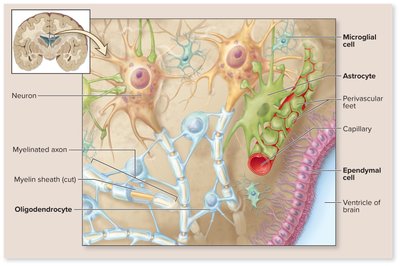
Astrocytes: Most abundant; form blood-brain barrier, regulate fluid, provide structural support, replace damaged neurons, assist development, regulate synaptic transmission.
Ependymal cells: Line ventricles and central canal; produce cerebrospinal fluid (CSF), form choroid plexus.
Microglial cells: Remove debris and damaged tissue.
Oligodendrocytes: Myelinate CNS axons; wrap axons with myelin sheath.
Glial Cells of the PNS
Satellite cells: Regulate fluid around neuron cell bodies in ganglia.
Neurolemmocytes (Schwann cells): Form myelin around PNS axons.
Myelination of Axons
Myelination Process
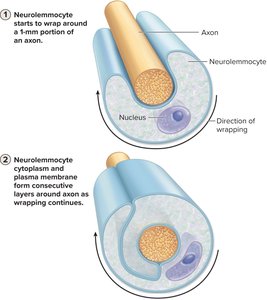
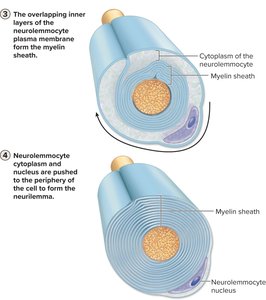
Myelination is the process of wrapping axons with a myelin sheath, which electrically insulates and increases the speed of nerve impulse conduction.
Neurolemmocytes (Schwann cells): Myelinate PNS axons; multiple cells required for one axon.
Oligodendrocytes: Myelinate CNS axons; one cell can myelinate multiple axons.
Neurilemma: Outer membrane of neurolemmocyte.
Myelinated vs. Unmyelinated Axons
Myelinated axons: Conduct impulses rapidly.
Unmyelinated axons: Conduct impulses slowly; in PNS, still associated with neurolemmocytes but lack myelin sheath.
Nerves
Structure and Organization of Nerves
Nerves are cable-like bundles of parallel axons, organized by connective tissue wrappings:
Endoneurium: Areolar connective tissue around each axon.
Perineurium: Dense irregular connective tissue around each fascicle (bundle) of axons.
Epineurium: Dense irregular connective tissue around the entire nerve.
Synapses and Neurotransmitters
Synapse Structure and Function
Synapses are specialized junctions for communication between neurons or between neurons and effector cells.
Presynaptic neuron: Sends signal via synaptic knobs.
Synaptic cleft: Narrow space between cells.
Postsynaptic neuron: Receives signal.
Types of synapses: Axodendritic, axosomatic, axoaxonic.
Neurotransmitters
Neurotransmitters are chemical messengers released by presynaptic neurons to transmit signals across the synaptic cleft.
Examples: Acetylcholine (ACh), glutamate, aspartate, GABA, glycine, norepinephrine (NE), dopamine (DA), serotonin, endorphins, nitric oxide (NO).
Lesson Summary
The nervous system has structural and functional divisions, including sensory and motor pathways.
Neuron parts support communication; neurons have structural and functional classes.
Glial cells have distinct supporting and protective roles.
Oligodendrocytes form CNS myelin; Schwann cells form PNS myelin.
Nerves contain axons organized within three connective tissue coverings.
At chemical synapses, neurotransmitters convey signals to target cells.
