 Indietro
Nutrition, Metabolism, and Energy Balance: Study Notes for Anatomy & Physiology
Guida di studio - Note intelligenti
 Appunti personalizzati basati sui tuoi materiali, ampliati con definizioni chiave, esempi e contesto.
Nutrients and Dietary Principles
Types of Nutrients
Nutrients are substances in food required for growth, maintenance, and repair. They are classified as macronutrients and micronutrients based on the quantity needed by the body.
Macronutrients: Carbohydrates, lipids, and proteins; these make up the bulk of ingested food.
Micronutrients: Vitamins and minerals; required in smaller amounts.
Essential nutrients: Must be obtained from the diet because the body cannot synthesize them.
Nonessential nutrients: Can be synthesized by the body if not enough is available.
Energy value: Measured in kilocalories (kcal); 1 dietary "Calorie" equals 1 kcal.
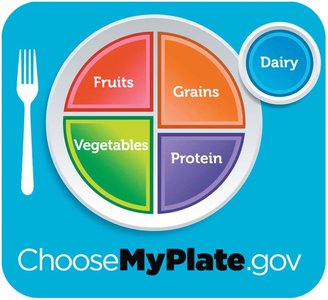
USDA's MyPlate provides guidelines for balanced nutrition, emphasizing fruits, vegetables, grains, protein, and dairy.
Basic Dietary Principles
Eat only what you need; avoid overeating.
Consume plenty of fruits, vegetables, and whole grains.
Limit intake of junk food and simple carbohydrates.
Carbohydrates
Dietary Sources and Types
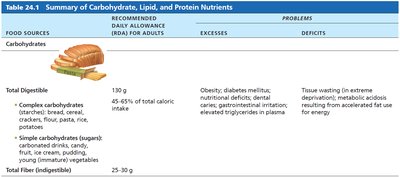
Carbohydrates are primarily derived from plants and are classified as complex or simple carbohydrates.
Complex carbohydrates: Starch in grains and vegetables.
Simple carbohydrates: Sugars in fruits, sugarcane, honey, and milk.
Insoluble fiber: Cellulose in vegetables; provides roughage.
Soluble fiber: Pectin in apples and citrus fruits; reduces blood cholesterol.
Uses in the Body
Glucose: Main fuel for ATP production; neurons and RBCs rely entirely on glucose.
Excess glucose is stored as glycogen or fat.
Fructose and galactose are converted to glucose in the liver.
Dietary Requirements
Recommended daily intake: 45–65% of total calories, mostly from complex carbohydrates.
Simple carbohydrates should be limited.
Lipids
Dietary Sources
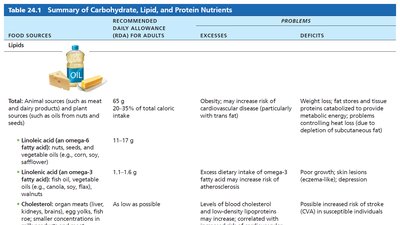
Lipids include triglycerides, saturated and unsaturated fats, and cholesterol. Essential fatty acids must be obtained from the diet.
Triglycerides: Most abundant; found in animal and plant sources.
Saturated fats: Meat, dairy, tropical oils, hydrogenated oils.
Unsaturated fats: Seeds, nuts, olive oil, vegetable oils.
Cholesterol: Egg yolk, meats, shellfish, milk products; liver synthesizes most cholesterol.
Essential fatty acids: Linoleic (omega-6) and linolenic (omega-3); found in vegetable oils.
Uses in the Body
Adipose tissue provides protection, insulation, and fuel storage.
Phospholipids are essential for cell membranes and myelin sheaths.
Cholesterol stabilizes membranes and is a precursor for bile salts and steroid hormones.
Prostaglandins regulate smooth muscle contraction, blood pressure, and inflammation.
Major fuel for hepatocytes and skeletal muscle; aids absorption of fat-soluble vitamins.
Dietary Requirements
Fats: 20–35% of total caloric intake.
Saturated fats: Limited to 10% or less.
Cholesterol: Intake should be minimized, especially for those with high blood cholesterol.
Proteins
Dietary Sources
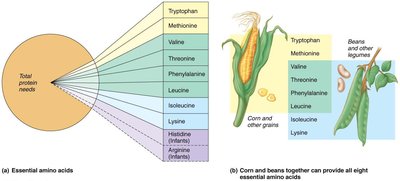
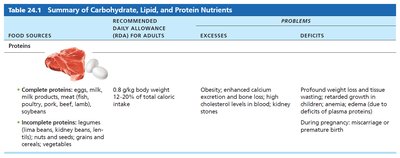
Proteins are obtained from animal and plant sources. Complete proteins contain all essential amino acids, while incomplete proteins lack one or more.
Complete proteins: Eggs, milk, fish, meats, soybeans.
Incomplete proteins: Legumes, nuts, cereals; combining legumes and grains provides all essential amino acids.
Uses in the Body
Structural materials: Keratin, collagen, elastin, muscle proteins.
Functional molecules: Enzymes, hormones.
Protein synthesis depends on the all-or-none rule, adequacy of caloric intake, and hormonal controls.
Nitrogen balance: Positive (synthesis > breakdown) or negative (breakdown > synthesis).
Dietary Requirements
Daily intake: 0.8 g per kg body weight.
Needs vary with age, size, metabolic rate, and nitrogen balance.
Vitamins
Types and Functions
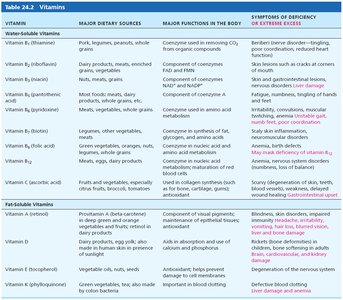
Vitamins are organic compounds crucial for nutrient utilization, mostly functioning as coenzymes. They are classified by solubility.
Water-soluble: B complex and C; absorbed with water, not stored, excess excreted.
Fat-soluble: A, D, E, K; absorbed with lipids, stored in body (except K), excess can cause health issues.
Some vitamins are antioxidants, neutralizing free radicals (C, E, A, selenium).
Dietary Sources
No single food group contains all vitamins.
Most must be ingested; exceptions include vitamin D, some B and K, and beta-carotene (converted to A).
Minerals
Types and Functions
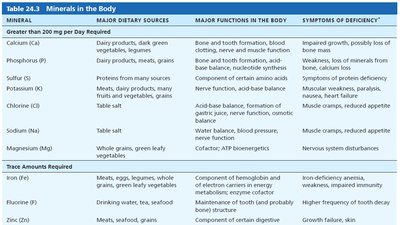
Minerals are inorganic elements required for proper body function. Seven are needed in moderate amounts; others are trace elements.
Major minerals: Calcium, phosphorus, potassium, sulfur, sodium, chlorine, magnesium.
Trace minerals: Iron, iodine, zinc, fluorine, copper, etc.
Minerals work with nutrients to ensure proper body functioning; uptake and excretion are balanced.
Uses in the Body
Bone hardening: Calcium, phosphorus, magnesium.
Oxygen transport: Iron (hemoglobin).
Thyroid hormone synthesis: Iodine.
Electrolyte balance: Sodium, chloride.
Metabolism: Anabolism and Catabolism
Overview of Metabolic Processes
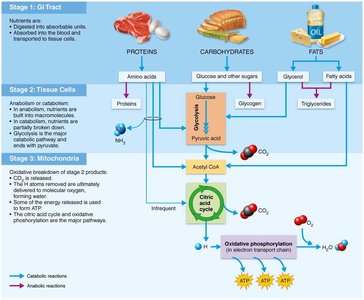
Metabolism is the sum of all biochemical reactions involving nutrients. It includes anabolism (building molecules) and catabolism (breaking down molecules).
Anabolism: Synthesis of large molecules from small ones.
Catabolism: Hydrolysis of complex structures to simpler ones.
Cellular respiration: Catabolic breakdown of food to trap energy in ATP.
Phosphorylation: Enzymes transfer high-energy phosphate groups from ATP to other molecules, activating them.
Stages of Nutrient Processing
Stage 1: Digestion, absorption, and transport to tissues.
Stage 2: Cellular processing (synthesis or catabolism in cytoplasm).
Stage 3: Oxidative breakdown in mitochondria to CO2, water, and ATP.
Oxidation-Reduction Reactions
Definitions and Enzymes
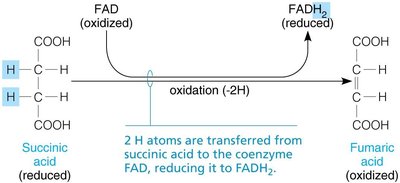
Oxidation-reduction (redox) reactions involve the transfer of electrons and are essential for energy production.
Oxidation: Gain of oxygen or loss of hydrogen/electrons.
Reduction: Loss of oxygen or gain of hydrogen/electrons.
Redox reactions are catalyzed by enzymes, often requiring B vitamin coenzymes.
Key enzymes: Dehydrogenases (remove H), oxidases (transfer O).
Coenzymes: NAD+ and FAD act as hydrogen/electron acceptors.
ATP Synthesis
Substrate-Level Phosphorylation
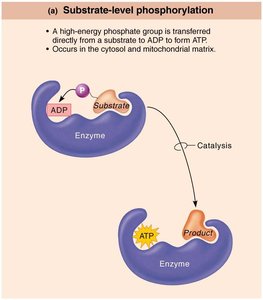
ATP can be synthesized directly by transferring a phosphate group from a substrate to ADP.
Occurs in glycolysis (cytosol) and citric acid cycle (mitochondria).
Enzymes catalyze the transfer.
Oxidative Phosphorylation
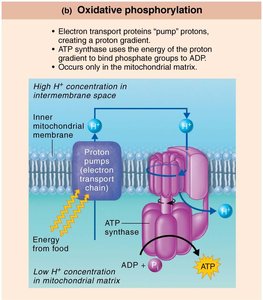
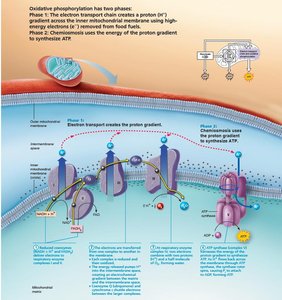
This process produces most ATP and involves the electron transport chain and chemiosmosis.
Energy from food oxidation pumps H+ across the inner mitochondrial membrane.
H+ flows back through ATP synthase, driving ATP production.
Carbohydrate Metabolism
Glucose Utilization
Glucose entering a cell is phosphorylated to glucose-6-phosphate, trapping it inside. Only certain cells can reverse this reaction.
Maintains low intracellular glucose, ensuring continued uptake.
Oxidation of Glucose
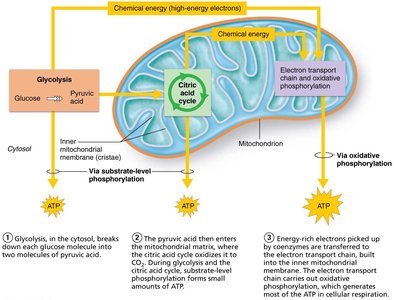
Complete glucose catabolism involves three pathways:
Glycolysis
Citric Acid Cycle (CAC)
Electron Transport Chain (ETC) and oxidative phosphorylation
Glycolysis
Phases of Glycolysis
Glycolysis is a 10-step anaerobic pathway in the cytosol, converting glucose to two pyruvic acid molecules.
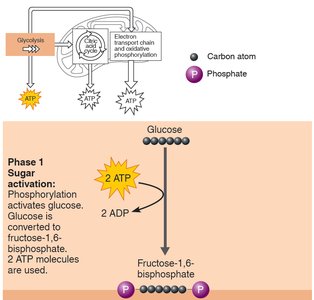
Phase 1: Sugar activation – Glucose is phosphorylated twice, using 2 ATP, to form fructose-1,6-bisphosphate.
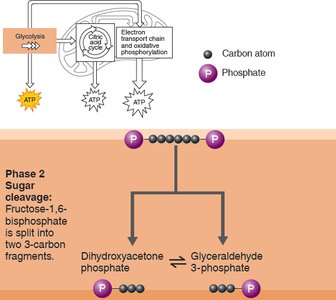
Phase 2: Sugar cleavage – Fructose-1,6-bisphosphate is split into two 3-carbon fragments: dihydroxyacetone phosphate and glyceraldehyde 3-phosphate.
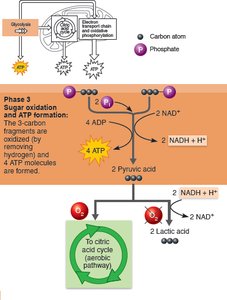
Phase 3: Sugar oxidation and ATP formation – Each fragment is oxidized, NAD+ is reduced to NADH + H+, and 4 ATP are produced by substrate-level phosphorylation.
Final Products of Glycolysis
2 pyruvic acids
2 NADH + H+
Net gain of 2 ATP
For glycolysis to continue, NAD+ must be regenerated. If oxygen is present, NADH transfers H to the ETC; if not, H is transferred to pyruvic acid, forming lactic acid.
Citric Acid Cycle (Krebs Cycle)
Transitional Phase
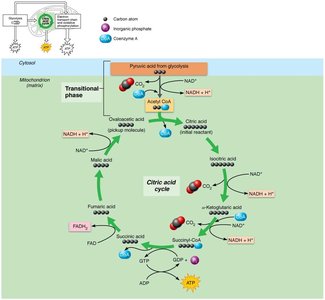
Pyruvic acid is converted to acetyl CoA in three steps: decarboxylation, oxidation, and formation of acetyl CoA.
Cycle Steps
Acetyl CoA combines with oxaloacetic acid to form citric acid.
Through eight steps, citric acid is decarboxylated and oxidized, producing NADH + H+, FADH2, CO2, and ATP.
Cycle intermediates can be used for anabolic reactions.
Final Products (per glucose)
6 CO2
8 NADH + H+
2 FADH2
2 ATP
Electron Transport Chain (ETC) and Chemiosmosis
ETC Overview
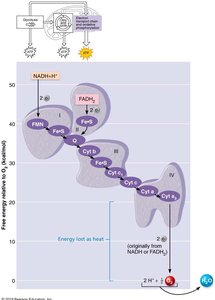
The ETC creates a proton gradient across the mitochondrial membrane using high-energy electrons from NADH and FADH2.
Electrons are passed through a series of carrier proteins (flavins, cytochromes).
Energy released pumps H+ into the intermembrane space.
At complex IV, electrons combine with H+ and O2 to form water.
Chemiosmosis
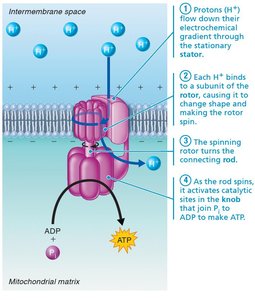
ATP synthase uses the energy of the proton gradient to synthesize ATP.
H+ flows through ATP synthase, causing it to spin and catalyze the addition of Pi to ADP.
Proton gradient also drives transport of ADP, pyruvic acid, Pi, and calcium into the mitochondria.
Summary of ATP Production
Energy Yield from Glucose
Substrate-level phosphorylation: 4 ATP (2 from glycolysis, 2 from citric acid cycle)
Oxidative phosphorylation: ~28 ATP (25 from NADH, 3 from FADH2)
Total: ~32 ATP per glucose molecule (actual yield may vary due to energy costs of transporting NADH into mitochondria)
Equation for complete oxidation of glucose:
Tables: Summary of Nutrients
Carbohydrates, Lipids, and Proteins
Food Sources | Recommended Daily Allowance | Excesses | Deficits |
|---|---|---|---|
Carbohydrates | 130 g; 45–65% of total caloric intake | Obesity, diabetes, nutritional deficits, dental caries, GI irritation, elevated triglycerides | Tissue wasting, metabolic acidosis |
Lipids | 65 g; 20–35% of total caloric intake | Obesity, cardiovascular disease | Weight loss, skin lesions, depression |
Proteins | 0.8 g/kg body weight; 12–20% of total caloric intake | Obesity, kidney stones, high cholesterol | Weight loss, anemia, edema |
Vitamins
Vitamin | Major Dietary Sources | Major Functions | Deficiency Symptoms |
|---|---|---|---|
Vitamin A | Provitamin A (beta-carotene), carrots, green vegetables | Component of visual pigment, antioxidant | Vision disorders, skin disorders |
Vitamin D | Dairy, egg yolk, sunlight | Calcium absorption, bone health | Rickets, bone softening |
Vitamin E | Vegetable oils, nuts | Antioxidant | Neurological issues |
Vitamin K | Green vegetables | Blood clotting | Bleeding disorders |
Minerals
Mineral | Major Dietary Sources | Major Functions | Deficiency Symptoms |
|---|---|---|---|
Calcium | Dairy, green vegetables | Bone and tooth formation | Impaired growth, bone loss |
Phosphorus | Dairy, meats, grains | Bone and tooth formation | Weakness, bone loss |
Iron | Meats, legumes | Hemoglobin component | Anemia |
Iodine | Seafood, iodized salt | Thyroid hormone synthesis | Goiter |
