Indietro
Overview of the Immune System: Innate and Adaptive Immunity
Guida di studio - Note intelligenti
 Appunti personalizzati basati sui tuoi materiali, ampliati con definizioni chiave, esempi e contesto.
The Immune System
Introduction
The immune system is a complex network of cells, tissues, and molecules that protects the body from pathogens such as bacteria, viruses, fungi, and parasites. It is divided into two main branches: the innate (nonspecific) immune system and the adaptive (specific) immune system. Each branch has distinct components and mechanisms for defending the body.
Innate (Nonspecific) Immune System
Overview
The innate immune system provides the first line of defense against pathogens. It responds rapidly and in the same way to all invaders, without generating long-lasting memory. Specialized cells constantly patrol the body to recognize, engulf, and destroy pathogens immediately after exposure.
Physical & Anatomical Barriers:
Skin: Acts as an impermeable barrier to pathogens.
Mucus membranes: Trap microorganisms in the respiratory, gastrointestinal, and urogenital tracts.
Cilia: Sweep trapped pathogens out of the respiratory tract.
Chemical & Physiological Barriers:
Stomach (pH 1-3): Destroys ingested microorganisms.
Lysozymes: Enzymes in tears, saliva, and sweat that disrupt bacterial cell walls.
Complement Proteins: Opsonize (tag) bacteria and recruit immune system cells.
Cytokines & Interferons: Signaling proteins that induce inflammation and block viral replication.
Cellular Components:
Neutrophils: Most abundant white blood cells; engulf bacteria.
Macrophages: Engulf pathogens and cell debris; act as antigen-presenting cells to the adaptive immune system T-cells.
Dendritic cells: In tissues in contact with the external environment; ingest pathogens and migrate to lymph nodes to activate T-cells.
Natural killer cells: Destroy compromised cells (virus-infected or tumor cells).
Mast cells: Release histamine to trigger inflammation or allergies.
Adaptive (Specific) Immune System
Overview
The adaptive immune system provides a targeted response to specific pathogens and generates immunological memory. It consists of humoral immunity (mediated by B cells and antibodies) and cell-mediated immunity (mediated by T cells).
Humoral Immunity:
B cells: Target extracellular pathogens in plasma and secrete antibodies.
Plasma cells: Activated B cells that secrete antibodies.
Memory B cells: Long-lived cells that respond rapidly upon re-exposure to the same antigen.
Cell-Mediated Immunity:
T cells: Target intracellular pathogens; direct destruction of infected host cells.
Helper T cells (CD4): Commanders of the immune system; secrete cytokines to activate cytotoxic T cells, direct B cells to make antibodies, and rally macrophages.
Cytotoxic T cells (CD8): Recognize and destroy virus-infected or cancerous cells by releasing chemicals (perforins and granzymes) to induce apoptosis.
Regulatory T cells: Suppress the immune response once infection is cleared, preventing autoimmunity.
T-memory cells: Remain in plasma for immediate response upon second exposure to a particular antigen.
T-cells cannot recognize free-floating antigens; they only respond to antigen fragments presented on cell surfaces using Major Histocompatibility Complex (MHC) molecules.
Connection Between Innate and Adaptive Immunity
T-cells and Natural Killer T-cells serve as a bridge between the innate and adaptive immune systems, facilitating communication and coordinated responses.
Clinical Note
AIDS targets CD4 Helper T-cells, severely diminishing the immune response by disrupting the signaling required for B-cells and cytotoxic T-cells.
Summary Table: Components of the Immune System
Component | Specific Example | Function |
|---|---|---|
Physical & Anatomical Barriers | Skin, Mucus membranes, Cilia | Prevent entry and remove pathogens |
Chemical & Physiological Barriers | Stomach acid, Lysozymes, Complement proteins, Cytokines | Destroy pathogens, signal immune response |
Cellular Components (Innate) | Neutrophils, Macrophages, Dendritic cells, Natural killer cells, Mast cells | Engulf, destroy, and signal about pathogens |
Cellular Components (Adaptive) | B cells, Plasma cells, Memory B cells, Helper T cells, Cytotoxic T cells, Regulatory T cells, T-memory cells | Target specific pathogens, generate memory, regulate response |
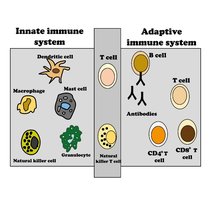
Illustration: Innate vs. Adaptive Immune System
The following diagram visually distinguishes the main cell types and their roles in the innate and adaptive immune systems, highlighting the bridge formed by T-cells and Natural Killer T-cells.