 Indietro
Physical Assessment: Concepts and Techniques for Anatomy & Physiology
Guida di studio - Note intelligenti
 Appunti personalizzati basati sui tuoi materiali, ampliati con definizioni chiave, esempi e contesto.
Physical Assessment
Purpose of Physical Assessment
Physical assessment is a fundamental process in healthcare used to evaluate a patient's health status. It helps identify current conditions, potential health problems, and the effectiveness of interventions.
Establishing Current Condition: Determines baseline health status.
Identifying Problems: Detects existing or potential health issues.
Evaluating Interventions: Assesses the effectiveness of nursing or medical care.
Monitoring Changes: Tracks alterations in body function over time.
Detecting Specific Needs: Pinpoints body systems requiring further assessment or testing.
Levels of Physical Assessment
Different levels of assessment are performed based on the clinical situation and patient needs.
Comprehensive Health Assessment: In-depth evaluation of physical, mental, emotional, cultural, and spiritual health.
Focused Assessment: Examination and interview targeting a specific body system.
Initial Head-to-Toe Shift Assessment: Conducted at the start of a shift to establish a baseline for ongoing care.
Timing of Physical Assessment
Physical assessment is an ongoing process, performed at various points during patient care.
On admission
At the beginning of each shift
When a patient’s condition changes
When evaluating the effectiveness of care
Whenever something feels abnormal or concerning
Abnormal Assessment Findings
Abnormal findings are those outside the normal range for the patient and require prompt reassessment.
Reassess within 4 hours or sooner, depending on severity.
Assessment Techniques
Physical assessment utilizes both subjective and objective data, employing several techniques:
Subjective Data: Information from patient interviews.
Objective Data: Observable and measurable signs.
Inspection/Observation: Visual examination of the patient.
Palpation: Using touch to assess texture, temperature, and structure.
Percussion: Tapping to evaluate underlying structures.
Auscultation: Listening to body sounds, often with a stethoscope.
Olfaction: Using smell to detect abnormalities.
Example:
Auscultation is used to assess heart, lung, and bowel sounds. For instance, listening to the lungs can reveal wheezes or rales, indicating respiratory issues.
Assessment Components Related to Body Systems
Physical assessment is organized by body systems, each with specific components to evaluate.
Head and Neck: Eyes (jaundice, ptosis, consensual reflex, accommodation response), oral mucous membranes, lips, teeth, speech, dressings/equipment.
Chest: Excursion, atelectasis, retractions, breath sounds (rales, rhonchi, wheezes, stridor), apical pulse.
Abdomen: Bowel sounds, peristalsis, suprapubic assessment, skin, dressings/equipment.
Extremities: Upper (radial pulses, movement, capillary refill), Lower (edema, pallor, circulation, pedal pulses).
Visual Screening
Visual screening, such as the Snellen Standard Chart, is commonly used in public health settings to assess vision.
Needs and Comfort
Assessment also includes evaluating patient needs and comfort, which may involve pain, mobility, and emotional well-being.
Documentation of Assessment Findings
All assessment findings must be documented promptly, using either computerized or handwritten methods. Facilities have specific forms and policies for documentation.
Documentation ensures continuity of care and legal compliance.
Initial head-to-toe shift assessments are recorded on designated forms.
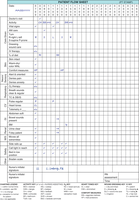
Example:
The Patient Flow Sheet is used to systematically record assessment findings for each body system, ensuring comprehensive and organized documentation.
Assessment of Head and Neck
Assessment of the head and neck includes evaluation of the eyes, oral cavity, and speech.
Eyes: Check for jaundice, ptosis, consensual reflex, and accommodation response.
Oral Mucous Membranes: Inspect for color, moisture, and lesions.
Lips: Look for cheilitis (inflammation).
Teeth: Assess for dental health.
Speech: Evaluate for dysphasia (difficulty speaking).
Example:
The consensual reflex is observed when shining a light in one eye causes both pupils to constrict simultaneously, due to the bifurcation of the optic nerve.
Assessment of Chest
Chest assessment focuses on respiratory and cardiac function.
Excursion: Movement of the chest during breathing.
Atelectasis: Collapse of lung tissue.
Retractions: Indrawing of the chest wall.
Adventitious Breath Sounds: Includes rales, rhonchi, wheezes, and stridor.
Apical Pulse: Heartbeat at the apex of the heart.
Assessment of Abdomen
Abdominal assessment includes evaluation of bowel sounds, peristalsis, and skin integrity.
Bowel Sounds: Listen for normal or abnormal sounds indicating peristalsis.
Suprapubic Assessment: Palpate for bladder distention.
Skin: Inspect for color, lesions, and dressings.
Assessment of Extremities
Assessment of extremities includes checking pulses, movement, and signs of circulation.
Upper Extremities: Radial pulses, movement, capillary refill time.
Lower Extremities: Edema, pallor, circulation, pedal pulses.
Glasgow Coma Scale
The Glasgow Coma Scale is used to assess neurological function, particularly in patients with altered consciousness.
Eye Opening: Response to stimuli.
Verbal Response: Ability to speak coherently.
Motor Response: Movement in response to commands.
Component | Score Range | Description |
|---|---|---|
Eye Opening | 1-4 | Spontaneous to none |
Verbal Response | 1-5 | Oriented to none |
Motor Response | 1-6 | Obeys commands to none |
Example:
A patient scoring 15 is fully alert; a score of 3 indicates deep unconsciousness.
Assessment Techniques Comparison Table
Technique | Purpose | Example |
|---|---|---|
Inspection | Visual examination | Skin color, swelling |
Palpation | Touch to assess texture/temperature | Detecting lumps |
Percussion | Tapping to assess structures | Detecting fluid in lungs |
Auscultation | Listening to sounds | Heart, lung, bowel sounds |
Olfaction | Smell to detect abnormalities | Detecting infection |
Summary
Physical assessment is a systematic process essential for identifying health status, guiding interventions, and ensuring comprehensive care. Proper documentation and use of standardized tools, such as the Patient Flow Sheet and Glasgow Coma Scale, support effective communication and patient safety.
