 Indietro
Physiology of Circulation and Blood Pressure Regulation
Guida di studio - Note intelligenti
 Appunti personalizzati basati sui tuoi materiali, ampliati con definizioni chiave, esempi e contesto.
Physiology of Circulation
Flow, Pressure, and Resistance
The movement of blood through the circulatory system is governed by several key physical principles. Understanding these terms is essential for grasping cardiovascular physiology.
Blood Flow: The volume of blood moving through a vessel, organ, or the entire circulation per unit time (ml/min). For the whole vascular system, it equals cardiac output (CO).
Blood Pressure (BP): The force per unit area exerted by blood on vessel walls, measured in mm Hg. It is highest in the aorta and decreases throughout the circulatory pathway.
Resistance (Peripheral Resistance): The opposition to blood flow, mainly due to friction with vessel walls. It is influenced by blood viscosity, vessel length, and vessel diameter.
Blood Viscosity: The thickness of blood, determined by formed elements and plasma proteins. Increased viscosity raises resistance.
Total Blood Vessel Length: Longer vessels increase resistance.
Blood Vessel Diameter: The most significant factor affecting resistance. Resistance varies inversely with vessel radius; smaller diameter increases resistance.
Laminar vs. Turbulent Flow: Laminar flow is smooth, while abrupt changes or obstacles (e.g., atherosclerotic plaques) cause turbulent flow, increasing resistance.
Example: The "milk shake and two different straws" analogy illustrates how vessel diameter affects resistance: a wider straw (vessel) allows easier flow than a narrow one.

Systemic Blood Pressure
Pressure Changes Throughout Circulation
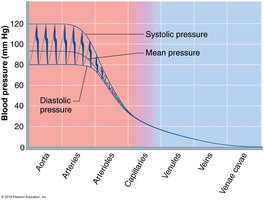
Blood pressure is generated by the heart and opposed by resistance. It is highest in the aorta and decreases as blood moves through arteries, arterioles, capillaries, venules, veins, and the venae cavae. The steepest drop occurs in arterioles.
Arterial Blood Pressure
Arterial blood pressure is determined by the elasticity of arteries and the volume of blood forced into them. It is pulsatile near the heart, rising and falling with each heartbeat.
Systolic Pressure: Pressure during ventricular contraction (average 120 mm Hg).
Diastolic Pressure: Lowest pressure during heart relaxation (average 80 mm Hg).
Pulse Pressure: Difference between systolic and diastolic pressure; responsible for the palpable pulse.
Mean Arterial Pressure (MAP): The average pressure propelling blood to tissues. MAP is calculated as:
Clinical Monitoring of Circulatory Efficiency
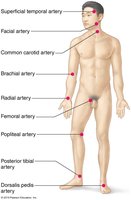
Vital signs include pulse, blood pressure, respiratory rate, and body temperature. The radial pulse is most commonly measured. Pressure points are sites where arteries are close to the surface and can be compressed to stop blood flow.
Measuring Blood Pressure
Blood pressure is measured indirectly using a sphygmomanometer. The first sound heard (Korotkoff sounds) is the systolic pressure; the last sound is the diastolic pressure.
Systolic Pressure: Normally less than 120 mm Hg.
Diastolic Pressure: Normally less than 80 mm Hg.
Capillary and Venous Blood Pressure
Capillary Blood Pressure: Ranges from 35 mm Hg to 17 mm Hg. Low pressure prevents capillary rupture and facilitates exchange.
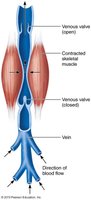
Venous Blood Pressure: Low and changes little during the cardiac cycle. Adaptations such as muscular and respiratory pumps, and sympathetic venoconstriction, aid venous return.
Regulation of Blood Pressure
Major Factors Affecting Blood Pressure
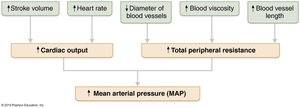
Blood pressure is regulated by cardiac output, peripheral resistance, and blood volume. It varies directly with these factors.
Cardiac Output (CO):
Peripheral Resistance (PR): Influenced by vessel diameter, blood viscosity, and vessel length.
Blood Volume: Controlled by kidneys.
Short-Term Regulation: Neural Controls
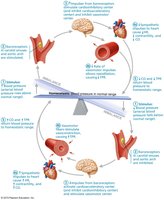
Neural mechanisms regulate blood pressure by altering vessel diameter and cardiac output. Reflex arcs involve the cardiovascular center in the medulla, baroreceptors, chemoreceptors, and higher brain centers.
Cardiovascular Center: Includes cardiac and vasomotor centers; maintains vasomotor tone.
Baroreceptor Reflexes: Located in carotid sinuses, aortic arch, and large arteries. High MAP stimulates dilation and decreases CO; low MAP triggers vasoconstriction and increases CO.
Chemoreceptor Reflexes: Respond to increased CO2, decreased pH or O2, causing increased BP.
Higher Brain Centers: Hypothalamus and cortex can modify BP during stress, exercise, and temperature changes.
Short-Term Regulation: Hormonal Controls
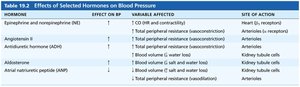
Hormones regulate BP by affecting peripheral resistance and blood volume.
Epinephrine and Norepinephrine: Increase CO and vasoconstriction.
Angiotensin II: Potent vasoconstrictor.
Antidiuretic Hormone (ADH): Causes vasoconstriction at high levels.
Atrial Natriuretic Peptide (ANP): Decreases BP by reducing blood volume.
Hormone | Effect on BP | Variable Affected | Site of Action |
|---|---|---|---|
Epinephrine and norepinephrine (NE) | ↑ | ↑ CO (HR and contractility), ↑ total peripheral resistance (vasoconstriction) | Heart (β receptors), arterioles (α receptors) |
Angiotensin II | ↑ | ↑ total peripheral resistance (vasoconstriction) | Arterioles |
Antidiuretic hormone (ADH) | ↑ | ↑ total peripheral resistance (vasoconstriction) | Arterioles |
Aldosterone | ↑ | ↑ blood volume (↑ salt and water retention) | Kidney tubule cells |
Atrial natriuretic peptide (ANP) | ↓ | ↓ blood volume (↑ salt and water loss), ↓ total peripheral resistance (vasodilation) | Kidney tubule cells, arterioles |
Long-Term Regulation: Renal Mechanisms
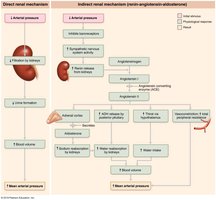
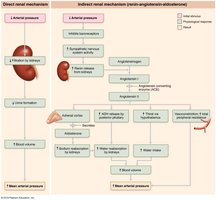
Kidneys regulate blood pressure by controlling blood volume through direct and indirect mechanisms.
Direct Renal Mechanism: Increased BP or blood volume leads to more urine formation, reducing BP. Decreased BP causes water conservation, raising BP.
Indirect Renal Mechanism (Renin-Angiotensin-Aldosterone): Low BP triggers renin release, leading to angiotensin II formation, which increases BP by vasoconstriction, stimulating aldosterone and ADH, and increasing thirst.
Homeostatic Imbalances in Blood Pressure
Hypertension
Hypertension is sustained elevated arterial pressure (≥140/90 mm Hg). It can be primary (no identifiable cause) or secondary (due to underlying disorders). Prolonged hypertension increases risk for heart failure, vascular disease, renal failure, and stroke.
Primary Hypertension: 90% of cases; risk factors include heredity, diet, obesity, age, diabetes, stress, and smoking. Managed by lifestyle changes and antihypertensive drugs.
Secondary Hypertension: Caused by identifiable disorders such as kidney disease or endocrine disorders. Treatment targets the underlying cause.
Hypotension
Hypotension is low blood pressure (<90/60 mm Hg). It is usually not concerning unless it impairs tissue perfusion. Types include orthostatic, chronic, and acute hypotension.
Orthostatic Hypotension: Temporary drop in BP upon standing.
Chronic Hypotension: May indicate poor nutrition or endocrine disorders.
Acute Hypotension: Sign of circulatory shock.
Circulatory Shock
Circulatory shock occurs when blood vessels are inadequately filled and cannot circulate blood normally, leading to insufficient tissue perfusion.
Hypovolemic Shock: Due to large-scale blood loss.
Vascular Shock: Caused by extreme vasodilation and decreased resistance.
Cardiogenic Shock: Results from an inefficient heart.
Summary of Blood Pressure Regulation
The goal is to maintain blood pressure high enough for adequate tissue perfusion, but not so high as to damage vessels. Both short-term and long-term mechanisms are essential for homeostasis.
