 Indietro
Physiology of Circulation and Blood Pressure Regulation
Guida di studio - Note intelligenti
 Appunti personalizzati basati sui tuoi materiali, ampliati con definizioni chiave, esempi e contesto.
The Cardiovascular System: Blood Vessels
Flow, Pressure, and Resistance
The movement of blood through the circulatory system is governed by several key physical principles. Understanding these terms is essential for grasping how blood is delivered to tissues and organs.
Blood Flow: The volume of blood moving through a vessel, organ, or the entire circulation in a given period, measured in ml/min. For the whole vascular system, it is equivalent to cardiac output (CO).
Blood Pressure (BP): The force per unit area exerted on the wall of a blood vessel by the blood, expressed in mm Hg. It is typically measured as systemic arterial BP in large arteries near the heart.
Resistance (Peripheral Resistance): The opposition to blood flow, primarily due to friction between blood and vessel walls. Major sources include blood viscosity, vessel length, and vessel diameter.
Blood Viscosity: The thickness or stickiness of blood, determined by formed elements and plasma proteins. Increased viscosity raises resistance.
Total Blood Vessel Length: Longer vessels increase resistance.
Blood Vessel Diameter: Has the greatest influence on resistance. Resistance varies inversely with the fourth power of vessel radius: .
Laminar vs. Turbulent Flow: Laminar flow is smooth, while abrupt changes or obstacles (e.g., fatty plaques) cause turbulent flow, increasing resistance.
Example: If vessel radius is doubled, resistance drops to 1/16 of its original value.

Relationship Between Flow, Pressure, and Resistance
Blood flow (F) is directly proportional to the pressure gradient (ΔP) and inversely proportional to peripheral resistance (R):
Increasing ΔP increases flow; increasing R decreases flow.
Resistance is the most important factor influencing local blood flow, as vessel diameter can be easily changed.
Systemic Blood Pressure
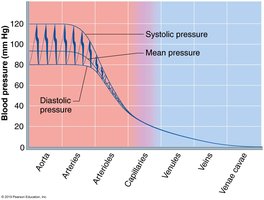
The heart's pumping action generates blood flow, and pressure results when flow is opposed by resistance. Systemic pressure is highest in the aorta and declines throughout the pathway, with the steepest drop in arterioles.
Arterial Blood Pressure
Arterial blood pressure is determined by the elasticity of arteries near the heart and the volume of blood forced into them. Blood pressure near the heart is pulsatile, rising and falling with each heartbeat.
Systolic Pressure: Pressure during ventricular contraction (average 120 mm Hg).
Diastolic Pressure: Lowest aortic pressure when the heart is at rest (average 80 mm Hg).
Pulse Pressure: Difference between systolic and diastolic pressure.
Mean Arterial Pressure (MAP): The pressure that propels blood to tissues. Calculated as:
Example: If BP = 120/80 mm Hg, Pulse Pressure = 40 mm Hg, MAP = 80 + (1/3) × 40 = 93 mm Hg.
Clinical Monitoring of Circulatory Efficiency
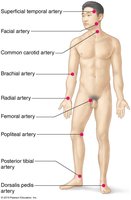
Vital signs include pulse, blood pressure, respiratory rate, and body temperature. The radial pulse is most commonly used, but other pulse points are clinically important. Pressure points can be compressed to stop blood flow during hemorrhaging.
Measuring Blood Pressure
Systemic arterial BP is measured indirectly using a sphygmomanometer. The cuff is wrapped around the arm, pressure is increased, and then slowly released while listening for sounds of Korotkoff with a stethoscope.
Systolic Pressure: Pressure when sounds first occur (normally <120 mm Hg).
Diastolic Pressure: Pressure when sounds disappear (normally <80 mm Hg).
Capillary and Venous Blood Pressure
Capillary blood pressure ranges from 35 mm Hg at the start to ~17 mm Hg at the end. Low pressure prevents rupture and allows filtrate to move into interstitial spaces. Venous blood pressure is low (about 15 mm Hg) and changes little during the cardiac cycle. Adaptations are required to aid venous return.
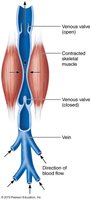
Muscular Pump: Skeletal muscle contractions "milk" blood toward the heart; valves prevent backflow.
Respiratory Pump: Breathing changes pressure, moving blood toward the heart.
Sympathetic Venoconstriction: Smooth muscle constriction pushes blood toward the heart.
Regulation of Blood Pressure
Main Factors Regulating Blood Pressure
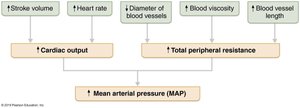
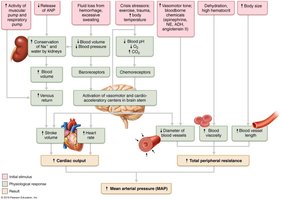
Blood pressure is regulated by the heart, blood vessels, and kidneys, all supervised by the brain. The three main factors are:
Cardiac Output (CO)
Peripheral Resistance (PR)
Blood Volume
Blood pressure varies directly with CO, PR, and blood volume. Changes in one variable are quickly compensated by changes in others.
Short-Term Regulation: Neural Controls
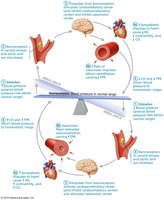
Neural mechanisms control peripheral resistance and blood pressure via reflex arcs involving the cardiovascular center of the medulla, baroreceptors, chemoreceptors, and higher brain centers.
Cardiovascular Center: Clusters of sympathetic neurons in the medulla, including cardiac and vasomotor centers.
Baroreceptor Reflexes: Located in carotid sinuses, aortic arch, and large arteries. High MAP stimulates baroreceptors, leading to vasodilation and decreased CO. Low MAP triggers vasoconstriction and increased CO.
Chemoreceptor Reflexes: Detect increased CO2, decreased pH or O2, and signal for increased CO and vasoconstriction.
Higher Brain Centers: Hypothalamus and cerebral cortex can modify arterial pressure during stress, exercise, and temperature changes.
Short-Term Mechanisms: Hormonal Controls
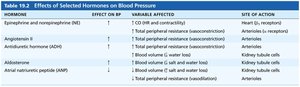
Hormones regulate blood pressure in the short term by altering peripheral resistance and in the long term by changing blood volume.
Epinephrine and Norepinephrine: Increase CO and vasoconstriction.
Angiotensin II: Stimulates vasoconstriction.
Antidiuretic Hormone (ADH): High levels cause vasoconstriction.
Atrial Natriuretic Peptide (ANP): Decreases BP by reducing blood volume.
Hormone | Effect on BP | Variable Affected | Site of Action |
|---|---|---|---|
Epinephrine and norepinephrine (NE) | ↑ | ↑ CO (HR and contractility), ↑ total peripheral resistance (vasoconstriction) | Heart (β receptors), arterioles (α receptors) |
Angiotensin II | ↑ | ↑ total peripheral resistance (vasoconstriction) | Arterioles |
Antidiuretic hormone (ADH) | ↑ | ↑ total peripheral resistance (vasoconstriction) | Arterioles |
Aldosterone | ↑ | ↑ blood volume (↑ salt and water retention) | Kidney tubule cells |
Atrial natriuretic peptide (ANP) | ↓ | ↓ blood volume (↓ salt and water retention), ↓ total peripheral resistance (vasodilation) | Kidney tubule cells, arterioles |
Long-Term Mechanisms: Renal Regulation
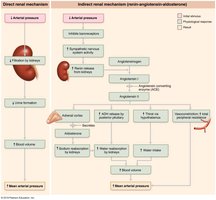
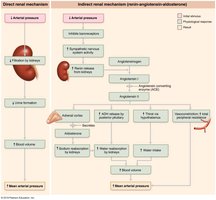
Long-term regulation of blood pressure is achieved by altering blood volume via the kidneys. There are two mechanisms:
Direct Renal Mechanism: Increased BP or blood volume causes kidneys to eliminate more urine, reducing BP. Decreased BP causes kidneys to conserve water, raising BP.
Indirect Renal Mechanism (Renin-Angiotensin-Aldosterone): Decreased arterial BP triggers renin release, leading to formation of angiotensin II, which increases BP by stimulating aldosterone and ADH release, thirst, and vasoconstriction.
Summary of Blood Pressure Regulation
The goal is to maintain blood pressure high enough for adequate tissue perfusion but not so high as to damage vessels. If BP to the brain is too low, perfusion is inadequate and consciousness is lost; if too high, risk of stroke increases.
Homeostatic Imbalances in Blood Pressure
Hypertension
Hypertension is sustained elevated arterial pressure (≥140/90 mm Hg). It may be transient or persistent, and is a major cause of heart failure, vascular disease, renal failure, and stroke. There are two types:
Primary Hypertension: No identifiable cause; risk factors include heredity, diet, obesity, age, diabetes, stress, and smoking. Managed by lifestyle changes and antihypertensive drugs.
Secondary Hypertension: Due to identifiable disorders (e.g., kidney disease, endocrine disorders). Treatment focuses on correcting the underlying cause.
Hypotension
Hypotension is low blood pressure (<90/60 mm Hg). It is usually not a concern unless it causes inadequate blood flow. Types include:
Orthostatic Hypotension: Temporary low BP and dizziness when rising suddenly.
Chronic Hypotension: May indicate poor nutrition or endocrine disorders.
Acute Hypotension: Important sign of circulatory shock.
Circulatory Shock
Circulatory shock occurs when blood vessels inadequately fill and cannot circulate blood normally, leading to insufficient tissue perfusion. Types include:
Hypovolemic Shock: Due to large-scale blood loss.
Vascular Shock: Due to extreme vasodilation and decreased resistance.
Cardiogenic Shock: Due to inefficient heart function.
References and Copyright
Content adapted from Human Anatomy & Physiology, Eleventh Edition, by Elaine N. Marieb and Katja Hoehn.
