 Indietro
Ch 20 pt 2 Renal Physiology: Reabsorption, Secretion, Excretion, and Micturition
Guida di studio - Note intelligenti
 Appunti personalizzati basati sui tuoi materiali, ampliati con definizioni chiave, esempi e contesto.
Chapter 20: The Kidney (Sections 20.5 - 20.8)
Overview of Renal Processes
The nephron, the functional unit of the kidney, is responsible for filtering blood, reabsorbing essential substances, secreting additional solutes, and excreting waste as urine. These processes are crucial for maintaining homeostasis, fluid balance, and electrolyte regulation.
Filtration: Movement of fluid and solutes from blood into the nephron tubule.
Reabsorption: Movement of substances from the tubule back into the blood.
Secretion: Active transport of additional solutes from blood into the tubule.
Excretion: Removal of urine from the body.
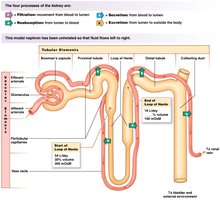
Reabsorption: Overview
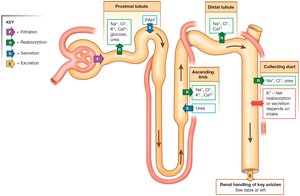
Reabsorption is the process by which the nephron reclaims water, ions, and nutrients from the filtrate, returning them to the bloodstream. Most reabsorption occurs in the proximal tubule. The glomerular filtration rate (GFR) is about 180 L/day, but only 1.5 L/day is excreted as urine, meaning approximately 178.5 L/day is reabsorbed.
Filtration: Produces an isosmotic filtrate (300 mOsm) similar to plasma.
Excretion: Urine volume varies (1.5 L/day minimum), with osmolality ranging from 50–1200 mOsm.
Purpose: High filtration rate allows rapid removal of waste; reabsorption fine-tunes homeostasis.
Mechanisms of Reabsorption
Reabsorption occurs via several mechanisms, including passive and active transport, solvent drag, and endocytosis.
Passive Reabsorption: Driven by electrochemical gradients (e.g., anions) and osmotic gradients (water follows solute reabsorption).
Active Reabsorption: Involves primary and secondary active transport, especially for sodium and glucose.
Solvent Drag: Water reabsorption drags dissolved solutes along.
Endocytosis: Small proteins that pass the filtration barrier are reabsorbed by endocytosis and degraded to amino acids.
Active Transport Example: Sodium and Glucose Reabsorption
Sodium is actively transported out of the tubule cell by the Na+/K+ ATPase, creating a gradient that drives secondary active transport of glucose via SGLT proteins. Glucose then exits the cell via GLUT transporters.
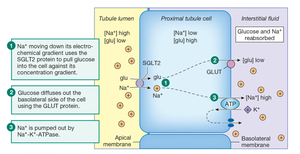
Reabsorption of Glucose
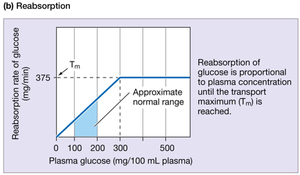
Glucose reabsorption is a classic example of transporter-mediated reabsorption, characterized by a transport maximum (Tmax) and a renal threshold.
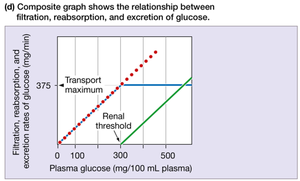
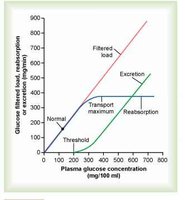
Transport Maximum (Tmax): The maximum rate at which glucose can be reabsorbed, determined by the number and speed of transporters.
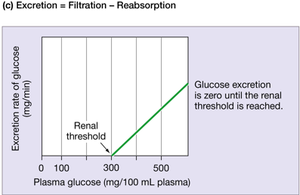
Renal Threshold: The plasma glucose concentration at which glucose begins to appear in the urine because transporters are saturated.
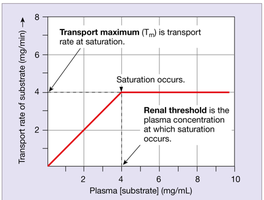
Filtration, Reabsorption, and Excretion of Glucose
Filtration: Proportional to plasma glucose concentration and GFR; does not saturate.
Reabsorption: Proportional to plasma glucose until Tmax is reached; then plateaus.
Excretion: Zero until renal threshold is reached; then increases linearly with plasma glucose.
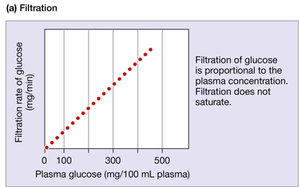
Clinical Relevance: Glucosuria (glucose in urine) occurs when plasma glucose exceeds the renal threshold, as in diabetes mellitus or genetic transporter defects.
Reabsorption of Water
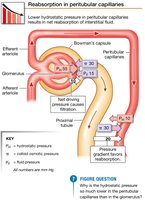
Water reabsorption is driven by net filtration pressure (NFP) in the peritubular capillaries and facilitated by aquaporin channels (e.g., AQP1). The NFP is calculated as:
PC: Peritubular capillary hydrostatic pressure (filtration force, ~10 mm Hg)
πC: Peritubular capillary colloid osmotic pressure (reabsorption force, ~30 mm Hg)
Secretion
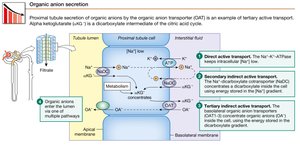
Secretion is the active transport of solutes from the blood into the nephron tubule, primarily in the proximal tubule. It involves multiple types of active transport (primary, secondary, tertiary) and facilitated diffusion.
Excretion and Renal Clearance
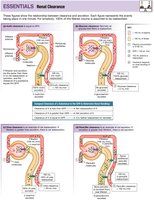
Excretion is the final removal of substances in urine. Renal clearance quantifies the volume of plasma cleared of a substance per unit time and is calculated as:
CS: Clearance of solute S
US: Urine concentration of S
V: Urine volume per unit time
PS: Plasma concentration of S
Inulin clearance is used to measure GFR because inulin is filtered but neither reabsorbed nor secreted. Creatinine clearance is a practical alternative, though it is slightly secreted.
Clearance Comparisons
Substance | Renal Handling | Clearance vs. GFR |
|---|---|---|
Inulin | Filtered only | = GFR |
Glucose | Filtered, fully reabsorbed | 0 |
Urea | Filtered, partially reabsorbed | < GFR |
Penicillin | Filtered, secreted | > GFR |
Micturition (Urination)
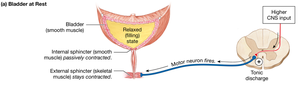
Micturition is the process of bladder emptying, controlled by a spinal reflex with voluntary modulation. The bladder's detrusor muscle is relaxed during filling (storage reflex), and both the internal and external urethral sphincters remain contracted to prevent urination.
Initiation of Micturition
As the bladder fills, stretch receptors activate a spinal reflex. Parasympathetic stimulation contracts the detrusor muscle and relaxes the internal sphincter, while inhibition of somatic motor neurons relaxes the external sphincter, allowing urination.
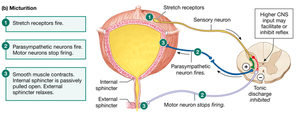
Voluntary Control: The brainstem and cerebral cortex can delay micturition by inhibiting the reflex and maintaining sphincter contraction.
Valsalva Maneuver: Voluntary contraction of abdominal muscles increases bladder pressure, promoting urination.
Summary Equations and Concepts
Excretion Equation:
Renal Clearance Equation:
Key Factors Affecting Renal Handling: GFR, Tmax (transport maximum), and secretion rates determine how substances are filtered, reabsorbed, and excreted by the kidney.
