 Indietro
Renal System Physiology: Filtration, Reabsorption, and Hormonal Regulation
Guida di studio - Note intelligenti
 Appunti personalizzati basati sui tuoi materiali, ampliati con definizioni chiave, esempi e contesto.
Renal System Physiology
Nephron Structure and Function
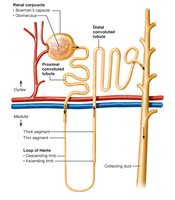
The nephron is the functional unit of the kidney, responsible for filtering blood and forming urine. Each nephron consists of a renal corpuscle (glomerulus and Bowman's capsule) and a renal tubule (proximal convoluted tubule, loop of Henle, distal convoluted tubule, and collecting duct).
Afferent arteriole: Brings blood into the glomerulus.
Efferent arteriole: Carries blood away from the glomerulus.
Glomerulus: Network of capillaries where filtration occurs.
Bowman's capsule: Surrounds the glomerulus and collects filtrate.
Renal tubule: Processes filtrate through reabsorption and secretion.
Glomerular Filtration Rate (GFR)
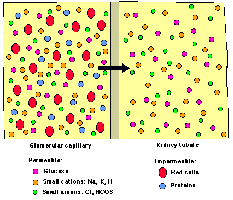
Glomerular Filtration Rate (GFR) is the rate at which blood is filtered in the glomerulus, typically 80–140 mL/min in healthy adults. The filtrate contains water, ions, glucose, and small molecules, but excludes blood cells and proteins due to size and charge selectivity.
Filtration barrier: Allows passage of water and small solutes; restricts proteins and cells.
Normal GFR: 80–140 mL/min.
Filtrate composition: Water, electrolytes, glucose, amino acids; no blood cells or large proteins.
Regulation of GFR: Arteriole Radius and Blood Pressure
The GFR is regulated by the diameters of the afferent and efferent arterioles and by systemic blood pressure.
Afferent arteriole constriction: Decreases GFR by reducing blood flow into the glomerulus.
Efferent arteriole constriction: Increases GFR by increasing glomerular pressure.
Blood pressure: Higher systemic blood pressure increases GFR; lower pressure decreases GFR.
Key relationship: Glomerular pressure and GFR are closely linked; changes in arteriole radius or blood pressure directly affect filtration rate.
Renal Compensation for Blood Pressure Changes
When blood pressure falls, GFR decreases. The kidney compensates by adjusting arteriole diameters to restore GFR:
Increase afferent arteriole radius (vasodilation) to allow more blood into the glomerulus.
Decrease efferent arteriole radius (vasoconstriction) to increase glomerular pressure.
These adjustments help maintain normal filtration rates despite fluctuations in systemic blood pressure.
Solute Gradients and Urine Concentration
The nephron creates a solute gradient in the medulla, allowing the kidney to concentrate urine. The loop of Henle plays a critical role:
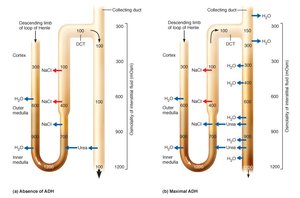
Descending limb: Permeable to water, impermeable to solutes; water exits by osmosis.
Ascending limb: Impermeable to water, permeable to NaCl; NaCl is actively transported out.
ADH (Antidiuretic Hormone): Increases water reabsorption in the distal convoluted tubule (DCT) and collecting duct by inserting aquaporins.
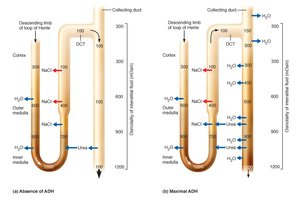
With ADH: Urine becomes highly concentrated as water is reabsorbed.
Without ADH: No aquaporins are present; water cannot be reabsorbed, resulting in a large volume of dilute urine.
Reabsorption of Glucose
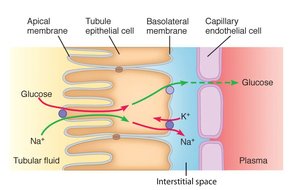
Glucose is reabsorbed in the proximal convoluted tubule by glucose carrier proteins. Normally, all filtered glucose is reabsorbed, so none appears in the urine.
Carrier saturation: If glucose exceeds the transport maximum, excess appears in urine (glycosuria).
Increased carriers: More glucose is reabsorbed, less is lost in urine.
Hormonal Regulation of Renal Function
Two major hormones regulate kidney function:
Antidiuretic Hormone (ADH): Increases water reabsorption, resulting in more concentrated urine. Inserts aquaporins into the DCT and collecting duct.
Aldosterone: Increases sodium reabsorption and potassium secretion, which also affects water reabsorption and urine volume.
Both hormones: Ultimately increase blood pressure by increasing blood volume.
Interactions: Aldosterone reduces urine volume by promoting sodium (and thus water) reabsorption. ADH can also affect potassium concentration in urine due to changes in water reabsorption and flow rate.
Summary Table: Effects of Hormones on Renal Function
Hormone | Main Action | Effect on Urine Volume | Effect on Blood Pressure |
|---|---|---|---|
ADH | Increases water reabsorption (aquaporins in DCT/collecting duct) | Decreases (more concentrated urine) | Increases |
Aldosterone | Increases Na+ reabsorption, K+ secretion | Decreases (more water reabsorbed with Na+) | Increases |
Additional info: The renal system's ability to regulate blood volume, pressure, and composition is essential for homeostasis. Disruptions in these processes can lead to clinical conditions such as hypertension, edema, or diabetes mellitus (glycosuria).
