 Indietro
Respiratory Physiology: Gas Exchange and Regulation
Guida di studio - Note intelligenti
 Appunti personalizzati basati sui tuoi materiali, ampliati con definizioni chiave, esempi e contesto.
Gas Laws and Alveolar Air
Dalton’s Law and Partial Pressures
Dalton’s Law states that the total pressure of a mixture of gases is the sum of the partial pressures of each individual gas. In respiratory physiology, partial pressure refers to the pressure exerted by a single gas in a mixture, such as oxygen (O2) or carbon dioxide (CO2).
Partial Pressure of Oxygen (PO2): In atmospheric air, PO2 is approximately 159 mm Hg.
Partial Pressure of Carbon Dioxide (PCO2): Much lower than PO2 in atmospheric air.
Henry’s Law and Solubility
Henry’s Law states that the amount of gas dissolved in a liquid is proportional to its partial pressure and solubility. This principle is important for understanding how gases move between alveolar air and blood.
Solubility: O2 and CO2 have limited solubility in plasma, requiring transport proteins for efficient movement.
Alveolar Air vs. Inhaled Air
Alveolar air composition differs from inhaled air due to gas exchange, humidification, and mixing with residual air in the lungs.
Key Differences: Lower PO2 and higher PCO2 in alveolar air compared to atmospheric air.
Gas Exchange Mechanisms
Factors Affecting Gas Exchange
Gas exchange in the lungs is influenced by several factors:
Partial Pressure Differences: Gases move from areas of higher to lower partial pressure.
Small Distance: The thin respiratory membrane allows rapid diffusion.
Lipid-Soluble Gases: O2 and CO2 easily cross cell membranes.
Large Surface Area: Alveoli provide a vast area for gas exchange.
Coordinated Blood and Airflow: Matching ventilation and perfusion optimizes exchange.
Oxygen and Hemoglobin
Hemoglobin Saturation and Affinity
Hemoglobin (Hb) binds oxygen in red blood cells, forming oxyhemoglobin (HbO2). The affinity of Hb for O2 depends on several factors:
PO2 of Blood: Higher PO2 increases Hb saturation.
Blood pH: Lower pH (acidic) decreases Hb affinity for O2 (Bohr Effect).
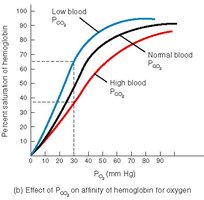
PCO2 of Blood: Higher PCO2 decreases Hb affinity for O2.
Temperature: Higher temperature decreases Hb affinity for O2.
Metabolism in RBCs: Increased metabolism produces BPG, promoting O2 release.
Oxygen-Hemoglobin Saturation Curve
The oxygen-hemoglobin saturation curve illustrates the relationship between PO2 and percent saturation of hemoglobin. The curve is sigmoidal due to cooperativity—binding of one O2 molecule increases affinity for others.
Oxygen Reserve: Hb releases O2 in tissues with low PO2.
Breathing More Oxygen: Increases Hb saturation, but most Hb is already saturated at normal PO2.
Carbon Monoxide: Binds Hb with high affinity, preventing O2 transport.
Hemoglobin and pH (Bohr Effect)
Active tissues produce acids, lowering blood pH. The Bohr Effect describes how decreased pH reduces Hb affinity for O2, facilitating O2 release in tissues.
Normal Blood pH: 7.35–7.45
Active Tissues: More acidic, promoting O2 unloading.
Hemoglobin and PCO2
CO2 can bind to Hb, forming carbaminohemoglobin. Carbonic anhydrase in RBCs catalyzes the reaction:
Equation:
Effect: Increased PCO2 decreases Hb affinity for O2.
Hemoglobin and Temperature
Normal blood temperature is 37ºC. Active tissues have higher temperatures, which decrease Hb affinity for O2, promoting O2 release.
Hemoglobin and RBC Metabolism
RBCs rely on glycolysis, producing lactic acid and BPG (2,3-bisphosphoglycerate). BPG is required for Hb to release O2 efficiently.
Fetal Hemoglobin
Fetal hemoglobin (HbF) has a higher affinity for O2 than adult hemoglobin, allowing efficient O2 transfer from mother to fetus.
Carbon Dioxide Transport
Forms of CO2 Transport
CO2 is transported in blood in three main forms:
Dissolved CO2: Small amount dissolved in plasma.
Carbamino Compounds: CO2 binds to proteins, especially Hb (carbaminohemoglobin).
Bicarbonate Ions: Most CO2 is converted to bicarbonate via carbonic anhydrase.
Key reactions:
Chloride Shift: Exchange of Cl- and HCO3- across RBC membrane.
Haldane Effect: Deoxygenated Hb increases CO2 carrying capacity.
Respiratory Control
Respiratory Centers
The brainstem regulates breathing through several centers:
Medullary Rhythmicity Area: Controls basic rhythm of breathing.
Inspiratory and Expiratory Areas: Regulate inhalation and exhalation.
Pneumotaxic Area: Inhibits inspiratory area, promoting exhalation.
Apneustic Area: Stimulates inspiratory area, prolonging inhalation.
Respiratory Reflexes
Types of Hypoxia
Hypoxia refers to inadequate O2 supply to tissues. Types include:
Hypoxic Hypoxia: Low arterial PO2.
Anemic Hypoxia: Low Hb or impaired Hb function.
Ischemic Hypoxia: Reduced blood flow.
Histotoxic Hypoxia: Cells unable to use O2.
Chemoreceptor Reflexes
Chemoreceptors monitor blood gases and pH:
Central Chemoreceptors: Located in medulla, sensitive to CO2 and pH.
Peripheral Chemoreceptors: Located in aortic and carotid bodies, sensitive to O2, CO2, and pH.
Hypercapnia: Elevated CO2 stimulates increased ventilation.
Hypocapnia: Low CO2 reduces ventilation.
Hyperventilation: Rapid breathing decreases CO2.
Other Reflexes
Baroreceptor Reflex: Responds to changes in blood pressure.
Hering-Breuer Reflexes: Prevent over-inflation of lungs.
Protective Reflexes: Include coughing, sneezing, and apnea (temporary cessation of breathing).
Summary
Respiratory physiology involves the interplay of gas laws, hemoglobin function, and neural control to ensure efficient gas exchange and homeostasis. Understanding these mechanisms is essential for diagnosing and treating respiratory disorders.
