 Indietro
Respiratory Physiology: Gas Exchange and Transport
Guida di studio - Note intelligenti
 Appunti personalizzati basati sui tuoi materiali, ampliati con definizioni chiave, esempi e contesto.
Respiratory Physiology: Gas Exchange and Transport
Ventilation and Respiration
Respiratory physiology involves two main processes: ventilation (movement of air in and out of the lungs) and respiration (exchange of gases with the blood). Respiration is further divided into external respiration (gas exchange between alveoli and pulmonary capillaries) and internal respiration (gas exchange between systemic capillaries and body tissues).
Factors Influencing Gas Exchange
The rate of gas exchange across membranes is determined by several factors:
Surface Area: Larger surface area increases diffusion rate.
Membrane Thickness: Thinner membranes allow faster diffusion.
Concentration Gradient: Greater differences in partial pressure drive faster diffusion.
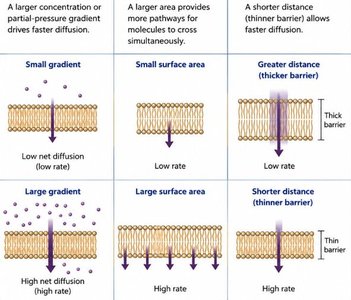
Example: The lungs and capillary beds have large surface areas and thin membranes, optimizing gas exchange.
Gas Laws Governing Diffusion
Two gas laws are fundamental to understanding respiratory physiology:
Dalton's Law: The total pressure of a mixture of gases is the sum of the partial pressures of each gas. Each gas exerts its own partial pressure, which determines its diffusion direction.
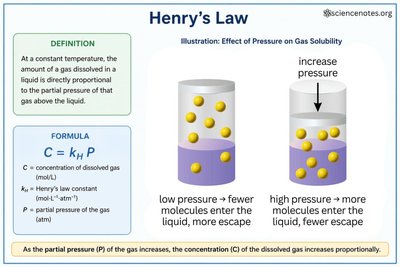
Henry's Law: The amount of gas dissolved in a liquid is proportional to its partial pressure above the liquid and its solubility.
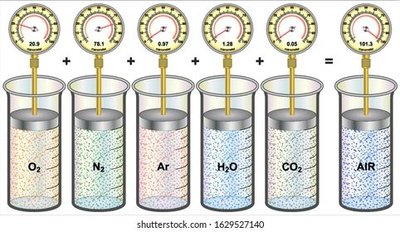
Formula for Dalton's Law:
Formula for Henry's Law:
Where is the concentration of dissolved gas, is Henry's law constant, and is partial pressure.
Partial Pressures and Gas Exchange
Partial pressures of oxygen (O2) and carbon dioxide (CO2) vary by location in the body, influencing the direction of gas movement:
External Respiration: O2 moves from alveoli to blood; CO2 moves from blood to alveoli.
Internal Respiration: O2 moves from blood to tissues; CO2 moves from tissues to blood.
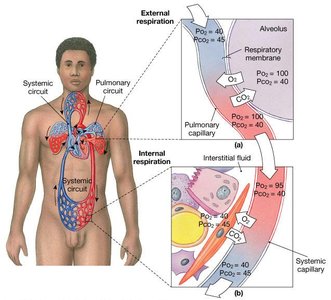
Example: At the alveoli, PO2 is higher than in the pulmonary capillaries, so oxygen diffuses into the blood.
Calculating Partial Pressures
Partial pressure is calculated by multiplying the percentage concentration of a gas by the total atmospheric pressure:
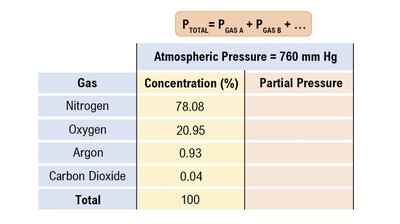
Example: At sea level (760 mm Hg), oxygen is 21% of air, so PO2 = 0.21 × 760 = 160 mm Hg.
Oxygen Transport in Blood
Oxygen is transported in the blood in two ways:
~2% dissolved directly in plasma
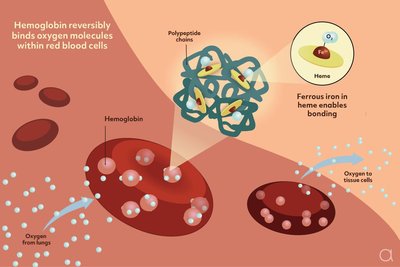
~98% bound to hemoglobin, forming oxyhemoglobin (HbO2)
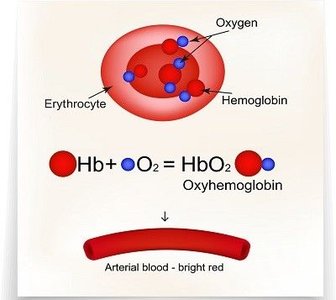
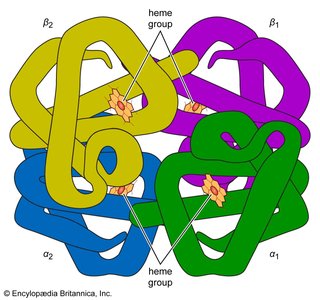
Hemoglobin Structure: Hemoglobin has four subunits, each with a heme group containing iron, allowing one molecule to carry four oxygen molecules.
Cooperativity of Hemoglobin
Hemoglobin exhibits cooperative binding:
Positive cooperativity: Binding of one O2 increases affinity for subsequent O2 molecules.
Negative cooperativity: Release of one O2 makes further release easier.
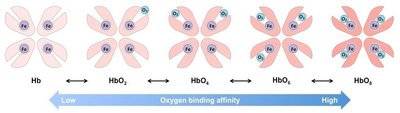
Example: In oxygen-rich areas (lungs), hemoglobin loads oxygen efficiently; in oxygen-poor areas (tissues), it unloads oxygen.
Oxygen-Hemoglobin Dissociation Curve
The oxygen-hemoglobin dissociation curve shows the relationship between PO2 and hemoglobin saturation. The curve is sigmoidal due to cooperative binding.
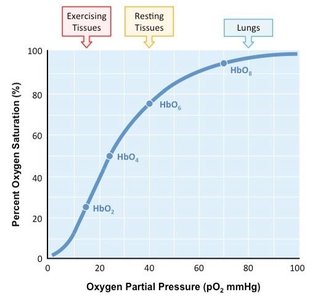
Key Point: Small changes in PO2 in the mid-range can significantly affect oxygen saturation.
Right and Left Shifts in the Dissociation Curve
Shifts in the curve indicate changes in hemoglobin's affinity for oxygen:
Right shift: Reduced affinity, more oxygen released at tissues (high CO2, high H+, high temperature, more BPG).
Left shift: Increased affinity, less oxygen released at tissues (low CO2, low H+, low temperature, less BPG).
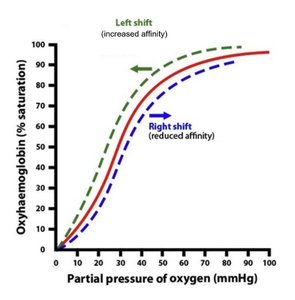
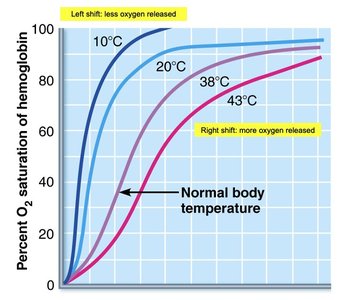
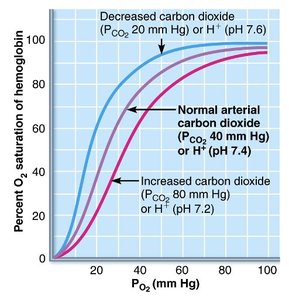
Example: Exercise increases temperature and CO2, causing a right shift and promoting oxygen release to tissues.
Carbon Dioxide Transport
CO2 is transported in three ways:
~7% dissolved in plasma
~23% bound to hemoglobin (carbaminohemoglobin, HbCO2)
~70% converted to bicarbonate ions (HCO3-)
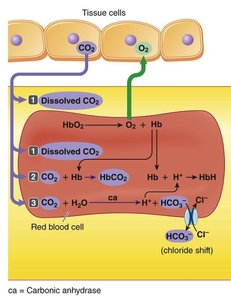
Key Reaction: CO2 + H2O → H2CO3 → H+ + HCO3-
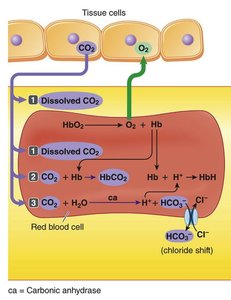
Carbonic anhydrase in RBCs speeds up this reaction. Bicarbonate ions are exchanged with chloride ions (chloride shift) to maintain electrical neutrality.
Chloride Shift and Its Significance
The chloride shift enables high-capacity CO2 transport and maintains electrical charge in RBCs. It also drives the reaction forward, allowing continuous CO2 absorption.
Gas Exchange at the Lungs
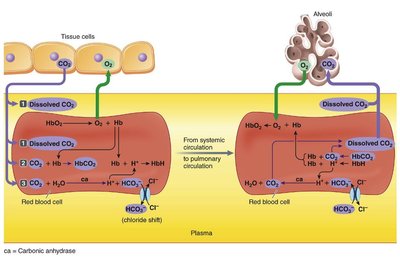
At the lungs, the process reverses:
Bicarbonate enters RBC from plasma (chloride leaves).
Bicarbonate and H+ recombine to form carbonic acid.
Carbonic acid splits into CO2 and H2O.
CO2 diffuses out of RBC, into plasma, then alveoli, and is exhaled.
Hypoxia and Its Causes
Hypoxia is inadequate oxygen delivery to tissues, often indicated by hemoglobin saturation below 75% and cyanosis (bluish skin/mucosae).
Anemic hypoxia: Not enough RBCs or hemoglobin.
Histotoxic hypoxia: Cells cannot use delivered oxygen (e.g., cyanide poisoning).
Carbon monoxide poisoning: CO binds hemoglobin with high affinity, preventing O2 binding and release.
Example: Hookah smoking exposes users to high levels of CO, leading to "hookah sickness" (mild to moderate CO poisoning).
Summary Table: Partial Pressures of O2 and CO2 in Different Locations
Location | PO2 (mm Hg) | PCO2 (mm Hg) |
|---|---|---|
Alveoli | 104 | 40 |
Systemic Arteries | 100 | 40 |
Systemic Veins | 40 | 45 |
Tissues | 40 | 45 |
Additional info: This table summarizes the partial pressures of oxygen and carbon dioxide in key locations, illustrating the gradients that drive gas exchange.
