 Indietro
Respiratory Physiology: Oxygen and Carbon Dioxide Transport, Regulation, and Pathology
Guida di studio - Note intelligenti
 Appunti personalizzati basati sui tuoi materiali, ampliati con definizioni chiave, esempi e contesto.
Oxygen Transport in Blood
Hemoglobin and Oxygen Binding
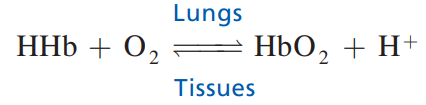
Oxygen is transported in the blood primarily by binding to hemoglobin (Hb) within red blood cells (RBCs). Each hemoglobin molecule can carry up to four oxygen molecules, binding at its iron-containing heme groups. The reversible reaction governing oxygen loading and unloading is:
Oxygen Loading (in Lungs): Hemoglobin binds oxygen to form oxyhemoglobin.
Oxygen Unloading (in Tissues): Oxygen is released from hemoglobin, forming deoxyhemoglobin.
The reaction can be represented as:
Oxygen-Hemoglobin Dissociation Curve
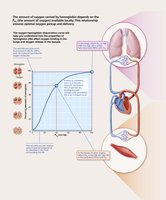
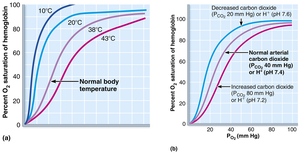
The relationship between partial pressure of oxygen (PO2) and hemoglobin saturation is depicted by the oxygen-hemoglobin dissociation curve. This S-shaped curve illustrates how hemoglobin's affinity for oxygen changes with PO2, facilitating efficient loading in the lungs and unloading in tissues.
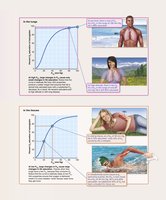
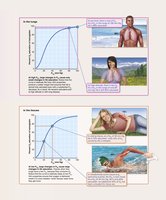
Arterial Blood: Hemoglobin is about 98% saturated.
Venous Blood: Hemoglobin is about 75% saturated, providing a venous reserve.
Factors Affecting Hemoglobin Saturation
Hemoglobin's affinity for oxygen is influenced by temperature, blood pH, partial pressure of CO2 (PCO2), and concentration of 2,3-bisphosphoglycerate (BPG). These factors shift the dissociation curve:
Increased Temperature, PCO2, BPG, or Decreased pH: Decreases affinity, enhances oxygen unloading (curve shifts right).
Decreased Temperature, PCO2, BPG, or Increased pH: Increases affinity, enhances oxygen loading (curve shifts left).
Fetal vs. Adult Hemoglobin
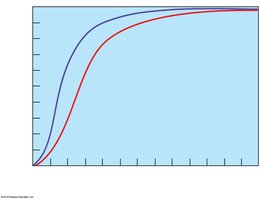
Fetal hemoglobin has a higher affinity for oxygen than adult hemoglobin, allowing efficient oxygen transfer from maternal blood.
Carbon Dioxide Transport in Blood
Forms of Carbon Dioxide Transport
Carbon dioxide is transported in blood in three main forms:
Dissolved in Plasma: 7–10% of CO2 is transported this way.
Bound to Hemoglobin: About 20% binds to globin, forming carbaminohemoglobin.
As Bicarbonate Ions: About 70% is converted to bicarbonate ions via the following reaction:

Transport and Exchange of CO2 and O2
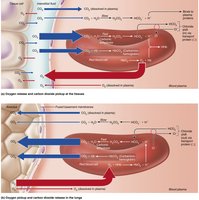
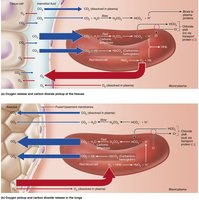
Gas exchange occurs in tissues and lungs, involving oxygen release and carbon dioxide uptake in tissues, and the reverse in lungs. The chloride shift maintains ionic balance during bicarbonate transport.
Haldane and Bohr Effects
Bohr Effect: Increased CO2 and H+ in tissues promote oxygen release from hemoglobin.
Haldane Effect: Deoxygenated hemoglobin increases CO2 transport capacity.
Bicarbonate Buffer System and Blood pH
The bicarbonate buffer system helps maintain blood pH. Changes in ventilation affect CO2 levels and thus pH:
Slow, shallow breathing: Increases CO2, lowers pH (acidosis).
Rapid, deep breathing: Decreases CO2, raises pH (alkalosis).
Respiratory Regulation: Neural and Chemical Control
Respiratory Centers in the Brain Stem
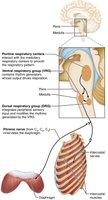
Breathing is controlled by neural centers in the medulla and pons. The ventral respiratory group (VRG) generates the basic rhythm, while the dorsal respiratory group (DRG) integrates sensory input. Pontine centers smooth transitions between inspiration and expiration.
Chemical Regulation of Breathing
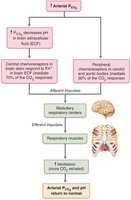
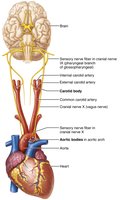
Central and peripheral chemoreceptors monitor CO2, O2, and pH levels, adjusting ventilation accordingly. CO2 is the most potent regulator.
Neural and Chemical Influences
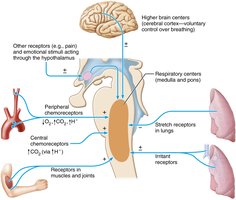
Higher brain centers, pulmonary irritant reflexes, and the inflation reflex also influence breathing rate and depth.
Respiratory Pathology
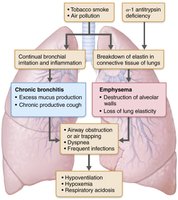
Chronic Obstructive Pulmonary Disease (COPD)
COPD includes emphysema and chronic bronchitis, characterized by irreversible airflow obstruction. Smoking is a major risk factor. Symptoms include dyspnea, hypoventilation, and frequent infections.
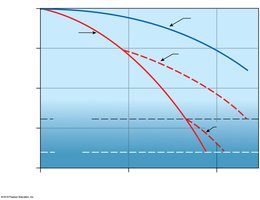
Decline in Respiratory Performance
Respiratory efficiency decreases with age and is further impaired by smoking.
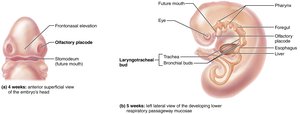
Developmental Aspects of the Respiratory System
The respiratory system develops early in embryogenesis, with structures forming by weeks 4–5. Lungs mature until young adulthood, and efficiency decreases in old age.
Factor | Effect on O2 Affinity | Curve Shift |
|---|---|---|
↑ Temperature | ↓ Affinity | Right |
↓ pH | ↓ Affinity | Right |
↑ PCO2 | ↓ Affinity | Right |
↓ Temperature | ↑ Affinity | Left |
↑ pH | ↑ Affinity | Left |
↓ PCO2 | ↑ Affinity | Left |
Additional info: These notes expand on the original content by providing definitions, context, and examples for key physiological processes and pathologies relevant to respiratory physiology.
