 Indietro
Somatic Sensory Pathways: Structure and Function in the Nervous System
Guida di studio - Note intelligenti
 Appunti personalizzati basati sui tuoi materiali, ampliati con definizioni chiave, esempi e contesto.
The Somatic Nervous System
Overview of Somatic Sensory Pathways
The somatic nervous system is responsible for transmitting sensory information from the body to the central nervous system (CNS), allowing us to perceive touch, pain, temperature, and proprioception. Sensory pathways consist of nerves, nuclei, and tracts that carry impulses either ascending (toward the brain) or descending (away from the brain).
Somatic-sensory pathways are organized to distinguish sensations from different body regions.
Pathways are composed of chains of neurons that relay information from receptors to the brain.
Localization of sensation depends on where the impulse arrives in the primary somatosensory cortex.
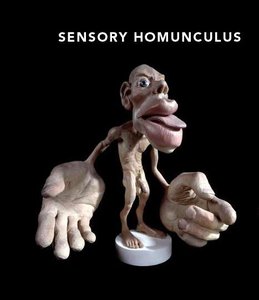
Somatosensory Homunculus
The somatosensory homunculus is a functional map of the primary sensory cortex located in the postcentral gyrus. It illustrates how different regions of the body are represented in the cortex, with the size of each region proportional to its sensitivity rather than its physical size.
High sensitivity areas (e.g., hands, lips) occupy larger regions in the cortex.
Low sensitivity areas (e.g., trunk) occupy smaller regions.
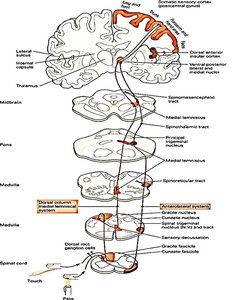
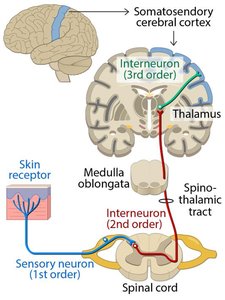
Somatosensory Pathways
Neuron Chains in Sensory Pathways
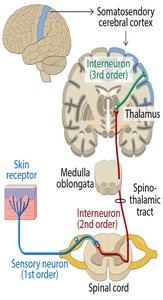
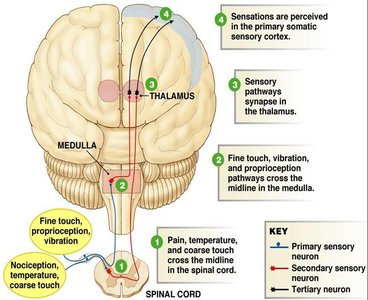
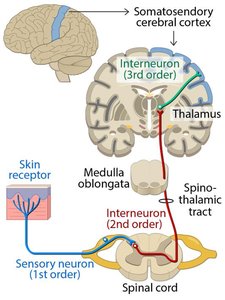
Somatosensory pathways conduct impulses through three successive neurons:
First-order neuron: Sensory neuron carrying information from skin (cutaneous receptors), muscles (proprioceptors), body wall, head, neck, and limbs. Cell body is located in the dorsal root ganglion or cranial nerve ganglia.
Second-order neuron: Interneuron in the spinal cord or brainstem that receives information from the first-order neuron. It crosses to the opposite side of the CNS (decussation).
Third-order neuron: Interneuron in the thalamus that receives information from the second-order neuron and relays impulses to the somatosensory cortex of the cerebrum for conscious awareness.
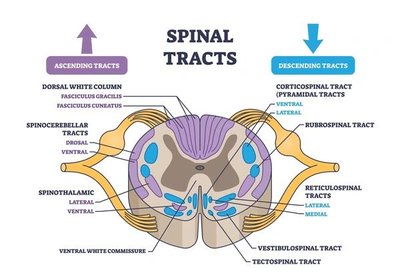
White Matter Structures in the Spinal Cord
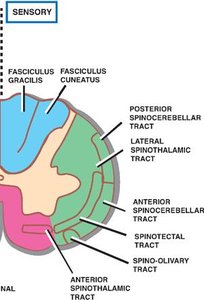
White matter in the spinal cord is organized into bundles:
Funiculus: Large bundle of nerve fibers comprising multiple tracts.
Fasciculus: Smaller, more specific bundle of nerve fibers within a funiculus, sharing a common origin, function, and destination.
Major Ascending (Sensory) Tracts
Ascending tracts carry sensory information to the brain. The main tracts include:
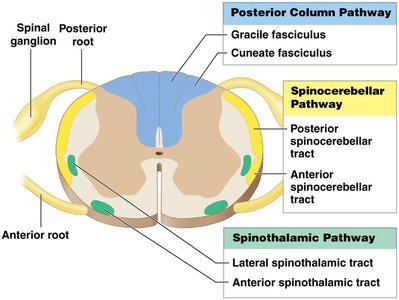
Dorsal column–medial lemniscus pathway: Fine touch, vibration, pressure, proprioception.
Spinothalamic pathway: Pain, temperature, crude touch, pressure.
Spinocerebellar pathway: Proprioceptive information processed unconsciously by the cerebellum.
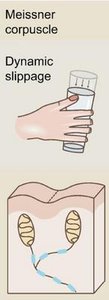
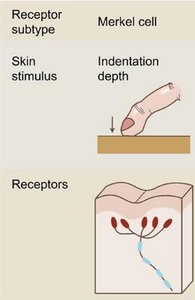
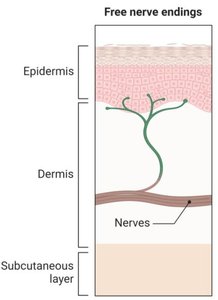
Types of Tactile Senses
Tactile senses are classified as fine touch or crude touch:
Feature | Fine Touch | Crude Touch |
|---|---|---|
Description | Discriminative, detailed perception of texture, shape, and form. | General sense of touch, pressure, and hair movement. |
Localization | Precise localization is possible. | Localization is not precise; you know you've been touched, but not exactly where. |
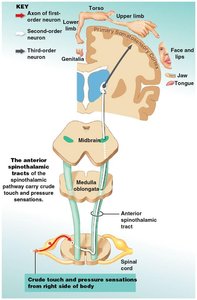
Nerve Pathways | Dorsal column–medial lemniscus pathway. | Anterior spinothalamic tract. |
Examples | Reading Braille, typing, feeling the smoothness of a stone. | Feeling a tickle, a light brush on your arm, or an itch. |
Spinothalamic Pathway
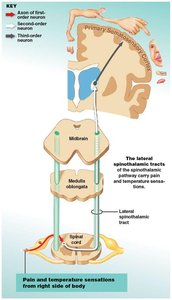
The spinothalamic pathway transmits pain, temperature, crude touch, and pressure. Second-order neurons cross over at the spinal cord level and ascend to the thalamus, where third-order neurons relay the impulse to the somatosensory cortex.
Anterior spinothalamic tract: Crude touch and pressure.
Lateral spinothalamic tract: Pain and temperature.
Referred pain: Pain felt in an uninjured part of the body when pain originates elsewhere (e.g., heart attack felt in the left arm).
Posterior Column–Medial Lemniscus (PCML) Pathway
The PCML pathway carries sensations of highly localized fine touch, vibration, pressure, and conscious proprioception. Second-order neurons decussate in the brainstem and ascend to the thalamus for processing.
Gracile fasciculus: Carries sensory signals from the lower body.
Cuneate fasciculus: Carries sensory signals from the upper body.
Conscious proprioception: Awareness of body position and movement in space.
Spinocerebellar Pathway
The spinocerebellar pathway transmits proprioceptive information from muscles, joints, and the inner ear to the cerebellum. This information is processed unconsciously, allowing automatic adjustments for balance and coordination.
Posterior spinocerebellar tract: Proprioceptive information from the lower body.
Anterior spinocerebellar tract: Proprioceptive information from the upper body.
Damage or stimulation of these tracts does not result in conscious sensation.
Summary Table: Major Somatosensory Pathways
Pathway | Sensations Transmitted | Decussation Location | Destination |
|---|---|---|---|
Spinothalamic | Pain, temperature, crude touch, pressure | Spinal cord | Somatosensory cortex |
Posterior Column–Medial Lemniscus | Fine touch, vibration, pressure, conscious proprioception | Medulla oblongata | Somatosensory cortex |
Spinocerebellar | Unconscious proprioception | Varies (some cross, some do not) | Cerebellum |
Study Guide Questions
Destination of somatosensory pathway: Primary somatosensory cortex (for conscious sensation) or cerebellum (for unconscious proprioception).
Order of sensory neurons: First-order (periphery to CNS), second-order (spinal cord/brainstem, decussation), third-order (thalamus to cortex).
Three somatosensory pathways: Spinothalamic, posterior column–medial lemniscus, spinocerebellar.
Gracile fasciculus: Lower body; Cuneate fasciculus: Upper body.
Crude vs. fine touch: Crude touch is general and poorly localized; fine touch is detailed and precisely localized.
Conscious vs. subconscious proprioception: Conscious is processed in cortex; subconscious in cerebellum.
Crossing over (decussation): Spinothalamic at spinal cord; PCML at medulla; spinocerebellar varies.
Referred pain: Pain felt in a location different from its origin, often due to shared neural pathways.
Key Terms and Definitions
Somatosensory cortex: Region of the brain responsible for processing sensory information from the body.
Proprioception: The sense of body position and movement.
Decussation: The crossing over of nerve fibers from one side of the CNS to the other.
Referred pain: Pain perceived at a location other than the site of the painful stimulus.
Relevant Formulas and Concepts
Graded potentials: Sensory receptors generate graded potentials (generator or receptor potentials) that initiate action potentials in sensory neurons.
Pathway summary:
Examples and Applications
Reading Braille: Fine touch pathway (dorsal column–medial lemniscus).
Walking on uneven ground: Spinocerebellar pathway for unconscious proprioception.
Heart attack pain in left arm: Referred pain via spinothalamic pathway.
Additional info:
Some diagrams and tables were expanded for clarity and completeness.
Images included only when directly relevant to the explanation.
