 Indietro
Step-by-Step Study Guidance for Muscular System (Anatomy & Physiology)
Guida di studio - Note intelligenti
 Appunti personalizzati basati sui tuoi materiali, ampliati con definizioni chiave, esempi e contesto.
Q1. For each action below, identify which of the two labeled muscles you would expect to be the agonist and which you would expect to be the antagonist. Then, state roughly where on the body you would expect to find a synergist for each of these movements.
Background
Topic: Muscle Actions (Agonist, Antagonist, Synergist, Fixator)
This question tests your understanding of how muscles work together to produce movement. You need to identify the roles of specific muscles (agonist, antagonist, synergist) for given actions and locate where a synergist would be found.
Key Terms:
Agonist (Prime Mover): The muscle primarily responsible for a specific movement.
Antagonist: The muscle that opposes the action of the agonist.
Synergist: A muscle that assists the agonist in performing the movement.
Fixator: A muscle that stabilizes the origin of the agonist.
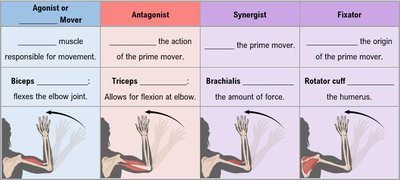
Step-by-Step Guidance
Review the actions described (e.g., lifting your arm to the side, smiling) and the muscles listed (Deltoid, Zygomaticus major, Mentalis, Teres major).
Recall the primary function of each muscle. For example, the Deltoid is involved in abduction of the arm, while the Zygomaticus major is involved in smiling.
Determine which muscle acts as the agonist (prime mover) for each action. The agonist is the muscle that produces the main movement.
Identify the antagonist for each action. The antagonist is the muscle that opposes the movement of the agonist.
Think about where a synergist would be located. Synergists are often found near the agonist and help refine or assist the movement.
Set up your answers for each action, but stop before filling in the final muscle names and locations. Use your textbook or notes to check the specific roles if needed.
Try solving on your own before revealing the answer!
Final Answer:
Lifting your arm to the side:
Agonist: Deltoid
Antagonist: Teres major
Synergist Location: Upper arm/shoulder region (e.g., supraspinatus)
Smiling:
Agonist: Zygomaticus major
Antagonist: Mentalis
Synergist Location: Cheek region (e.g., risorius)
Agonists produce the main movement, antagonists oppose it, and synergists assist. Locations are based on anatomical proximity to the action.
Q2. True or False: A fixator works to stabilize the insertion of the antagonist. If false, choose the answer that best corrects the statement.
Background
Topic: Muscle Actions – Fixator
This question tests your understanding of the role of fixators in muscle movement, specifically what they stabilize during an action.
Key Terms:
Fixator: A muscle that stabilizes the origin of the agonist, not the insertion.
Origin: The attachment site of a muscle that remains relatively stationary during movement.
Insertion: The attachment site that moves during contraction.
Step-by-Step Guidance
Read the statement carefully and identify what is being stabilized (insertion or origin).
Recall the definition of a fixator and its function in muscle movement.
Compare the statement to your knowledge: does a fixator stabilize the insertion or the origin?
Review the answer choices and select the one that correctly describes the role of a fixator.
Try solving on your own before revealing the answer!
Final Answer: b) False, the fixator stabilizes the origin of the agonist.
Fixators stabilize the origin of the prime mover (agonist), allowing for efficient movement.
Q3. The genioglossus is the primary muscle involved in sticking out your tongue. The styloglossus is responsible for pulling the tongue back in. What is the role of the styloglossus for sticking out your tongue?
Background
Topic: Muscle Actions – Agonist vs. Antagonist
This question tests your ability to identify the role of a muscle that opposes the action of another muscle.
Key Terms:
Agonist: Muscle responsible for the main action (sticking out the tongue).
Antagonist: Muscle that opposes the action (pulls the tongue back in).
Step-by-Step Guidance
Identify the action: sticking out the tongue.
Determine which muscle is the agonist (genioglossus).
Determine which muscle opposes this action (styloglossus).
Recall the definition of antagonist and match it to the role of the styloglossus.
Try solving on your own before revealing the answer!
Final Answer: c) Antagonist
The styloglossus acts as the antagonist to the genioglossus when sticking out the tongue.
Q4. The soleus, gastrocnemius, and tibialis anterior are all major muscles of the lower leg. The gastrocnemius and soleus are both located in the posterior region of the calf, while the tibialis anterior is located in the anterior region of the lower leg. Based only on this information, which statement is most likely true?
Background
Topic: Muscle Actions – Antagonist, Synergist, Fixator
This question tests your ability to use anatomical location to infer muscle relationships (antagonist, synergist, fixator).
Key Terms:
Antagonist: Muscles on opposite sides of a joint often act as antagonists.
Synergist: Muscles that work together to produce a movement.
Fixator: Muscle that stabilizes a joint or origin.
Step-by-Step Guidance
Identify the location of each muscle (posterior vs. anterior).
Recall that muscles on opposite sides of a joint often act as antagonists.
Consider which muscles might work together (synergists) or stabilize (fixators).
Review the answer choices and eliminate those that do not fit the anatomical relationships.
Try solving on your own before revealing the answer!
Final Answer: d) The gastrocnemius and the tibialis anterior are antagonists.
Because they are located on opposite sides of the lower leg, they likely act as antagonists to each other.
