 Indietro
Step-by-Step Study Guidance: Nervous Tissue, Ion Gradients, and Membrane Potentials
Guida di studio - Note intelligenti
 Appunti personalizzati basati sui tuoi materiali, ampliati con definizioni chiave, esempi e contesto.
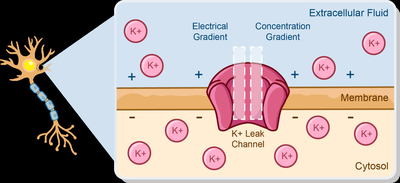
Q1. Electrochemical Gradient: In which direction do the electrical and concentration gradients direct the flow of potassium ions through the K+ channel?
Background
Topic: Ion Movement Across Membranes
This question tests your understanding of how ions move across cell membranes, specifically the role of electrical and concentration gradients in determining the direction of ion flow.
Key Terms and Concepts:
Electrical Gradient: The difference in charge across the membrane; ions move toward areas of opposite charge.
Concentration Gradient: The difference in ion concentration across the membrane; ions move from areas of high concentration to low concentration.
Electrochemical Gradient: The combined effect of electrical and concentration gradients.
Step-by-Step Guidance
Identify the location of potassium ions: There are more K+ ions inside the cell (cytosol) than outside (extracellular fluid).
Determine the concentration gradient: Potassium will tend to move from the area of higher concentration (inside) to lower concentration (outside).
Determine the electrical gradient: The inside of the cell is more negative, so positively charged K+ ions are attracted inward.
Consider the net effect: If the gradients oppose each other, the stronger gradient will determine the net direction of flow.
Set up your answer: Draw arrows for each gradient and decide which direction the net flow would be.
Try solving on your own before revealing the answer!
Final Answer:
The concentration gradient directs K+ ions out of the cell, while the electrical gradient directs them into the cell. The net flow depends on which gradient is stronger, but typically, K+ leaks out of the cell through the channel.
This is because the concentration gradient is usually stronger than the electrical gradient for potassium at rest.
Q2. Chloride Ion Movement: Given the extracellular Cl- concentration is 120mM and cytosol Cl- is 60mM, with cytosol more negative, which statement is correct about Cl- movement?
Background
Topic: Electrochemical Gradients and Ion Movement
This question tests your ability to analyze how both concentration and electrical gradients affect the movement of chloride ions (Cl-) across the cell membrane.
Key Terms and Concepts:
Concentration Gradient: Ions move from high to low concentration.
Electrical Gradient: Negative ions (Cl-) are attracted to positive areas.
Net Charge: The cytosol is more negative than the extracellular fluid.
Step-by-Step Guidance
Compare Cl- concentrations: Higher outside (120mM) than inside (60mM).
Concentration gradient: Cl- will tend to move from outside to inside (high to low concentration).
Electrical gradient: Cl- is a negative ion, and the cytosol is more negative, so Cl- will be repelled from entering the cell.
Analyze the options: Decide which gradients favor movement in or out of the cell.
Try solving on your own before revealing the answer!
Final Answer:
The concentration gradient favors movement of Cl- into the cell, while the electrical gradient favors movement out of the cell. The correct statement is: "The concentration gradient favors a net movement into the cell, the electrical gradient favors movement out of the cell."
Q3. Sodium and Potassium Concentrations: In a neuron at rest, which ion is higher outside the cell, and which is higher inside?
Background
Topic: Ion Distribution in Neurons
This question tests your knowledge of the typical distribution of sodium (Na+) and potassium (K+) ions across the neuronal membrane at rest.
Key Terms and Concepts:
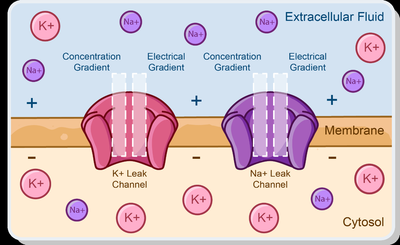
Na+ (Sodium): High concentration outside the cell.
K+ (Potassium): High concentration inside the cell.
Resting Membrane Potential: The voltage difference across the membrane when the neuron is not active.
Step-by-Step Guidance
Recall the typical ion concentrations: Na+ is higher outside, K+ is higher inside.
Match the ions to their locations: Which is greater outside, which is greater inside?
Review the answer choices and select the one that matches this distribution.
Try solving on your own before revealing the answer!
Final Answer:
Sodium concentration is higher outside the cell, and potassium concentration is higher inside the cell. The correct answer is: a) Sodium; potassium.
Q4. Sodium Potassium Pump: What does the Na+/K+ ATPase do, and how does it affect ion concentrations?
Background
Topic: Active Transport and Ion Gradients
This question tests your understanding of the sodium-potassium pump, which is essential for maintaining the resting membrane potential and proper ion distribution in neurons.
Key Terms and Concepts:
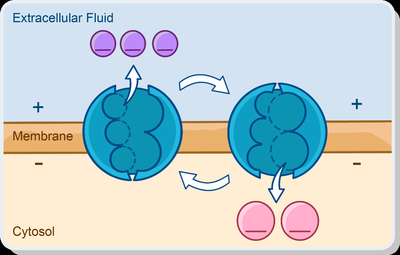
Na+/K+ ATPase: An enzyme that uses ATP to transport sodium and potassium ions against their gradients.
Active Transport: Movement of ions against their electrochemical gradient, requiring energy.
Ion Exchange: Ejects 3 Na+ ions from the cell and brings in 2 K+ ions.
Step-by-Step Guidance
Recall the function of the sodium-potassium pump: It moves Na+ out and K+ in.
Count the ions: For each cycle, 3 Na+ are ejected, 2 K+ are brought in.
Consider the effect: This maintains high Na+ outside and high K+ inside.
Review the answer choices and select the one that matches this mechanism.
Try solving on your own before revealing the answer!
Final Answer:
The sodium-potassium pump transports 2 potassium ions into the cell and ejects 3 sodium ions. The correct answer is: d) The sodium potassium pump transports 2 potassium ions and ejects 3 sodium ions.
Q5. Resting Membrane Potential: What is the most important factor in generating resting membrane potential?
Background
Topic: Resting Membrane Potential
This question tests your understanding of the factors that contribute to the voltage difference across the neuronal membrane when the cell is at rest.
Key Terms and Concepts:
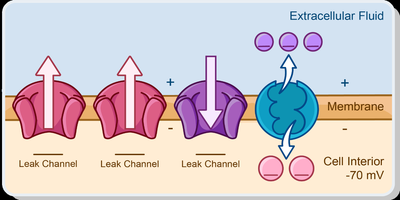
Resting Membrane Potential: The voltage difference across the membrane, typically around -70 mV.
K+ Concentration Gradient: The main factor in establishing resting potential.
Na+/K+ ATPase: Helps maintain the gradients but is not the primary factor.
Step-by-Step Guidance
Recall that the resting membrane potential is mainly due to the movement of K+ ions through leak channels.
Consider the role of the sodium-potassium pump in maintaining gradients, but not directly generating the potential.
Review the answer choices and select the one that best explains the main factor.
Try solving on your own before revealing the answer!
Final Answer:
The most important factor in generating resting membrane potential is the potassium concentration gradient. The correct answer is: b) K+ concentration gradient.
Q6. Membrane Potential Changes: A neuron's membrane potential goes from -90 mV to -10 mV. What term describes this change?
Background
Topic: Changes in Membrane Potential
This question tests your understanding of the terminology used to describe changes in membrane potential, such as depolarization, repolarization, and hyperpolarization.
Key Terms and Concepts:
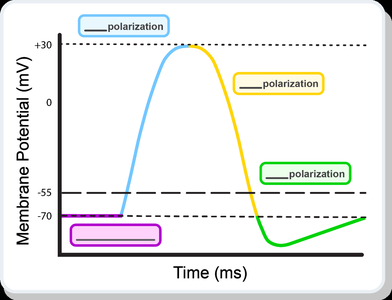
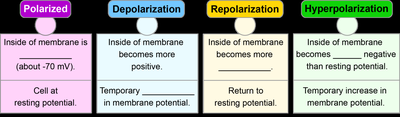
Depolarization: Membrane potential becomes less negative (more positive).
Hyperpolarization: Membrane potential becomes more negative than resting.
Repolarization: Return to resting potential after depolarization.
Step-by-Step Guidance
Identify the starting and ending membrane potentials: -90 mV to -10 mV.
Determine if the membrane is becoming more positive or more negative.
Recall the definitions: Depolarization is when the membrane becomes less negative.
Review the answer choices and select the term that matches this change.
Try solving on your own before revealing the answer!
Final Answer:
This change is called depolarization. The correct answer is: c) Depolarization.
