 Indietro
Study Guide: Fundamentals of the Nervous System
Guida di studio - Note intelligenti
 Appunti personalizzati basati sui tuoi materiali, ampliati con definizioni chiave, esempi e contesto.
The Nervous System: Overview
Functions of the Nervous System
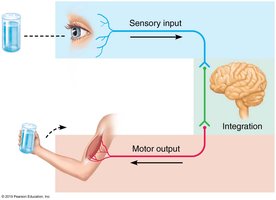
The nervous system is the master controlling and communicating system of the body. It utilizes electrical and chemical signals to rapidly and specifically coordinate bodily functions, often resulting in immediate responses. The nervous system performs three main functions:
Sensory Input: Gathering information from sensory receptors about internal and external changes.
Integration: Processing and interpreting sensory input to determine the appropriate response.
Motor Output: Activating effector organs (muscles and glands) to produce a response.
Divisions of the Nervous System
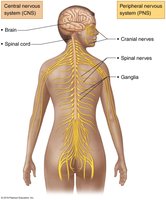
The nervous system is divided into two principal parts:
Central Nervous System (CNS): Consists of the brain and spinal cord, located in the dorsal body cavity. It serves as the integration and control center, interpreting sensory input and dictating motor output.
Peripheral Nervous System (PNS): Comprises nerves that extend from the brain and spinal cord, including cranial and spinal nerves. The PNS connects the CNS to the rest of the body.
Neuron Structure and Classification
Structural Classification of Neurons
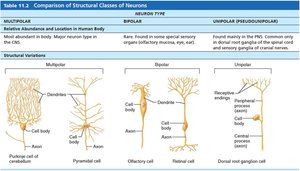
Neurons are classified based on the number of processes extending from the cell body:
Multipolar: Three or more processes (one axon, others dendrites). Most common in the CNS; includes many interneurons.
Bipolar: Two processes (one axon, one dendrite). Rare, found in special sensory organs (e.g., retina, olfactory mucosa).
Unipolar (Pseudounipolar): One T-like process (two axons). Commonly found in the PNS, especially in dorsal root ganglia.
Neuron Type | Location | Structural Features |
|---|---|---|
Multipolar | CNS (interneurons, motor neurons) | Many dendrites, one axon |
Bipolar | Retina, olfactory mucosa | One dendrite, one axon |
Unipolar | PNS (sensory neurons) | Single process splits into two branches |
Functional Regions of a Neuron
Neurons have distinct regions for receiving, integrating, and transmitting signals:
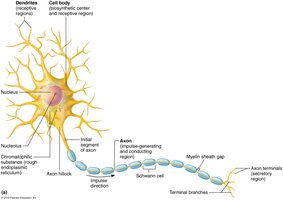
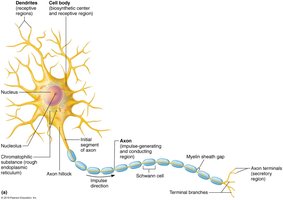
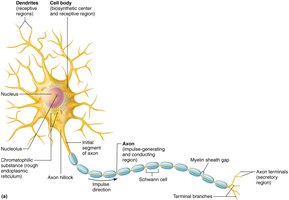
Dendrites: Receptive (input) region; convey incoming messages toward the cell body as graded potentials.
Cell Body: Biosynthetic center and receptive region; contains nucleus and organelles.
Axon: Impulse-generating and conducting region; transmits action potentials away from the cell body.
Axon Terminals: Secretory region; releases neurotransmitters to communicate with other cells.
Neuron Processes and Myelination
Neuron Processes: Dendrites and Axons
Neurons possess armlike processes that extend from the cell body. Dendrites are short, highly branched structures specialized for receiving signals. Axons are long, singular processes responsible for transmitting electrical impulses.
Tracts: Bundles of neuron processes in the CNS.
Nerves: Bundles of neuron processes in the PNS.
Myelin Sheath and Its Function
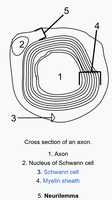
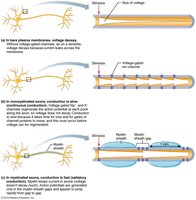
The myelin sheath is a whitish, protein-lipid covering that insulates axons and increases the speed of nerve impulse transmission. Myelinated fibers conduct impulses rapidly, while nonmyelinated fibers conduct more slowly.
Myelination in CNS: Oligodendrocytes form myelin sheaths; each cell can wrap multiple axons.
Myelination in PNS: Schwann cells form myelin sheaths; each cell wraps one segment of an axon.
Myelin Sheath Gaps: Also known as nodes of Ranvier; sites where axon collaterals can emerge and action potentials are generated.
Conduction Velocity in Axons
Action potentials (APs) occur only in axons. The rate of AP propagation depends on the degree of myelination and axon diameter. Two types of conduction are observed:
Continuous Conduction: Slow conduction in nonmyelinated axons.
Saltatory Conduction: Fast conduction in myelinated axons; electrical signals jump from node to node.
Neuroglia (Glial Cells) of the PNS
Types and Functions
Neuroglia are supporting cells in the nervous system. In the PNS, two major types are present:
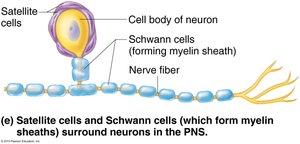
Satellite Cells: Surround neuron cell bodies in the PNS; function similarly to astrocytes in the CNS.
Schwann Cells (Neurolemmocytes): Surround all peripheral nerve fibers and form myelin sheaths in thicker nerve fibers; vital for regeneration of damaged peripheral nerve fibers.
The Synapse
Structure and Function
Synapses are junctions that mediate information transfer from one neuron to another or from a neuron to an effector cell. The presynaptic neuron conducts impulses toward the synapse, while the postsynaptic neuron transmits signals away from the synapse.
Axodendritic: Between axon terminals of one neuron and dendrites of another.
Axosomatic: Between axon terminals and cell bodies.
Other types: Axoaxonal, dendrodendritic, somatodendritic.
Chemical Synapses
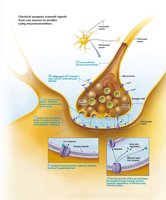
Chemical synapses are the most common type, specialized for the release and reception of neurotransmitters. They consist of:
Axon Terminal: Contains synaptic vesicles filled with neurotransmitter.
Receptor Region: Located on the postsynaptic neuron's membrane.
Synaptic Cleft: Fluid-filled gap separating the two parts; ensures unidirectional communication.
Transmission Across Synaptic Cleft
Transmission across the synaptic cleft is a chemical event involving the release, diffusion, and receptor binding of neurotransmitters. This process converts electrical impulses to chemical signals and back to electrical, ensuring unidirectional communication between neurons.
Summary Table: Structural Classes of Neurons
Neuron Type | Location | Function | Example |
|---|---|---|---|
Multipolar | CNS | Interneurons, motor neurons | Pyramidal cell |
Bipolar | Special sensory organs | Sensory neurons | Retinal cell |
Unipolar | PNS | Sensory neurons | Dorsal root ganglion cell |
Key Equations
Resting Membrane Potential:
Ohm's Law for Neurons:
Saltatory Conduction:
where v = conduction velocity, d = axon diameter, τ = time constant
Additional info: Academic context was added to clarify the structural and functional classification of neurons, the role of neuroglia, and the mechanisms of synaptic transmission. Tables were recreated and expanded for clarity. Only images directly relevant to the explanation were included.
