 Indietro
Study Guide: Gross Anatomy of the Skeletal Muscle System
Guida di studio - Note intelligenti
 Appunti personalizzati basati sui tuoi materiali, ampliati con definizioni chiave, esempi e contesto.
The Skeletal Muscular System
Overview of Skeletal Muscles
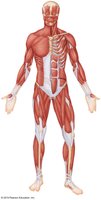
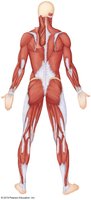
The skeletal muscular system consists of muscles attached to the skeleton, responsible for voluntary movements, posture, and joint stability. Muscles work in groups to produce coordinated actions, and their arrangement and function are essential for understanding human movement.
Skeletal muscles are striated, voluntary, and attached to bones via tendons.
Muscle groups are organized by their location and function.
Muscles act as levers with bones and joints to produce movement.
Functional Groupings of Muscles
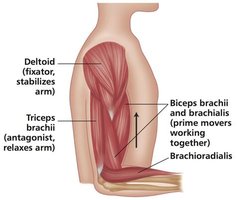
Agonists, Antagonists, Synergists, and Fixators
Muscles are classified based on their roles during movement. For any movement, muscles can act as agonists (prime movers), antagonists, synergists, or fixators. The same muscle may serve different roles depending on the movement.
Agonist (Prime Mover): Major responsibility for producing a specific movement.
Antagonist: Opposes or reverses the movement of the agonist.
Synergist: Assists the prime mover, adds extra force, or reduces unnecessary movement.
Fixator: A synergist that stabilizes the origin of the prime mover.
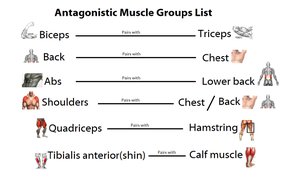
Antagonistic Muscle Groups
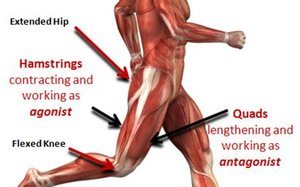
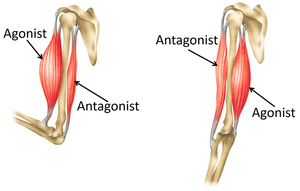
Antagonistic muscle pairs are located on opposite sides of the joint they act upon. When one muscle contracts, its antagonist relaxes, allowing coordinated movement.
Biceps vs. Triceps
Quadriceps vs. Hamstrings
Tibialis anterior vs. Calf muscles
Muscle Actions Relative to Joints
Determining Muscle Action
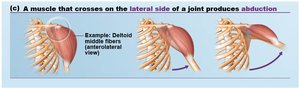
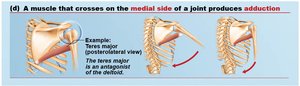
The action of a muscle is determined by its position relative to the joint it crosses. Muscles can only pull, never push. The direction of movement depends on the muscle's insertion and origin.
Abduction: Muscle crosses on the lateral side of a joint (e.g., deltoid middle fibers).
Adduction: Muscle crosses on the medial side of a joint (e.g., teres major).
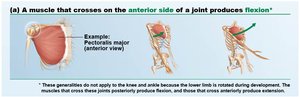
Flexion: Muscle crosses on the anterior side of a joint (e.g., pectoralis major).
Muscle Attachments: Origin and Insertion
Definition and Importance
Each muscle has two attachments: the origin and the insertion. The origin is the fixed attachment, while the insertion moves during contraction. This relationship determines the muscle's action.
Origin: Attachment to the stationary bone.
Insertion: Attachment to the moving bone.
Muscle Naming Criteria
How Skeletal Muscles Are Named
Skeletal muscles are named based on several criteria, including location, shape, size, direction of fibers, number of origins, location of attachments, and action.
Location: Temporalis (over temporal bone)
Shape: Deltoid (triangle-shaped)
Size: Maximus (largest), Minimus (smallest), Longus (long)
Direction: Rectus (straight), Transversus (right angles), Oblique (angles)
Number of origins: Biceps (two), Triceps (three)
Attachments: Sternocleidomastoid (origin first)
Action: Flexor, Extensor
Fascicle Arrangements and Muscle Shape
Types of Fascicle Arrangements
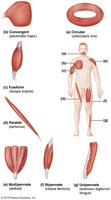
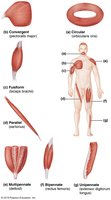
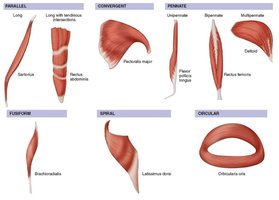
The arrangement of muscle fascicles determines muscle shape and force production. There are five main types:
Circular: Fascicles arranged in concentric rings (e.g., sphincter).
Convergent: Broad origin, fascicles converge toward a single tendon (e.g., pectoralis major).
Fusiform: Spindle-shaped with parallel fibers (e.g., biceps brachii).
Parallel: Fascicles parallel to the long axis (e.g., sartorius).
Pennate: Short fascicles attach obliquely to a central tendon; includes unipennate, bipennate, and multipennate forms (e.g., deltoid).
Muscle and Bone Lever Systems
Lever Classes in the Musculoskeletal System
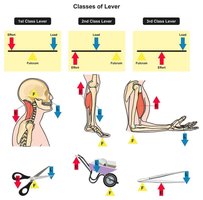
Muscles, bones, and joints form lever systems to produce movement. There are three classes of levers, each with different arrangements of effort, load, and fulcrum.
First-class lever: Fulcrum between effort and load (e.g., neck muscles).
Second-class lever: Load between fulcrum and effort (e.g., calf muscles).
Third-class lever: Effort between fulcrum and load (e.g., biceps brachii).
Innervation of Muscles
Nerve Supply to Muscles
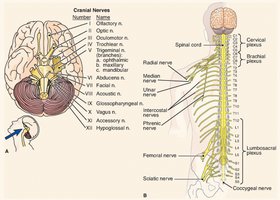
Muscles are innervated by nerves that arise from the brain (cranial nerves) or spinal cord (peripheral nerves). Innervation determines muscle function and is essential for voluntary movement.
Cranial nerves: Supply muscles of the head and some neck muscles.
Peripheral nerves: Supply muscles of the torso, neck, upper and lower extremities.
Summary Table: Muscle Roles and Attachments
Muscle Group | Origin | Insertion | Action | Innervation |
|---|---|---|---|---|
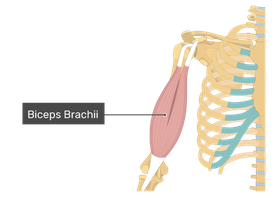
Biceps Brachii | Scapula | Radius | Elbow Flexion | Musculocutaneous Nerve |
Triceps Brachii | Scapula/Humerus | Ulna | Elbow Extension | Radial Nerve |
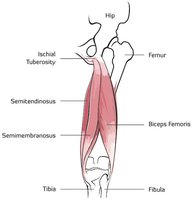
Hamstrings | Ischial Tuberosity | Tibia/Fibula | Knee Flexion | Sciatic Nerve |
Quadriceps | Femur/AIIS | Patella/Tibia | Knee Extension | Femoral Nerve |
Deltoid | Clavicle/Scapula | Humerus | Shoulder Abduction | Axillary Nerve |
Key Concepts and Study Tips
Muscles act in groups to produce movement, stabilize joints, and maintain posture.
Understanding origin, insertion, action, and innervation is essential for identifying muscle function.
Muscle names often reflect their characteristics, location, or function.
Lever systems and fascicle arrangements influence muscle strength and range of motion.
