 Indietro
Study Guide: The Brain and Cranial Nerves (Anatomy & Physiology)
Guida di studio - Note intelligenti
 Appunti personalizzati basati sui tuoi materiali, ampliati con definizioni chiave, esempi e contesto.
The Brain
Overview of Brain Regions
The brain is a complex organ responsible for integrating sensory information, controlling motor functions, and supporting higher mental processes. It is divided into several major regions, each with distinct functions:
Cerebrum: Largest part, controls conscious thought, intellect, memory, and complex movement.
Cerebellum: Coordinates ongoing body movements and balance.
Diencephalon: Contains thalamus and hypothalamus, relays sensory information and regulates autonomic and endocrine functions.
Brainstem: Includes midbrain, pons, and medulla oblongata; processes sensory/motor information and regulates vital functions.
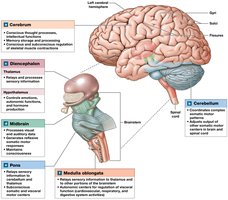
Cerebrum
The cerebrum is the largest region of the adult brain, divided into left and right hemispheres. It is responsible for conscious sensations, voluntary movement, and higher mental functions such as reasoning, memory, and intellect.
Controls: Sensations, complex movement, conscious thoughts, intellect, memory.
Structure: Two hemispheres separated by the longitudinal fissure.
Cerebellum
The cerebellum is the second-largest brain region, located posterior to the cerebrum. It coordinates voluntary movements and maintains balance and posture.
Function: Coordination of ongoing body movements.
Structure: Two hemispheres, covered by the cerebellar cortex (gray matter).
Diencephalon
The diencephalon is a central brain region consisting of the thalamus and hypothalamus. It integrates sensory information and regulates autonomic and endocrine functions.
Thalamus: Relays and processes sensory information.
Hypothalamus: Controls emotions, autonomic functions, hormone production; connects to the pituitary gland.
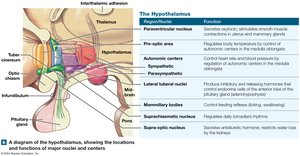
Region/Nucleus | Function |
|---|---|
Paraventricular nucleus | Produces oxytocin, stimulates smooth muscle contractions |
Pre-optic area | Regulates body temperature |
Autonomic centers | Control autonomic functions in medulla oblongata |
Lateral tuberal nuclei | Produce inhibitory and releasing hormones for pituitary gland |
Mammillary bodies | Control feeding reflexes (chewing, swallowing) |
Supra-optic nucleus | Produces antidiuretic hormone (ADH) |
Brainstem
The brainstem connects the cerebrum and cerebellum to the spinal cord and is essential for basic life functions.
Midbrain: Processes visual and auditory information, reflexes, and consciousness.
Pons: Contains tracts and nuclei for somatic and visceral motor control.
Medulla oblongata: Relays sensory information, regulates autonomic functions (heart rate, blood pressure).
Brain Protection and Support
Cranial Meninges
The brain is protected by three layers of cranial meninges, which are continuous with the spinal meninges:
Dura mater: Tough, outermost layer.
Arachnoid mater: Middle layer, web-like structure.
Pia mater: Innermost layer, adheres to brain surface.
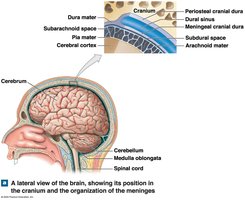
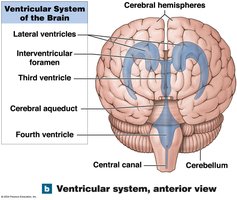
Ventricular System
The ventricular system consists of interconnected cavities filled with cerebrospinal fluid (CSF), which cushions and supports the brain.
Lateral ventricles
Third ventricle
Fourth ventricle
Cerebral aqueduct
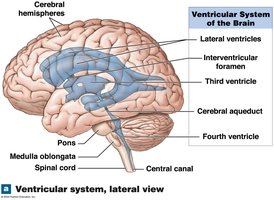
Cerebrospinal Fluid (CSF)
CSF surrounds all exposed surfaces of the central nervous system (CNS). It supports the brain, cushions neural structures, and transports nutrients, chemical messengers, and wastes.
Function: Mechanical protection, chemical stability, nutrient transport.
Blood-Brain Barrier (BBB)
The BBB isolates the CNS from general circulation, allowing selective transport of substances. Only lipid-soluble compounds (e.g., oxygen, carbon dioxide, ammonia, steroids) can diffuse freely.
Function: Protects brain from toxins, maintains stable environment.
Cerebrovascular Diseases
Cerebrovascular diseases interfere with blood supply to the brain. A cerebrovascular accident (CVA), or stroke, stops blood flow to a portion of the brain, causing neuron death within minutes.
Stroke: Sudden loss of blood flow, rapid neuron death.
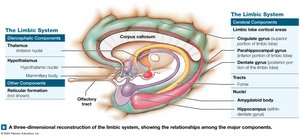
The Limbic System
Structure and Function
The limbic system is a functional grouping of brain structures that establishes emotional states, links conscious and autonomic functions, and facilitates memory storage and retrieval.
Components: Thalamus, hypothalamus, hippocampus, amygdaloid body, cingulate gyrus, and others.
Functions: Emotion, motivation, memory.
The Cerebrum
Integrative Centers
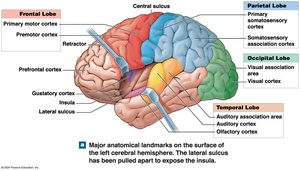
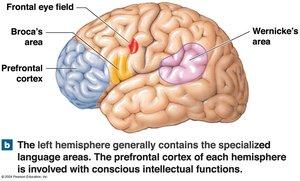
Integrative centers in the cerebrum receive information from association areas, direct complex motor activities, and perform analytical functions. The prefrontal cortex is involved in abstract intellectual functions, such as predicting consequences.
Prefrontal cortex: Abstract thinking, planning, prediction.
Language Areas
Specialized centers in the cerebrum control language comprehension and production:
Wernicke’s area: Language comprehension, access to visual and auditory memories.
Broca’s area: Speech production.
Dyslexia: Inability to comprehend or use written words.
Aphasia: Inability to speak.
Hemispheric Lateralization
The left and right cerebral hemispheres have functional differences:
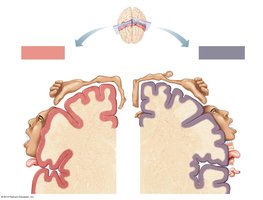
Left hemisphere: Reading, writing, math, speech, language, decision making.
Right hemisphere: Analyzes sensory information, recognizes faces and voice inflections.
Body Maps in the Cerebrum
The primary motor cortex (precentral gyrus) and primary somatosensory cortex (postcentral gyrus) contain body maps that represent different regions of the body. These maps illustrate the distribution of motor and sensory functions.
Motor map: Controls voluntary movements.
Sensory map: Receives sensory input from the body.
Synchronization of Electrical Activity
Electrical activity between hemispheres is synchronized by a pacemaker mechanism involving the thalamus. Desynchronization can result from injury or tumor, leading to seizures or epilepsies.
Seizure: Temporary cerebral disorder with abnormal electrical activity.
Epilepsies: Clinical disorders characterized by recurrent seizures.
Functions of Major Parts of the Brain
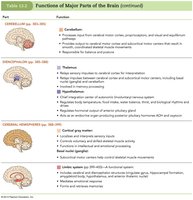
The brain's major parts have distinct functions, summarized in the following table:
Part | Function |
|---|---|
Cerebellum | Adjusts postural muscles, coordinates movement, refines motor activity |
Thalamus | Relays sensory information, coordinates voluntary/involuntary motor commands |
Cerebral cortex | Conscious thought, memory, learning, sensory processing, motor activity |
Additional info: Academic context was added to clarify the functions and relationships of brain regions, the limbic system, and the protection/support mechanisms. Tables were recreated and expanded for completeness.
