 Indietro
Study Guide: The Digestive System – Small and Large Intestine, Digestion, and Absorption
Guida di studio - Note intelligenti
 Appunti personalizzati basati sui tuoi materiali, ampliati con definizioni chiave, esempi e contesto.
The Digestive System
The Small Intestine
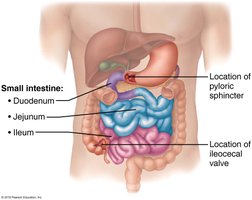
The small intestine is the principal organ for digestion and absorption in the human body. It extends from the pyloric sphincter to the ileocecal valve, connecting the stomach to the large intestine. Its structure and function are optimized for nutrient absorption.
Length and Structure: 2–4 meters long, with a diameter of 2.5–4 cm.
Subdivisions:
Duodenum: ~25 cm, curves around the pancreas, mostly retroperitoneal.
Jejunum: ~2.5 m, attached by mesentery.
Ileum: ~3.6 m, attached by mesentery, joins large intestine at ileocecal valve.
Blood Supply: Supplied by the superior mesenteric artery; veins drain into the superior mesenteric vein.
Microscopic Anatomy and Structural Modifications
The small intestine is highly specialized for absorption, with structural modifications that increase its surface area by approximately 600 times, reaching about 200 m2.
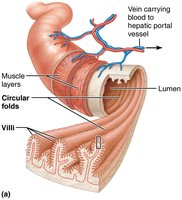
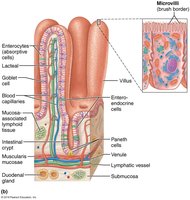
Circular folds: Permanent folds (~1 cm deep) that slow the movement of chyme, increasing absorption time.
Villi: Fingerlike projections (~1 mm high) containing capillary beds and lymphatic capillaries (lacteals) for nutrient absorption.
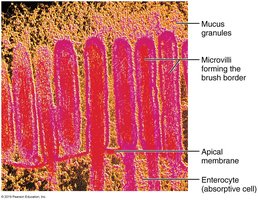
Microvilli: Cytoplasmic extensions forming the brush border, which contains enzymes for final carbohydrate and protein digestion.
Motility and Regulation
The small intestine exhibits two main types of motility: segmentation and peristalsis. Segmentation mixes and moves contents after a meal, while peristalsis propels remnants, bacteria, and debris between meals.
Segmentation: Most common after meals; intensity regulated by neural reflexes and hormones.
Peristalsis: Increases between meals, moving contents toward the large intestine.
Ileocecal valve: Controls entry of chyme into the large intestine, preventing regurgitation.
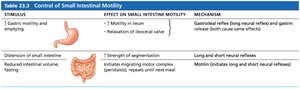
Stimulus | Effect on Small Intestine Motility | Mechanism |
|---|---|---|
Gastric motility and emptying | ↑ Motility in ileum; relaxation of ileocecal valve | Gastroileal reflex (long neural reflex) and gastrin release (both cause same effects) |
Distension of small intestine | ↑ Strength of segmentation | Long and short neural reflexes |
Reduced intestinal volume, fasting | Initiates migrating motor complex (peristalsis), repeats until next meal | Motilin (initiates long and short neural reflexes) |
The Large Intestine
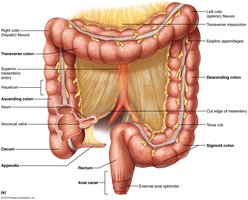
The large intestine absorbs water and electrolytes, forms feces, and houses a diverse bacterial flora. It consists of several subdivisions, each with distinct functions.
Cecum: First part; receives chyme from ileum.
Appendix: Contains lymphoid tissue; part of immune system and bacterial storehouse.
Colon:
Ascending colon: Right side, ends in right-angle turn.
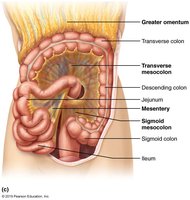
Transverse colon: Across abdominal cavity.
Descending colon: Left side.
Sigmoid colon: S-shaped, through pelvis.
Rectum: Contains rectal valves to separate feces from gas.
Anal canal: Opens to exterior; has internal (smooth muscle) and external (skeletal muscle) sphincters.
Bacterial Flora and Metabolic Functions
The colon is colonized by over 1000 types of bacteria, which outnumber human cells and perform essential metabolic functions.
Fermentation: Bacteria ferment indigestible carbohydrates, releasing acids and gases.
Vitamin synthesis: Synthesize B complex and vitamin K for clotting factor production.
Immune function: Beneficial bacteria suppress pathogens; immune system destroys bacteria breaching mucosal barrier.
Digestive Processes and Clinical Considerations
Residue remains in the large intestine for 12–24 hours. Water, electrolytes, and vitamins are absorbed, and feces are propelled toward the anus for defecation. Several clinical conditions affect the large intestine:
Appendicitis: Inflammation due to blockage; can cause peritonitis if ruptured.
Antibiotic-associated diarrhea: Often caused by Clostridium difficile; treated with fecal transplants.
Diverticulosis/Diverticulitis: Herniations of mucosa, common in older adults; can be life-threatening if inflamed.
Irritable Bowel Syndrome (IBS): Functional disorder with recurring pain and stool changes; stress management is key.
Diarrhea: Results from insufficient water absorption; can cause dehydration and electrolyte imbalance.
Constipation: Excessive water absorption; caused by low fiber/fluid, poor habits, lack of exercise, or laxative abuse.
Physiology of Digestion and Absorption
Mechanism of Digestion: Enzymatic Hydrolysis
Digestion is a catabolic process breaking down macromolecules into monomers for absorption. Enzymes from intrinsic and accessory glands carry out hydrolysis, adding water to break chemical bonds.
Hydrolysis equation:
Mechanisms of Absorption
Absorption moves substances from the gut lumen into the body. Tight junctions force molecules through epithelial cells. Lipids are absorbed passively; polar molecules require active transport. Most nutrients are absorbed before chyme reaches the ileum.
Processing of Nutrients
Carbohydrates: Only monosaccharides are absorbed. Starch and disaccharides are broken down by salivary and pancreatic amylase, then brush border enzymes.
Proteins: Digested into amino acids, starting in the stomach by pepsin.
Lipids: Emulsified by bile salts, then digested by lipases. Short-chain fatty acids diffuse directly into blood.
Nucleic Acids: Digested by pancreatic nucleases; absorbed as nucleotide monomers.
Water: 95% absorbed in small intestine by osmosis; remainder in large intestine.
Clinical Considerations in Digestion and Absorption
Lactose intolerance: Deficiency of lactase leads to undigested lactose, causing diarrhea.
Malabsorption: Caused by impaired delivery of bile/pancreatic juice or damaged mucosa (e.g., celiac disease).
Cleft palate/lip: Failure of palatine bones/processes to fuse; affects feeding in infants.
Cystic fibrosis: Thick mucus blocks pancreatic duct, affecting digestion.
Developmental Aspects of the Digestive System
Digestive System After Birth
Fetal nutrition: Occurs via placenta; GI tract matures by swallowing amniotic fluid.
Newborn reflexes: Rooting and sucking aid in feeding.
Growth: Newborns double birth weight in 6 months; adult diet by 2 years.
Aging and the Digestive System
Decline in activity: Less digestive juice, less efficient absorption, slower peristalsis.
Common conditions: Diverticulosis, fecal incontinence, GI cancers.
Prevention: Regular dental and medical exams; early detection improves outcomes.
