 Indietro
Study Guide: The General and Special Senses in Anatomy & Physiology
Guida di studio - Note intelligenti
 Appunti personalizzati basati sui tuoi materiali, ampliati con definizioni chiave, esempi e contesto.
General Senses
Overview of General Senses
The general senses encompass the body's ability to detect temperature, pain, touch, pressure, vibration, and proprioception. These senses are mediated by specialized sensory receptors distributed throughout the body, particularly in the skin and connective tissues.
Proprioception: Awareness of the position of joints and muscles, essential for coordinated movement.
Sensory Receptors: Specialized cells or cell processes that monitor internal and external conditions.
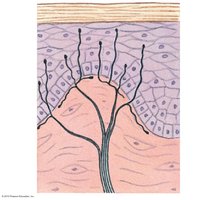
Free Nerve Endings: The simplest type of sensory receptor, capable of responding to multiple stimuli.
Functional Classification of General Sensory Receptors
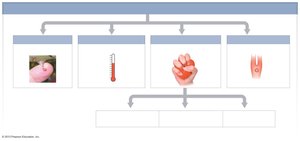
General sensory receptors are classified based on the type of stimulus they detect:
Nociceptors: Detect pain.
Thermoreceptors: Detect temperature changes (hot and cold).
Mechanoreceptors: Detect touch, pressure, vibration, and stretch.
Chemoreceptors: Respond to dissolved chemicals.
Proprioceptors: Monitor the position of joints and muscles.
Baroreceptors: Monitor pressure changes inside hollow organs.
Tactile Receptors: Detect touch, pressure, and vibration.
General Sensory Receptors in the Skin
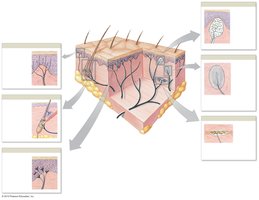
The skin contains several types of sensory receptors, each specialized for different sensations:
Free Nerve Endings: Detect pain and temperature.
Root Hair Plexus: Detect hair displacement.
Tactile Discs (Merkel cells): Detect touch in the epidermis.
Meissner’s (Tactile) Corpuscles: Detect touch; located in the papillary layer of the dermis.
Pacinian (Lamellated) Corpuscles: Detect deep pressure; found in the reticular layer of the dermis.
Ruffini Corpuscles: Detect tension in the dermis.
Baroreceptors
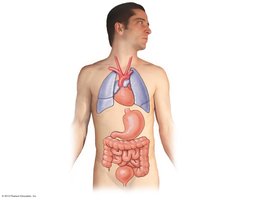
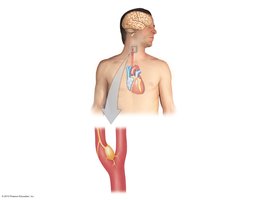
Baroreceptors are specialized mechanoreceptors that monitor changes in pressure within hollow organs. Their elastic walls change shape with pressure, altering the rate of action potential generation.
Aortic Arch and Carotid Body: Monitor blood pressure.
Lungs: Help control respiratory rate.
Digestive Tract: Provide information for movement.
Urinary Bladder and Colon: Stretching triggers excretory reflexes.
Chemoreceptors
Chemoreceptors detect levels of dissolved chemicals such as pH, CO2, and O2. They play a crucial role in reflexively influencing heart rate and respiratory rate.
Medulla Oblongata: Monitors pH and CO2 levels of cerebrospinal fluid (CSF).
Aortic Arch and Carotid Body: Monitor pH, CO2, and oxygen levels of blood.
Special Senses: Olfaction and Gustation
Overview of Special Senses
Special senses are mediated by structurally complex receptors located in specific areas of the head. These include olfaction (smell), gustation (taste), vision, hearing, and equilibrium (balance).
Olfaction: Receptors are modified neurons.
Gustation: Receptors are specialized cells that communicate with neurons.
Receptors must contact dissolved chemicals to send signals.
Olfaction (Smell)
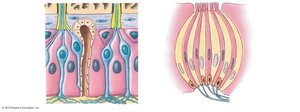
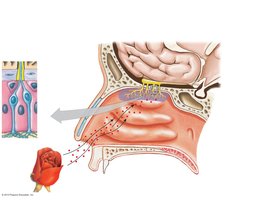
Olfactory organs consist of receptor cells within supporting epithelium. Odorants bind to these receptor cells, initiating a signal that travels through the olfactory nerve (CN I) to the olfactory bulb and tract, and is processed in the olfactory cortex, limbic system, hypothalamus, and gustatory cortex.
Odorants: Chemicals that bind to olfactory receptors.
Olfactory Pathway: Receptor neurons → olfactory nerve → cribriform plate → olfactory bulb → olfactory tract → brain regions.
Gustation (Taste)
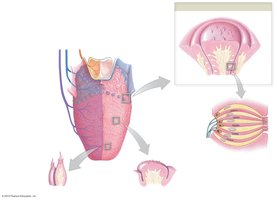
Taste receptors are primarily located in taste buds found on the papillae of the tongue, as well as in the pharynx and larynx. There are five basic flavors: salt, sour, bitter, sweet, and umami. Taste information is carried by the facial, glossopharyngeal, and vagus nerves to the gustatory cortex.
Salt: Metal cations.
Sour: Hydrogen ions (acid).
Bitter: Alkaloids (often toxic).
Sweet: Hydroxyl groups on sugars.
Umami: Glutamate amino acid.
Water Receptors: Located in the pharynx, send information to the hypothalamus.
Additional info:
These notes cover the General and Special Senses, corresponding to Chapter 9: The General and Special Senses, and are directly relevant to Anatomy & Physiology college coursework. The included images visually reinforce the anatomical structures and pathways described in the text, aiding in the understanding of sensory physiology.
