 Indietro
Study Guide: The Lymphatic System and Lymphoid Organs & Tissues
Guida di studio - Note intelligenti
 Appunti personalizzati basati sui tuoi materiali, ampliati con definizioni chiave, esempi e contesto.
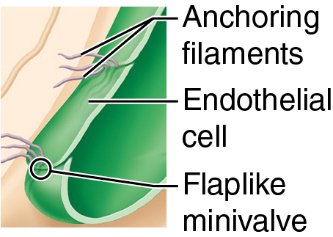
Q8. Describe how the anchoring filaments and minivalves shown below facilitate the uptake of fluid into lymphatic capillaries.
Background
Topic: Structure and function of lymphatic capillaries
This question tests your understanding of how lymphatic capillaries absorb interstitial fluid from tissues, focusing on the roles of anchoring filaments and minivalves.
Key Terms:
Anchoring filaments: Elastic fibers that attach lymphatic capillaries to surrounding tissue.
Minivalves: Flaplike structures formed by overlapping endothelial cells that act as one-way valves.
Endothelial cells: Cells lining the lymphatic capillaries.
Step-by-Step Guidance
When tissue fluid pressure increases, it pulls on the anchoring filaments attached to the lymphatic capillary.
This tension causes the endothelial cells to separate slightly, opening the minivalves.
Fluid (along with any particles or pathogens) enters the lymphatic capillary through these open minivalves.
Once inside, the pressure within the capillary closes the minivalves, preventing backflow of fluid into the tissue.
Try solving on your own before revealing the answer!
Final Answer:
Anchoring filaments pull on the endothelial cells when tissue fluid pressure rises, opening the flaplike minivalves. This allows interstitial fluid to enter the lymphatic capillary. When the pressure inside the capillary increases, the minivalves close, preventing fluid from leaking back out. This mechanism ensures efficient uptake of fluid and particles from tissues into the lymphatic system.
