 Indietro
Study Guide: The Muscular System (Anatomy & Physiology, Marieb 12th Edition, Chapter 10)
Guida di studio - Note intelligenti
 Appunti personalizzati basati sui tuoi materiali, ampliati con definizioni chiave, esempi e contesto.
The Muscular System: Overview
Introduction
The muscular system is essential for movement, posture, and various bodily functions. Understanding muscle anatomy and physiology is crucial for improving body mechanics and preventing injury.
Muscle Actions and Interactions
Functional Groups of Muscles
Muscles work together to produce movement, and are classified into three main functional groups:
Prime mover (agonist): The muscle primarily responsible for a specific movement.
Antagonist: Opposes or reverses the action of the prime mover.
Synergist: Assists the prime mover by adding force or reducing unnecessary movement.
Fixators: A type of synergist that stabilizes the origin of the prime mover.
Origin and Insertion
Muscles attach to bones at two points:
Origin: The attachment site that moves the least, usually proximal or medial.
Insertion: The attachment site that moves the most, usually distal or lateral.
Inferring Muscle Action by Position Relative to Joint
Principles of Muscle Action
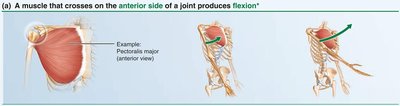
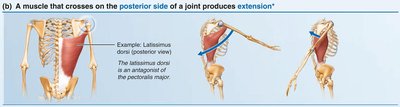
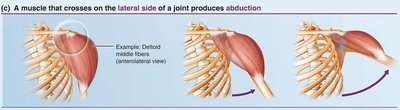
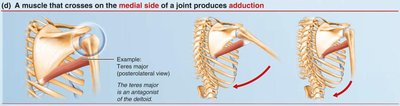
The action of a muscle can often be predicted by its position relative to the joint it crosses.
Anterior side: Produces flexion.
Posterior side: Produces extension.
Lateral side: Produces abduction.
Medial side: Produces adduction.
Naming Skeletal Muscles
Criteria for Naming Muscles
Muscles are named based on several criteria:
Location: Associated bone or region (e.g., temporalis).
Shape: Distinctive shape (e.g., deltoid = triangle).
Size: Maximus (largest), minimus (smallest), longus (long).
Direction of fibers: Rectus (straight), transversus (right angles), oblique (angles).
Number of origins: Biceps (two), triceps (three).
Location of attachments: Origin and insertion (e.g., sternocleidomastoid).
Action: Flexor, extensor, etc.
Combined criteria: Extensor carpi radialis longus.
Fascicle Arrangements in Muscles
Patterns of Fascicle Arrangement
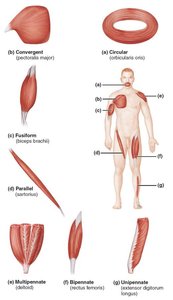
Fascicle arrangement determines muscle shape and function. Common patterns include:
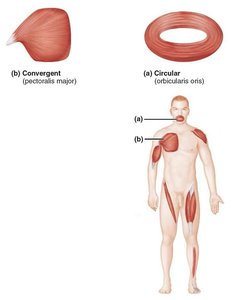
Circular: Fascicles arranged in concentric rings (e.g., orbicularis oris).
Convergent: Broad origin, fascicles converge to a single tendon (e.g., pectoralis major).
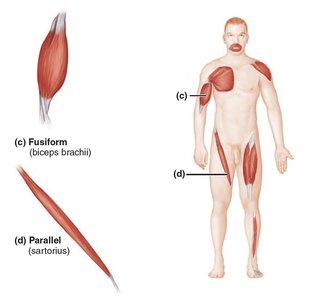
Parallel: Fascicles run parallel to long axis (e.g., sartorius).
Fusiform: Spindle-shaped with parallel fibers (e.g., biceps brachii).
Pennate: Short fascicles attach obliquely to a central tendon.
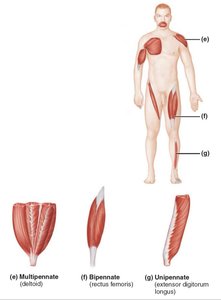
Unipennate: Fascicles attach to one side (e.g., extensor digitorum longus).
Bipennate: Fascicles attach to both sides (e.g., rectus femoris).
Multipennate: Multiple feather-like fascicles (e.g., deltoid).
Functional Implications
Range of motion: Determined by fascicle length and arrangement.
Power: Pennate muscles have more fibers and are more powerful but shorten less.
Lever Systems in the Body
Components of a Lever System
Most skeletal muscles use leverage to move loads.
Lever: Rigid bar (bone).
Fulcrum: Fixed point (joint).
Effort: Force applied by muscle contraction.
Load: Resistance moved by the effort.
Power vs. Speed Levers
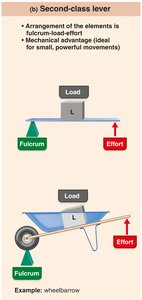
Mechanical advantage (power lever): Load is close to fulcrum, effort is far. Small effort moves large load.
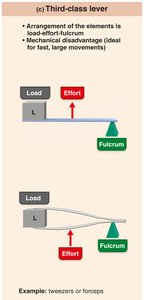
Mechanical disadvantage (speed lever): Load is far from fulcrum, effort is close. Load moves rapidly over large distance.
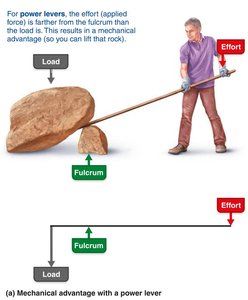
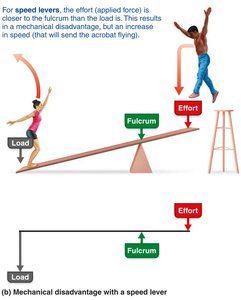
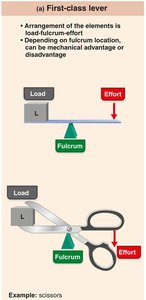
Classes of Levers
First-class lever: Fulcrum between load and effort (e.g., seesaw, scissors, raising head off chest).
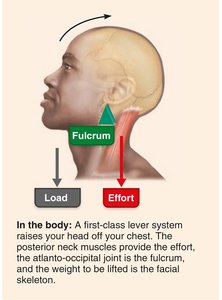
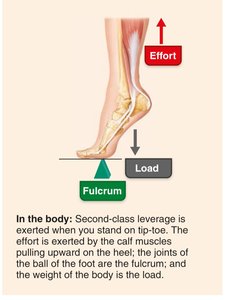
Second-class lever: Load between fulcrum and effort (e.g., wheelbarrow, standing on tiptoe).
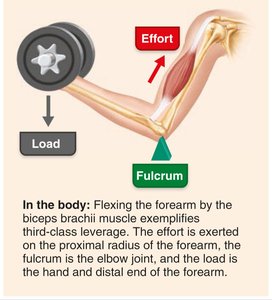
Third-class lever: Effort between fulcrum and load (e.g., tweezers, most skeletal muscles, flexing forearm).
Major Skeletal Muscles of the Body
Muscle Groups and Locations
There are over 600 skeletal muscles, grouped by function and location. Muscle tables typically include:
Description: Location relative to other muscles.
Origin and insertion: Attachment points.
Actions: Movements produced by contraction.
Innervation: Major nerve supplying the muscle.
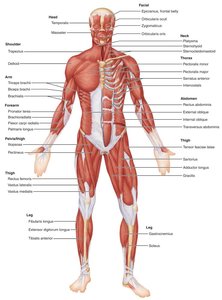
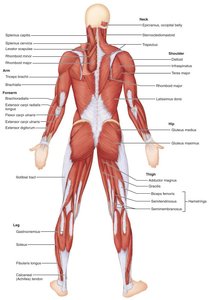
Muscles of the Head: Facial Expression
Overview
Muscles of facial expression are unique because they insert into skin, not bone, and are important for nonverbal communication. All are innervated by cranial nerve VII (facial nerve).
Muscles of the Scalp
Epicranius (occipitofrontalis): Two-part muscle (frontal and occipital bellies) connected by epicranial aponeurosis.
Frontal belly: Raises eyebrows, wrinkles forehead.
Occipital belly: Pulls scalp posteriorly.
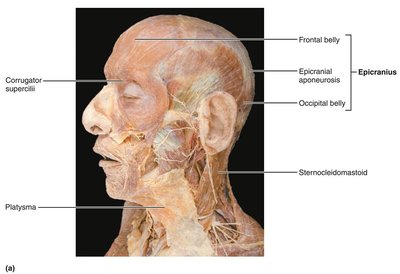
Muscles of the Face
Corrugator supercilii: Pulls eyebrows medially and inferiorly.
Orbicularis oculi: Closes eye, blinking, squinting.
Zygomaticus (major and minor): Raises corners of mouth (smiling).
Risorius: Pulls corner of lip laterally.
Levator labii superioris: Raises upper lip.
Depressor labii inferioris: Pulls lower lip down.
Depressor anguli oris: Pulls corners of mouth down.
Orbicularis oris: Closes lips, purses lips.
Mentalis: Wrinkles chin, protrudes lower lip.
Buccinator: Compresses cheek, holds food between teeth.
Platysma: Tenses skin of neck, depresses mandible.
Summary Table: Fascicle Arrangements
Purpose: Classification of Muscle Shapes
Pattern | Example | Functional Implication |
|---|---|---|
Circular | Orbicularis oris | Closes body openings |
Convergent | Pectoralis major | Versatile movement, strong contraction |
Parallel | Sartorius | Greater range of motion |
Fusiform | Biceps brachii | Combination of strength and range |
Pennate | Deltoid, rectus femoris, extensor digitorum longus | High power, less range |
Summary Table: Lever Classes
Purpose: Comparison of Lever Types
Class | Arrangement | Example | Advantage |
|---|---|---|---|
First-class | Fulcrum between load and effort | Scissors, head raising | Can be mechanical advantage or disadvantage |
Second-class | Load between fulcrum and effort | Wheelbarrow, standing on tiptoe | Mechanical advantage (powerful) |
Third-class | Effort between fulcrum and load | Tweezers, biceps brachii | Mechanical disadvantage (speed, range) |
Key Equations
Lever Mechanics
Law of the lever:
Mechanical Advantage:
Conclusion
Summary
The muscular system is organized by functional groups, fascicle arrangements, and lever mechanics. Understanding these principles is essential for predicting muscle actions, naming muscles, and appreciating their roles in movement and stability.
Example Application
Predicting muscle action based on position relative to joint.
Identifying muscle function from its name and structure.
Applying lever mechanics to understand movement efficiency.
