 Indietro
Study Guide: The Muscular System and Articulations
Guida di studio - Note intelligenti
 Appunti personalizzati basati sui tuoi materiali, ampliati con definizioni chiave, esempi e contesto.
The Muscular System
Muscle Shape
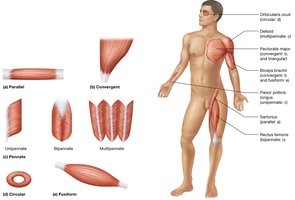
Muscle shape is a key characteristic used to classify and name muscles. The arrangement of muscle fibers determines the muscle's function and efficiency. Common shapes include parallel, convergent, pennate, circular, and fusiform.
Parallel: Fibers run parallel to the long axis; e.g., sartorius.
Convergent: Fibers converge to a single point; e.g., pectoralis major.
Pennate: Fibers attach obliquely to a tendon; e.g., rectus femoris (bipennate).
Circular: Fibers arranged in concentric rings; e.g., orbicularis oris.
Fusiform: Spindle-shaped with a central belly; e.g., biceps brachii.
Functional Groups of Muscles
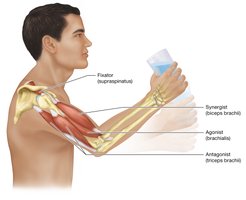
Muscles work in groups to produce coordinated movements. Each muscle in a group has a specific role:
Agonist (Prime Mover): Provides most of the force for a movement.
Antagonist: Opposes the agonist, slowing or stopping movement.
Synergist: Assists the agonist, ensuring smooth and guided movement.
Fixator: Stabilizes the origin of the agonist, increasing efficiency and reducing injury.
Origin and Insertion
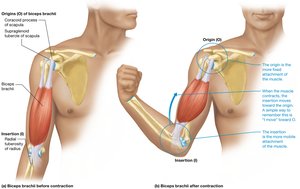
Muscles attach to bones at two points: the origin and the insertion. The origin is the fixed attachment, while the insertion moves during contraction. The roles of origin and insertion can change depending on the movement.
Origin: The stationary attachment point.
Insertion: The movable attachment point.
Example: Biceps brachii origin is on the scapula; insertion is on the radius.
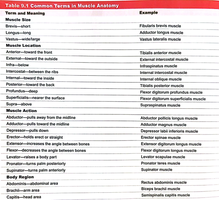
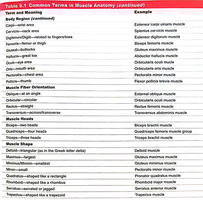
Common Terms in Muscle Anatomy
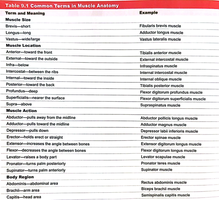
Muscle names often reflect their size, location, action, shape, or number of origins. Understanding these roots aids in identifying and learning muscle anatomy.
Term and Meaning | Example |
|---|---|
Brevis—short | Fibularis brevis muscle |
Longus—long | Adductor longus muscle |
Anterior—toward the front | Tibialis anterior muscle |
Flexor—decreases the angle between bones | Flexor digitorum profundus muscle |
Extensor—increases the angle between bones | Extensor digitorum muscle |
Rectus—straight | Rectus femoris muscle |
Deltoid—shaped like a triangle | Deltoid muscle |
Trapezius—shaped like a trapezoid | Trapezius muscle |
Articulations (Joints)
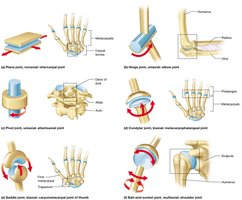
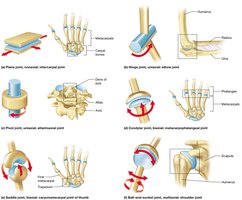
Types of Synovial Joints
Synovial joints are classified by their shapes and the movements they allow. Each type has a distinct structure and function:
Plane Joint: Allows gliding movements; e.g., intercarpal joints.
Hinge Joint: Permits flexion and extension; e.g., elbow joint.
Pivot Joint: Allows rotation; e.g., atlantoaxial joint.
Condyloid Joint: Permits flexion, extension, abduction, adduction; e.g., metacarpophalangeal joints.
Saddle Joint: Allows similar movements to condyloid but with greater freedom; e.g., carpometacarpal joint of thumb.
Ball-and-Socket Joint: Allows movement in all axes; e.g., shoulder and hip joints.
Angular Movements
Angular movements change the angle between bones. Examples include flexion, extension, abduction, adduction, and circumduction.
Circumduction: Movement in a circular pattern, combining flexion, extension, abduction, and adduction.
Example: Moving the arm in a circle at the shoulder joint.
Muscle Attachments
Muscles attach to bones via tendons, which are strong connective tissues. Tendons transmit the force generated by muscle contraction to the bone, resulting in movement.
Tendon: Connects muscle to bone.
Ligament: Connects bone to bone.
Bursa: Fluid-filled sac reducing friction.
Tendon Sheath: Encloses tendons, especially in the hand and foot.
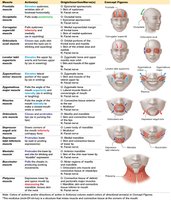
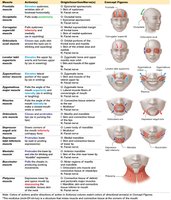
Muscles of Facial Expression
Overview
Muscles of facial expression are responsible for movements such as smiling, frowning, and blinking. They are unique because they insert into the skin rather than bone.
Orbicularis oculi: Closes the eyelids.
Orbicularis oris: Closes and protrudes the lips.
Zygomaticus major: Elevates the corners of the mouth (smiling).
Frontalis: Raises eyebrows and wrinkles forehead.
Summary Table: Muscle Terminology
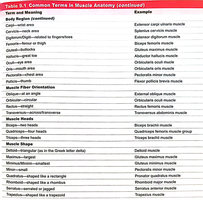
The following table summarizes common terms used in muscle anatomy, including their meanings and examples.
Term | Meaning | Example |
|---|---|---|
Flexor | Decreases angle between bones | Flexor digitorum profundus |
Extensor | Increases angle between bones | Extensor digitorum |
Rectus | Straight | Rectus femoris |
Deltoid | Triangle-shaped | Deltoid |
Trapezius | Trapezoid-shaped | Trapezius |
Review Questions
Angular Movement Example
Which of the following is an example of an angular movement?
Circumduction is an angular movement, involving a circular motion at a joint.
Muscle to Bone Connection
Which of the following connects a muscle to a bone?
Tendon is the connective tissue that attaches muscle to bone.
Class of Synovial Joint
Name the class of synovial joint shown here:
Pivot Joint allows rotational movement, such as the atlantoaxial joint.
Additional info:
Some content was expanded for clarity and completeness, including definitions and examples of muscle shapes, functional groups, and terminology. Tables were recreated and summarized based on the original images and text.
