 Indietro
Study Guide: The Respiratory System (Chapter 22)
Guida di studio - Note intelligenti
 Appunti personalizzati basati sui tuoi materiali, ampliati con definizioni chiave, esempi e contesto.
Respiratory System Overview
Introduction
The respiratory system is essential for gas exchange, providing oxygen to living cells and removing carbon dioxide. It involves coordinated activities across multiple organs and tissues to sustain cellular respiration and overall homeostasis.
Definition and Core Function
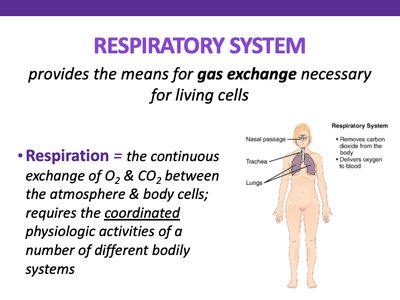
Respiration: The continuous exchange of O2 and CO2 between the atmosphere and body cells. This process requires the coordinated physiologic activities of several bodily systems.
Gas Exchange: The transfer of oxygen into the blood and carbon dioxide out of the blood, primarily occurring in the lungs.
Functions of the Respiratory System
Main Functions
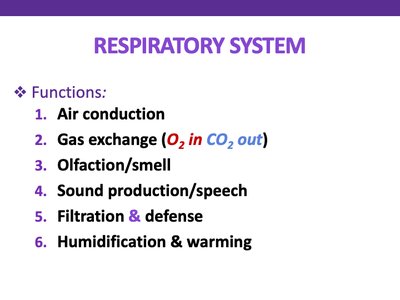
Air conduction: Pathway for inhaled air to reach the lungs.
Gas exchange: Oxygen enters, carbon dioxide exits (O2 in, CO2 out).
Olfaction: Sense of smell, facilitated by specialized receptors in the nasal cavity.
Sound production: Vocal folds in the larynx produce sound, resonated in upper respiratory structures.
Filtration and defense: Mucus and cilia trap and remove foreign particles (dust, smoke, pathogens).
Humidification and warming: Air is conditioned to body temperature and moisture levels before reaching the lungs.
Structural Organization of the Respiratory System
Regions
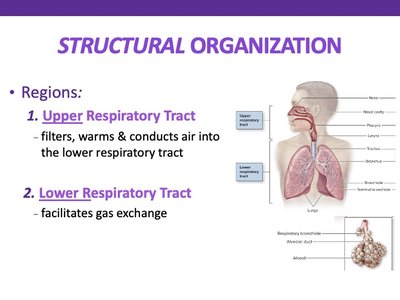
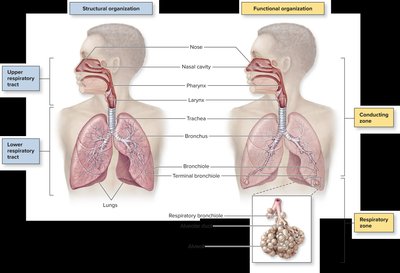
Upper Respiratory Tract: Filters, warms, and conducts air into the lower respiratory tract.
Lower Respiratory Tract: Facilitates gas exchange.
Detailed Structural and Functional Organization
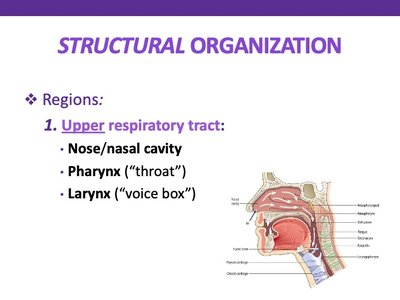
Upper Respiratory Tract: Includes the nose, nasal cavity, pharynx, and larynx.
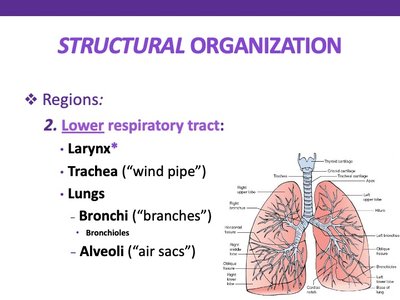
Lower Respiratory Tract: Includes the larynx, trachea, bronchi, bronchioles, and alveoli.
Upper Respiratory Tract
Components
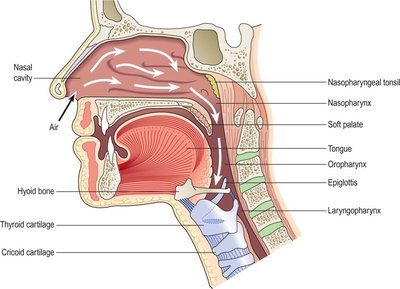
Nose/Nasal cavity: Warms, cleans, and humidifies incoming air; creates turbulence to increase contact between air and mucosa.
Pharynx ("throat"): Conducts both food and air; splits into the esophagus and larynx.
Larynx ("voice box"): Conducts air only, blocks food, produces speech.
Lower Respiratory Tract
Components
Larynx: Continues from the upper tract.
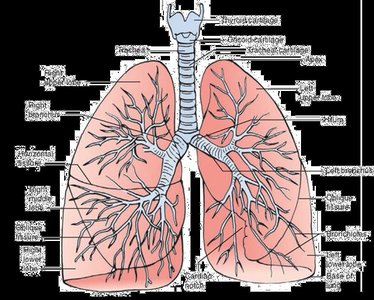
Trachea ("wind pipe"): Conducts air to the lungs; supported by cartilage rings.
Lungs: Contain the bronchial tree and alveoli.
Bronchi: Branches that get smaller until they reach the alveoli.
Bronchioles: Smaller airways leading to alveoli.
Alveoli: Site of gas exchange.
Functional Organization of the Respiratory System
Zones
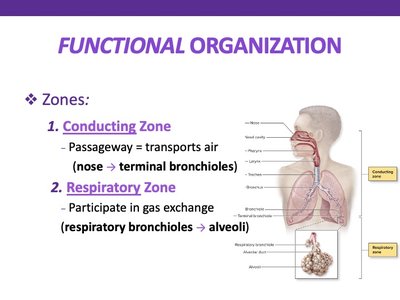
Conducting Zone: Passageway that transports air from the nose to terminal bronchioles. This zone does not participate in gas exchange.
Respiratory Zone: Participates in gas exchange, including respiratory bronchioles and alveoli.
Structure vs Function
Comparison of Structural and Functional Organization
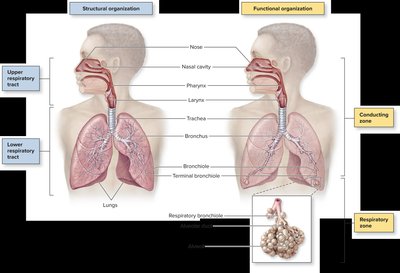
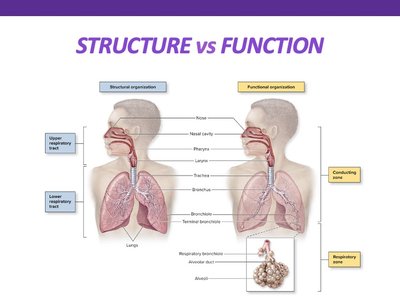
The structural organization divides the respiratory system into upper and lower tracts, while the functional organization divides it into conducting and respiratory zones.
Conducting zone includes all structures that transport air; respiratory zone includes structures where gas exchange occurs.
Summary Table: Structural vs Functional Organization
Structural Organization | Functional Organization |
|---|---|
Upper Respiratory Tract: Nose, Nasal Cavity, Pharynx, Larynx | Conducting Zone: Nose → Terminal Bronchioles |
Lower Respiratory Tract: Larynx, Trachea, Bronchi, Bronchioles, Alveoli | Respiratory Zone: Respiratory Bronchioles → Alveoli |
Example: The trachea is part of both the lower respiratory tract (structural) and the conducting zone (functional).
