 Indietro
Study Guide: The Respiratory System – Lung Physiology, Ventilation, and Gas Exchange
Guida di studio - Note intelligenti
 Appunti personalizzati basati sui tuoi materiali, ampliati con definizioni chiave, esempi e contesto.
Topic: Introduction to Lung Physiology
Ventilation and Respiration
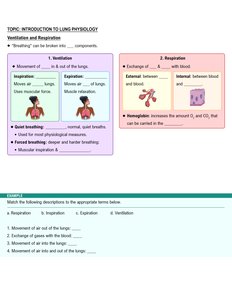
The process of breathing can be divided into two main components: ventilation and respiration. Ventilation refers to the movement of air into and out of the lungs, while respiration involves the exchange of gases between the lungs and blood.
Ventilation:
Inspiration: Air moves into the lungs via muscular contraction.
Expiration: Air moves out of the lungs, often passively or via muscle relaxation.
Quiet breathing is mostly passive, while forced breathing uses additional muscles.
Respiration:
External Respiration: Exchange of O2 and CO2 between alveoli and blood.
Internal Respiration: Exchange of gases between blood and tissues.
Hemoglobin: Increases the amount of O2 and CO2 that can be carried in the blood.
Topic: Ventilation
Mechanics of Ventilation
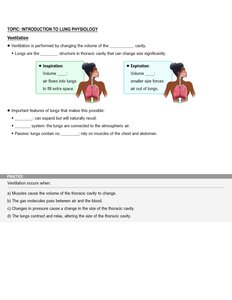
Ventilation is performed by changing the volume of the thoracic cavity, which alters the pressure inside the lungs. The lungs are the only structure in the thoracic cavity that can change size significantly.
Inspiration: Volume increases, air flows into lungs.
Expiration: Volume decreases, air flows out of lungs.
Lungs expand naturally due to their elasticity.
Passive lung inflation occurs when muscles of the chest and abdomen relax.
Topic: Pressure in the Lungs & Pleural Cavities
Forces That Shape the Lungs
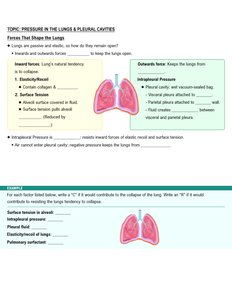
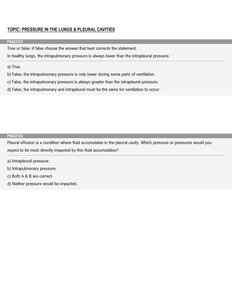
Lungs are passive and elastic, but remain open due to outward forces. Inward forces include elasticity and surface tension, while outward forces are maintained by intrapleural pressure.
Inward Forces:
Elasticity/Recoil
Surface Tension
Outward Forces:
Intrapleural Pressure (negative pressure in pleural cavity)
Transpulmonary Pressure (difference between intrapulmonary and intrapleural pressure)
Pressure Relationships in the Lungs
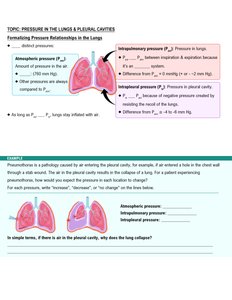
Pressure gradients drive ventilation. Atmospheric pressure, intrapulmonary pressure, and intrapleural pressure interact to keep the lungs inflated and allow air movement.
Atmospheric Pressure (Patm): Pressure of air outside the body (typically 760 mm Hg).
Intrapulmonary Pressure (Ppul): Pressure within the lungs; fluctuates during inspiration and expiration.
Intrapleural Pressure (Pip): Pressure within the pleural cavity; always negative relative to Ppul.
Transpulmonary Pressure:
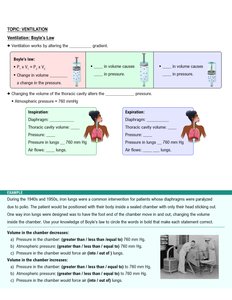
Topic: Ventilation – Boyle’s Law
Boyle’s Law and Air Movement
Ventilation works by altering the pressure gradient. Boyle’s Law states that pressure and volume are inversely related: as volume increases, pressure decreases, and vice versa.
Boyle’s Law:
Changing the volume of the thoracic cavity alters the pressure inside the lungs.
During inspiration, thoracic cavity expands, pressure drops, air flows in.
During expiration, thoracic cavity contracts, pressure rises, air flows out.
Topic: Muscles of Ventilation
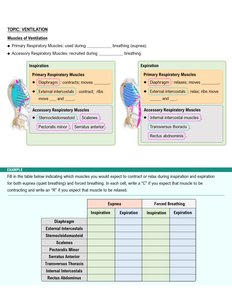
Primary and Accessory Respiratory Muscles
Ventilation involves both primary and accessory muscles. Primary muscles are used during quiet breathing, while accessory muscles are recruited during forced breathing.
Primary Respiratory Muscles:
Diaphragm (contracts during inspiration, relaxes during expiration)
External intercostals (elevate ribs during inspiration)
Accessory Respiratory Muscles:
Used during forced breathing (e.g., sternocleidomastoid, scalenes, abdominal muscles)
Topic: Lung Volumes & Capacities
Measures of Lung Function
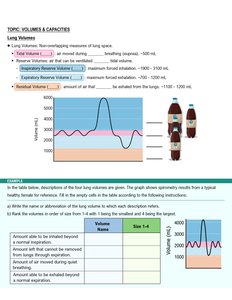
Lung volumes and capacities are important measures of respiratory health. They are determined by spirometry and include tidal volume, inspiratory reserve volume, expiratory reserve volume, and residual volume.
Tidal Volume (TV): Amount of air moved during normal breathing (~500 mL).
Inspiratory Reserve Volume (IRV): Maximum volume inhaled beyond TV (~3100 mL).
Expiratory Reserve Volume (ERV): Maximum volume exhaled beyond TV (~1200 mL).
Residual Volume (RV): Air remaining in lungs after maximal exhalation (~1200 mL).
Lung Capacities
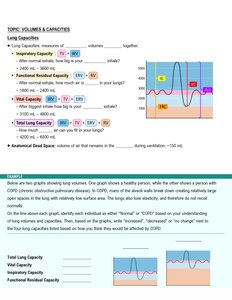
Lung capacities are combinations of lung volumes. Examples include inspiratory capacity, vital capacity, and total lung capacity.
Inspiratory Capacity (IC):
Vital Capacity (VC):
Total Lung Capacity (TLC):
Functional Residual Capacity (FRC):
Topic: Law of Partial Pressure
Partial Pressure and Gas Exchange
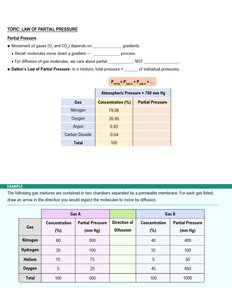
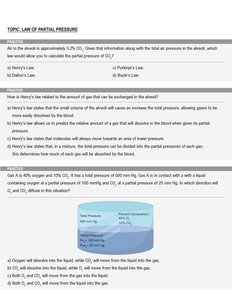
The movement of gases (O2 and CO2) depends on partial pressure gradients. Dalton’s Law states that the total pressure of a gas mixture is the sum of the partial pressures of individual gases.
Dalton’s Law:
Each gas diffuses independently according to its partial pressure.
Partial pressure gradients drive diffusion across membranes.
Henry’s Law
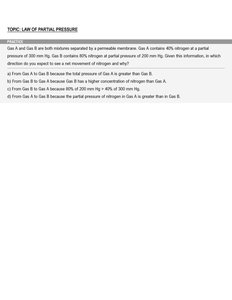
Henry’s Law describes how the amount of gas that dissolves in a liquid is proportional to its partial pressure and solubility.
Henry’s Law: (where C is concentration, k is solubility constant, P is partial pressure)
Higher partial pressure and solubility increase the amount of gas dissolved in blood.
Topic: Respiration
External and Internal Respiration
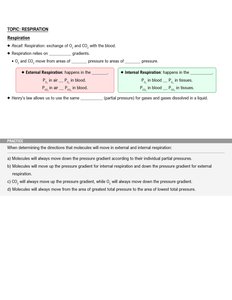
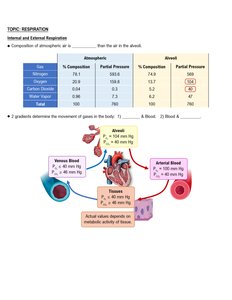
Respiration involves the exchange of O2 and CO2 between the alveoli and blood (external respiration), and between blood and tissues (internal respiration).
External Respiration: O2 moves from alveoli to blood; CO2 moves from blood to alveoli.
Internal Respiration: O2 moves from blood to tissues; CO2 moves from tissues to blood.
Partial pressure gradients drive these exchanges.
Gas Exchange and Hemoglobin
Hemoglobin in red blood cells increases the capacity of blood to carry O2 and CO2. The direction and rate of gas exchange depend on partial pressure gradients and hemoglobin saturation.
O2 binds to hemoglobin in areas of high partial pressure (lungs).
CO2 is carried in blood as dissolved gas, bicarbonate, or bound to hemoglobin.
Topic: Clinical Applications
Pneumothorax and Pleural Effusion
Pneumothorax occurs when air enters the pleural cavity, causing lung collapse. Pleural effusion is the accumulation of fluid in the pleural cavity, which affects pressure relationships and lung function.
Pneumothorax disrupts negative intrapleural pressure, leading to lung collapse.
Pleural effusion increases pressure in the pleural cavity, reducing lung expansion.
Topic: Summary Table – Lung Volumes and Capacities
Volume/Capacity | Definition | Typical Value (mL) |
|---|---|---|
Tidal Volume (TV) | Air moved in/out during normal breathing | ~500 |
Inspiratory Reserve Volume (IRV) | Max air inhaled beyond TV | ~3100 |
Expiratory Reserve Volume (ERV) | Max air exhaled beyond TV | ~1200 |
Residual Volume (RV) | Air remaining after maximal exhalation | ~1200 |
Vital Capacity (VC) | TV + IRV + ERV | ~4800 |
Total Lung Capacity (TLC) | TV + IRV + ERV + RV | ~6000 |
Topic: Summary Table – Partial Pressures of Atmospheric and Alveolar Gases
Gas | Atmospheric % | Atmospheric Partial Pressure (mm Hg) | Alveolar % | Alveolar Partial Pressure (mm Hg) |
|---|---|---|---|---|
Nitrogen | 78.6 | 593.8 | 74.8 | 569 |
Oxygen | 20.9 | 159 | 13.7 | 104 |
Carbon Dioxide | 0.04 | 0.3 | 5.2 | 40 |
Water Vapor | 0.5 | 3.7 | 6.2 | 47 |
Topic: Key Equations
Boyle’s Law:
Transpulmonary Pressure:
Dalton’s Law:
Henry’s Law:
Topic: Additional Info
Elastic recoil and surface tension are major inward forces that tend to collapse the lungs.
Negative intrapleural pressure is essential for keeping the lungs inflated.
Clinical conditions such as COPD, pneumothorax, and pleural effusion alter normal pressure relationships and lung volumes.
